

roles in controlling the assembly structures [33–36]. In 2005 they performed a
reaction of first-row transition metal ions with bis-bipyridine ligand (bptz) in the
presence of specific anions [33]. Cyclic structures were obtained with Ni(II), Zn(II),
and Fe (II) as revealed by X-ray crystallography. The decisive roles of anions in the
formation of a particular cyclic structure were carefully discussed. Interestingly,
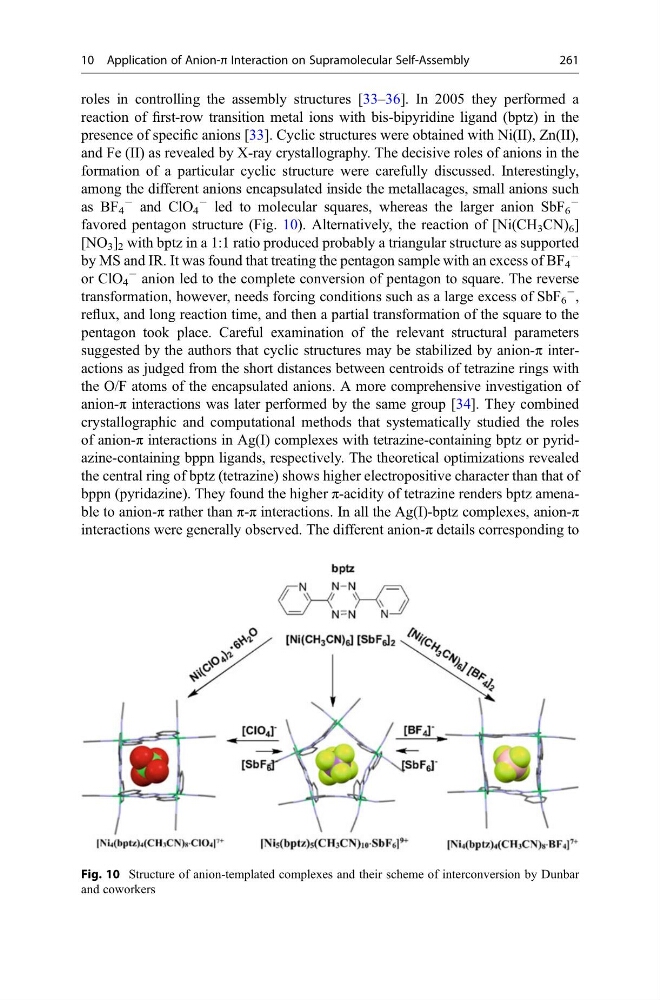
among the different anions encapsulated inside the metallacages, small anions such
as BF 4
À and ClO 4
À led to molecular squares, whereas the larger anion SbF 6
À
favored pentagon structure (Fig. 10). Alternatively, the reaction of [Ni(CH 3 CN) 6 ]
[NO 3 ] 2 with bptz in a 1:1 ratio produced probably a triangular structure as supported
by MS and IR. It was found that treating the pentagon sample with an excess of BF 4
À
or ClO 4
À anion led to the complete conversion of pentagon to square. The reverse
transformation, however, needs forcing conditions such as a large excess of SbF 6
À ,
reflux, and long reaction time, and then a partial transformation of the square to the
pentagon took place. Careful examination of the relevant structural parameters
suggested by the authors that cyclic structures may be stabilized by anion-π interactions as judged from the short distances between centroids of tetrazine rings with
the O/F atoms of the encapsulated anions. A more comprehensive investigation of
anion-π interactions was later performed by the same group [34]. They combined
crystallographic and computational methods that systematically studied the roles
of anion-π interactions in Ag(I) complexes with tetrazine-containing bptz or pyridazine-containing bppn ligands, respectively. The theoretical optimizations revealed
the central ring of bptz (tetrazine) shows higher electropositive character than that of
bppn (pyridazine). They found the higher π-acidity of tetrazine renders bptz amenable to anion-π rather than π-π interactions. In all the Ag(I)-bptz complexes, anion-π
interactions were generally observed. The different anion-π details corresponding to
Fig. 10 Structure of anion-templated complexes and their scheme of interconversion by Dunbar
and coworkers
10 Application of Anion-π Interaction on Supramolecular Self-Assembly
261
reaction of first-row transition metal ions with bis-bipyridine ligand (bptz) in the
presence of specific anions [33]. Cyclic structures were obtained with Ni(II), Zn(II),
and Fe (II) as revealed by X-ray crystallography. The decisive roles of anions in the
formation of a particular cyclic structure were carefully discussed. Interestingly,
among the different anions encapsulated inside the metallacages, small anions such
as BF 4
À and ClO 4
À led to molecular squares, whereas the larger anion SbF 6
À
favored pentagon structure (Fig. 10). Alternatively, the reaction of [Ni(CH 3 CN) 6 ]
[NO 3 ] 2 with bptz in a 1:1 ratio produced probably a triangular structure as supported
by MS and IR. It was found that treating the pentagon sample with an excess of BF 4
À
or ClO 4
À anion led to the complete conversion of pentagon to square. The reverse
transformation, however, needs forcing conditions such as a large excess of SbF 6
À ,
reflux, and long reaction time, and then a partial transformation of the square to the
pentagon took place. Careful examination of the relevant structural parameters
suggested by the authors that cyclic structures may be stabilized by anion-π interactions as judged from the short distances between centroids of tetrazine rings with
the O/F atoms of the encapsulated anions. A more comprehensive investigation of
anion-π interactions was later performed by the same group [34]. They combined
crystallographic and computational methods that systematically studied the roles
of anion-π interactions in Ag(I) complexes with tetrazine-containing bptz or pyridazine-containing bppn ligands, respectively. The theoretical optimizations revealed
the central ring of bptz (tetrazine) shows higher electropositive character than that of
bppn (pyridazine). They found the higher π-acidity of tetrazine renders bptz amenable to anion-π rather than π-π interactions. In all the Ag(I)-bptz complexes, anion-π
interactions were generally observed. The different anion-π details corresponding to
Fig. 10 Structure of anion-templated complexes and their scheme of interconversion by Dunbar
and coworkers
10 Application of Anion-π Interaction on Supramolecular Self-Assembly
261