

with amide. On the other hand, Ballester and coworkers [30] used “two-wall”
aryl-extended calix[4]pyrrole as model system and studied the thermodynamic
characterization of halide-π interaction in solution. The solid-state structures of the
inclusion complexes revealed that chloride was not located directly perpendicular to
the centroid of the phenyl rings but somewhat offset.
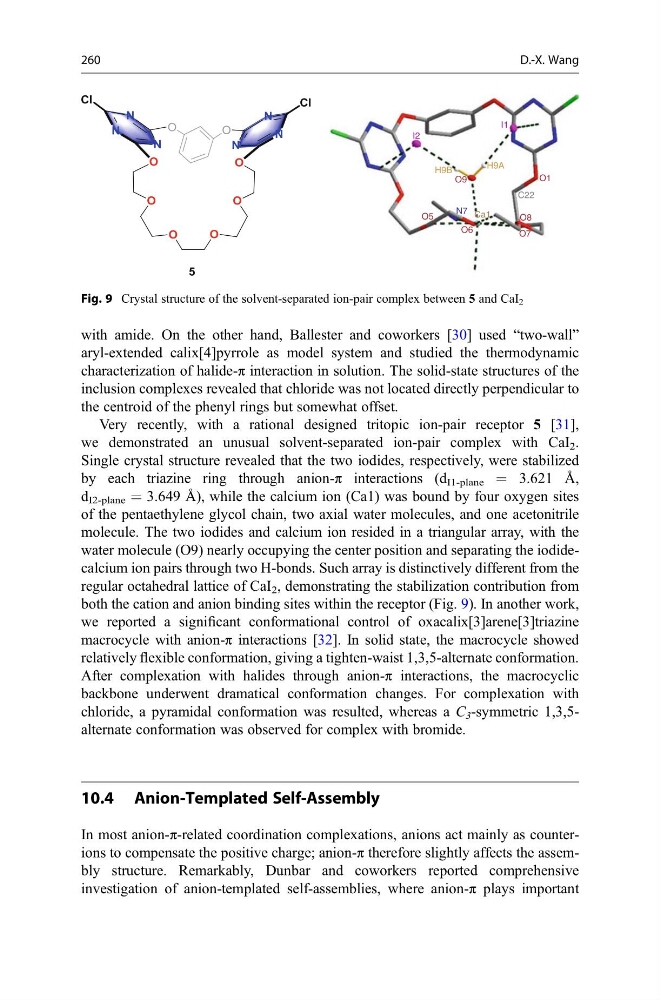
Very recently, with a rational designed tritopic ion-pair receptor 5 [31],
we demonstrated an unusual solvent-separated ion-pair complex with CaI 2 .
Single crystal structure revealed that the two iodides, respectively, were stabilized
by each triazine ring through anion-π interactions (d I1-plane = 3.621 Å,
d I2-plane = 3.649 Å), while the calcium ion (Ca1) was bound by four oxygen sites
of the pentaethylene glycol chain, two axial water molecules, and one acetonitrile
molecule. The two iodides and calcium ion resided in a triangular array, with the
water molecule (O9) nearly occupying the center position and separating the iodidecalcium ion pairs through two H-bonds. Such array is distinctively different from the
regular octahedral lattice of CaI 2 , demonstrating the stabilization contribution from
both the cation and anion binding sites within the receptor (Fig. 9). In another work,
we reported a significant conformational control of oxacalix[3]arene[3]triazine
macrocycle with anion-π interactions [32]. In solid state, the macrocycle showed
relatively flexible conformation, giving a tighten-waist 1,3,5-alternate conformation.
After complexation with halides through anion-π interactions, the macrocyclic
backbone underwent dramatical conformation changes. For complexation with
chloride, a pyramidal conformation was resulted, whereas a C 3 -symmetric 1,3,5alternate conformation was observed for complex with bromide.
10.4 Anion-Templated Self-Assembly
In most anion-π-related coordination complexations, anions act mainly as counterions to compensate the positive charge; anion-π therefore slightly affects the assembly structure. Remarkably, Dunbar and coworkers reported comprehensive
investigation of anion-templated self-assemblies, where anion-π plays important
I2
H9B
H9A
Ca1
O9
O5
O6
O7
O8
O1
C22
N7
I1
Fig. 9 Crystal structure of the solvent-separated ion-pair complex between 5 and CaI 2
260
D.-X. Wang
aryl-extended calix[4]pyrrole as model system and studied the thermodynamic
characterization of halide-π interaction in solution. The solid-state structures of the
inclusion complexes revealed that chloride was not located directly perpendicular to
the centroid of the phenyl rings but somewhat offset.
Very recently, with a rational designed tritopic ion-pair receptor 5 [31],
we demonstrated an unusual solvent-separated ion-pair complex with CaI 2 .
Single crystal structure revealed that the two iodides, respectively, were stabilized
by each triazine ring through anion-π interactions (d I1-plane = 3.621 Å,
d I2-plane = 3.649 Å), while the calcium ion (Ca1) was bound by four oxygen sites
of the pentaethylene glycol chain, two axial water molecules, and one acetonitrile
molecule. The two iodides and calcium ion resided in a triangular array, with the
water molecule (O9) nearly occupying the center position and separating the iodidecalcium ion pairs through two H-bonds. Such array is distinctively different from the
regular octahedral lattice of CaI 2 , demonstrating the stabilization contribution from
both the cation and anion binding sites within the receptor (Fig. 9). In another work,
we reported a significant conformational control of oxacalix[3]arene[3]triazine
macrocycle with anion-π interactions [32]. In solid state, the macrocycle showed
relatively flexible conformation, giving a tighten-waist 1,3,5-alternate conformation.
After complexation with halides through anion-π interactions, the macrocyclic
backbone underwent dramatical conformation changes. For complexation with
chloride, a pyramidal conformation was resulted, whereas a C 3 -symmetric 1,3,5alternate conformation was observed for complex with bromide.
10.4 Anion-Templated Self-Assembly
In most anion-π-related coordination complexations, anions act mainly as counterions to compensate the positive charge; anion-π therefore slightly affects the assembly structure. Remarkably, Dunbar and coworkers reported comprehensive
investigation of anion-templated self-assemblies, where anion-π plays important
I2
H9B
H9A
Ca1
O9
O5
O6
O7
O8
O1
C22
N7
I1
Fig. 9 Crystal structure of the solvent-separated ion-pair complex between 5 and CaI 2
260
D.-X. Wang