

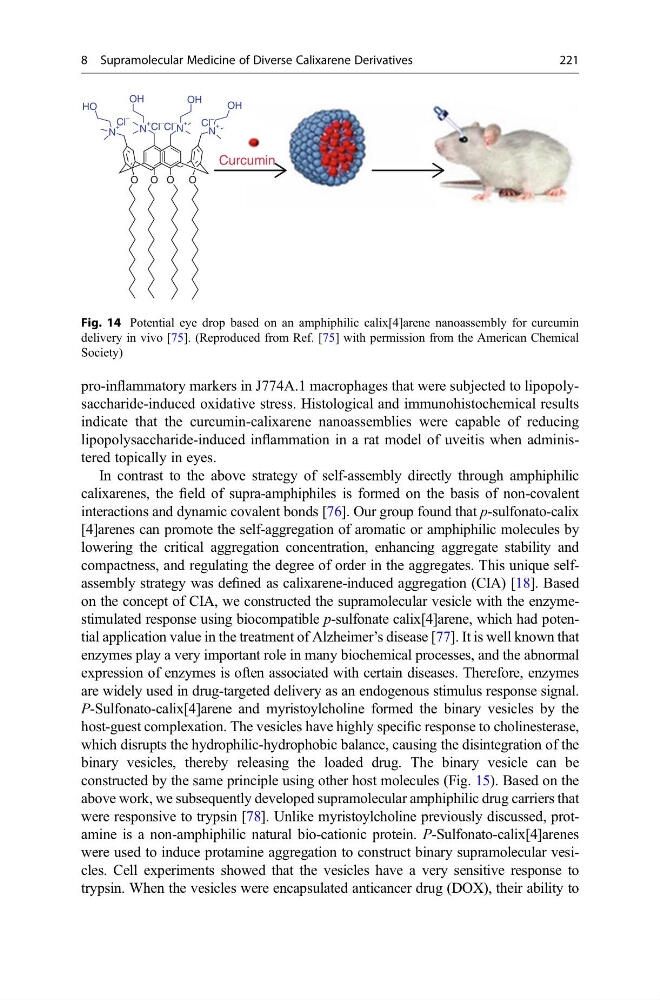
pro-inflammatory markers in J774A.1 macrophages that were subjected to lipopolysaccharide-induced oxidative stress. Histological and immunohistochemical results
indicate that the curcumin-calixarene nanoassemblies were capable of reducing
lipopolysaccharide-induced inflammation in a rat model of uveitis when administered topically in eyes.
In contrast to the above strategy of self-assembly directly through amphiphilic
calixarenes, the field of supra-amphiphiles is formed on the basis of non-covalent
interactions and dynamic covalent bonds [76]. Our group found that p-sulfonato-calix
[4]arenes can promote the self-aggregation of aromatic or amphiphilic molecules by
lowering the critical aggregation concentration, enhancing aggregate stability and
compactness, and regulating the degree of order in the aggregates. This unique selfassembly strategy was defined as calixarene-induced aggregation (CIA) [18]. Based
on the concept of CIA, we constructed the supramolecular vesicle with the enzymestimulated response using biocompatible p-sulfonate calix[4]arene, which had potential application value in the treatment of Alzheimer’s disease [77]. It is well known that
enzymes play a very important role in many biochemical processes, and the abnormal
expression of enzymes is often associated with certain diseases. Therefore, enzymes
are widely used in drug-targeted delivery as an endogenous stimulus response signal.
P-Sulfonato-calix[4]arene and myristoylcholine formed the binary vesicles by the
host-guest complexation. The vesicles have highly specific response to cholinesterase,
which disrupts the hydrophilic-hydrophobic balance, causing the disintegration of the
binary vesicles, thereby releasing the loaded drug. The binary vesicle can be
constructed by the same principle using other host molecules (Fig. 15). Based on the
above work, we subsequently developed supramolecular amphiphilic drug carriers that
were responsive to trypsin [78]. Unlike myristoylcholine previously discussed, protamine is a non-amphiphilic natural bio-cationic protein. P-Sulfonato-calix[4]arenes
were used to induce protamine aggregation to construct binary supramolecular vesicles. Cell experiments showed that the vesicles have a very sensitive response to
trypsin. When the vesicles were encapsulated anticancer drug (DOX), their ability to
HO
OH
Cl
–
Cl
–
Cl
–
Cl
–
OH
OH
Curcumin
O
O
O
O
N
+
N
+
N
+
N
+
Fig. 14 Potential eye drop based on an amphiphilic calix[4]arene nanoassembly for curcumin
delivery in vivo [75]. (Reproduced from Ref. [75] with permission from the American Chemical
Society)
8 Supramolecular Medicine of Diverse Calixarene Derivatives
221
indicate that the curcumin-calixarene nanoassemblies were capable of reducing
lipopolysaccharide-induced inflammation in a rat model of uveitis when administered topically in eyes.
In contrast to the above strategy of self-assembly directly through amphiphilic
calixarenes, the field of supra-amphiphiles is formed on the basis of non-covalent
interactions and dynamic covalent bonds [76]. Our group found that p-sulfonato-calix
[4]arenes can promote the self-aggregation of aromatic or amphiphilic molecules by
lowering the critical aggregation concentration, enhancing aggregate stability and
compactness, and regulating the degree of order in the aggregates. This unique selfassembly strategy was defined as calixarene-induced aggregation (CIA) [18]. Based
on the concept of CIA, we constructed the supramolecular vesicle with the enzymestimulated response using biocompatible p-sulfonate calix[4]arene, which had potential application value in the treatment of Alzheimer’s disease [77]. It is well known that
enzymes play a very important role in many biochemical processes, and the abnormal
expression of enzymes is often associated with certain diseases. Therefore, enzymes
are widely used in drug-targeted delivery as an endogenous stimulus response signal.
P-Sulfonato-calix[4]arene and myristoylcholine formed the binary vesicles by the
host-guest complexation. The vesicles have highly specific response to cholinesterase,
which disrupts the hydrophilic-hydrophobic balance, causing the disintegration of the
binary vesicles, thereby releasing the loaded drug. The binary vesicle can be
constructed by the same principle using other host molecules (Fig. 15). Based on the
above work, we subsequently developed supramolecular amphiphilic drug carriers that
were responsive to trypsin [78]. Unlike myristoylcholine previously discussed, protamine is a non-amphiphilic natural bio-cationic protein. P-Sulfonato-calix[4]arenes
were used to induce protamine aggregation to construct binary supramolecular vesicles. Cell experiments showed that the vesicles have a very sensitive response to
trypsin. When the vesicles were encapsulated anticancer drug (DOX), their ability to
HO
OH
Cl
–
Cl
–
Cl
–
Cl
–
OH
OH
Curcumin
O
O
O
O
N
+
N
+
N
+
N
+
Fig. 14 Potential eye drop based on an amphiphilic calix[4]arene nanoassembly for curcumin
delivery in vivo [75]. (Reproduced from Ref. [75] with permission from the American Chemical
Society)
8 Supramolecular Medicine of Diverse Calixarene Derivatives
221