

Monitoring enzymatic activity is of the utmost importance for academic and
industrial research. Nau’s group first proposed a supramolecular tandem assay strategy
based on IDA applied for the determination of enzyme kinetics. Nau and our groups
have reported some efforts toward clarifying the working mechanism of enzymes,
their inhibitors, and activators [23, 24, 31]. P-Sulfonato-calix[4]arenes have good
affinity with acetylcholine (ACh) and choline (Ch), but are not selective. In order to
solve the above problems, we cooperated with the Nau group to detect and quantify
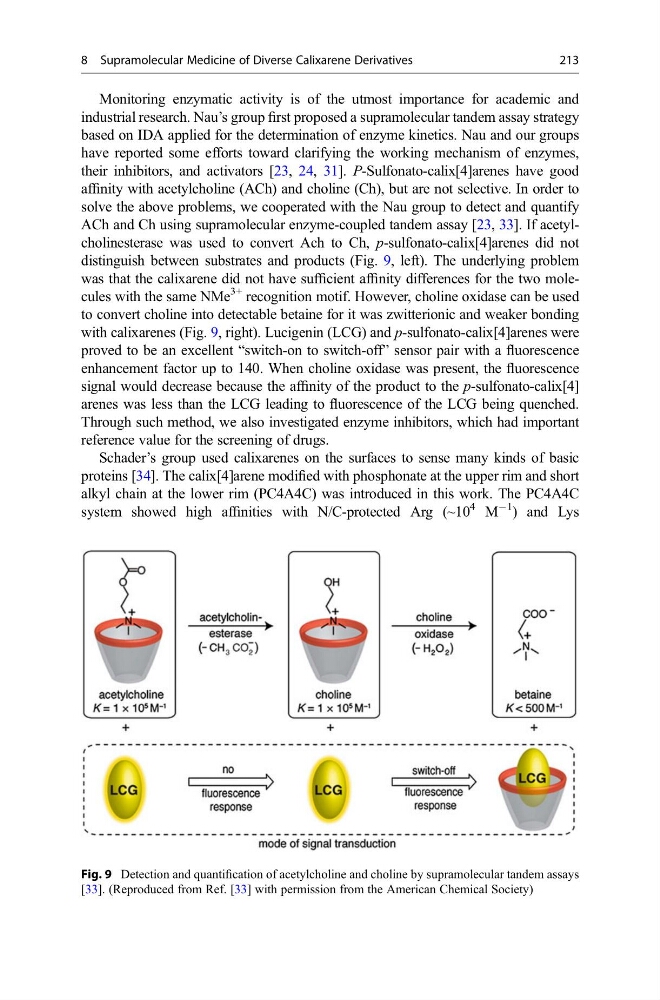
ACh and Ch using supramolecular enzyme-coupled tandem assay [23, 33]. If acetylcholinesterase was used to convert Ach to Ch, p-sulfonato-calix[4]arenes did not
distinguish between substrates and products (Fig. 9, left). The underlying problem
was that the calixarene did not have sufficient affinity differences for the two molecules with the same NMe
3+ recognition motif. However, choline oxidase can be used
to convert choline into detectable betaine for it was zwitterionic and weaker bonding
with calixarenes (Fig. 9, right). Lucigenin (LCG) and p-sulfonato-calix[4]arenes were
proved to be an excellent “switch-on to switch-off” sensor pair with a fluorescence
enhancement factor up to 140. When choline oxidase was present, the fluorescence
signal would decrease because the affinity of the product to the p-sulfonato-calix[4]
arenes was less than the LCG leading to fluorescence of the LCG being quenched.
Through such method, we also investigated enzyme inhibitors, which had important
reference value for the screening of drugs.
Schader’s group used calixarenes on the surfaces to sense many kinds of basic
proteins [34]. The calix[4]arene modified with phosphonate at the upper rim and short
alkyl chain at the lower rim (PC4A4C) was introduced in this work. The PC4A4C
system showed high affinities with N/C-protected Arg (~10
4 M
À1
) and Lys
Fig. 9 Detection and quantification of acetylcholine and choline by supramolecular tandem assays
[33]. (Reproduced from Ref. [33] with permission from the American Chemical Society)
8 Supramolecular Medicine of Diverse Calixarene Derivatives
213
industrial research. Nau’s group first proposed a supramolecular tandem assay strategy
based on IDA applied for the determination of enzyme kinetics. Nau and our groups
have reported some efforts toward clarifying the working mechanism of enzymes,
their inhibitors, and activators [23, 24, 31]. P-Sulfonato-calix[4]arenes have good
affinity with acetylcholine (ACh) and choline (Ch), but are not selective. In order to
solve the above problems, we cooperated with the Nau group to detect and quantify
ACh and Ch using supramolecular enzyme-coupled tandem assay [23, 33]. If acetylcholinesterase was used to convert Ach to Ch, p-sulfonato-calix[4]arenes did not
distinguish between substrates and products (Fig. 9, left). The underlying problem
was that the calixarene did not have sufficient affinity differences for the two molecules with the same NMe
3+ recognition motif. However, choline oxidase can be used
to convert choline into detectable betaine for it was zwitterionic and weaker bonding
with calixarenes (Fig. 9, right). Lucigenin (LCG) and p-sulfonato-calix[4]arenes were
proved to be an excellent “switch-on to switch-off” sensor pair with a fluorescence
enhancement factor up to 140. When choline oxidase was present, the fluorescence
signal would decrease because the affinity of the product to the p-sulfonato-calix[4]
arenes was less than the LCG leading to fluorescence of the LCG being quenched.
Through such method, we also investigated enzyme inhibitors, which had important
reference value for the screening of drugs.
Schader’s group used calixarenes on the surfaces to sense many kinds of basic
proteins [34]. The calix[4]arene modified with phosphonate at the upper rim and short
alkyl chain at the lower rim (PC4A4C) was introduced in this work. The PC4A4C
system showed high affinities with N/C-protected Arg (~10
4 M
À1
) and Lys
Fig. 9 Detection and quantification of acetylcholine and choline by supramolecular tandem assays
[33]. (Reproduced from Ref. [33] with permission from the American Chemical Society)
8 Supramolecular Medicine of Diverse Calixarene Derivatives
213