

8.4
Calixarene Biocompatibility
For the clinical application of calixarenes in medicine, they must have excellent
properties and application prospects. They are not only able to provide chemical/
physical benefits but must also have toxicological or biosafety. If calixarenes are
used as carriers, it is desirable that calixarenes not only reduce the toxicity and side
effects of the drugs but also allow the drug to have a targeted and stimulating
response. Therefore, the biological application of calixarene should be evaluated
for the inherent toxicity of calixarenes themselves, including cytotoxicity (the ability
to inhibit or kill cells) and in vivo toxicity (short-term toxicity, long-term toxicity,
side effects).
Biological studies investigating the toxicity of calixarene for clinical use
have been reported [8, 9]. Various studies have shown that calixarene, especially
water-soluble derivatives, has good compatibility and low cytotoxicity, which
are important prerequisites for the applications of calixarenes in supramolecular
medicine. Taking sulfonated calixarenes as an example, it was found that parasulfonato-calix[4]arene exhibited extremely low toxicity to mice at doses up to
100 mg/kg [10]. Such property clearly ensures the safety of calixarenes in the clinic
to enhance drug dissolution and facilitate delivery. Amino-calix[4]arene-based
fluorescent probes were found in cytotoxicity evaluation to be similar in toxicity
to phosphate-buffered saline in Chinese hamster ovary cells (CHO) and human
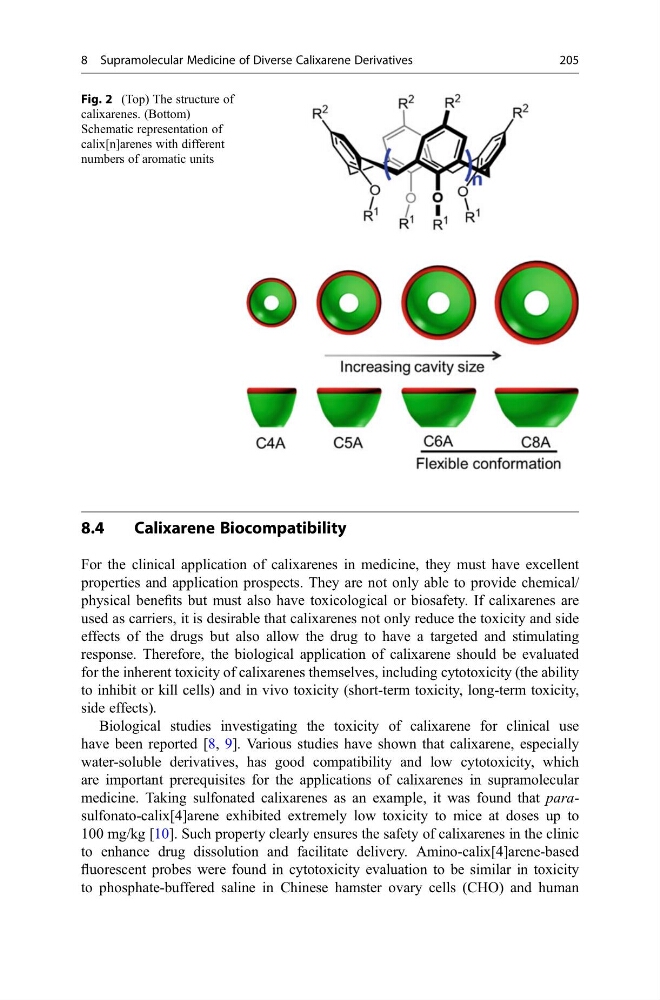
Fig. 2 (Top) The structure of
calixarenes. (Bottom)
Schematic representation of
calix[n]arenes with different
numbers of aromatic units
8 Supramolecular Medicine of Diverse Calixarene Derivatives
205
Calixarene Biocompatibility
For the clinical application of calixarenes in medicine, they must have excellent
properties and application prospects. They are not only able to provide chemical/
physical benefits but must also have toxicological or biosafety. If calixarenes are
used as carriers, it is desirable that calixarenes not only reduce the toxicity and side
effects of the drugs but also allow the drug to have a targeted and stimulating
response. Therefore, the biological application of calixarene should be evaluated
for the inherent toxicity of calixarenes themselves, including cytotoxicity (the ability
to inhibit or kill cells) and in vivo toxicity (short-term toxicity, long-term toxicity,
side effects).
Biological studies investigating the toxicity of calixarene for clinical use
have been reported [8, 9]. Various studies have shown that calixarene, especially
water-soluble derivatives, has good compatibility and low cytotoxicity, which
are important prerequisites for the applications of calixarenes in supramolecular
medicine. Taking sulfonated calixarenes as an example, it was found that parasulfonato-calix[4]arene exhibited extremely low toxicity to mice at doses up to
100 mg/kg [10]. Such property clearly ensures the safety of calixarenes in the clinic
to enhance drug dissolution and facilitate delivery. Amino-calix[4]arene-based
fluorescent probes were found in cytotoxicity evaluation to be similar in toxicity
to phosphate-buffered saline in Chinese hamster ovary cells (CHO) and human
Fig. 2 (Top) The structure of
calixarenes. (Bottom)
Schematic representation of
calix[n]arenes with different
numbers of aromatic units
8 Supramolecular Medicine of Diverse Calixarene Derivatives
205