

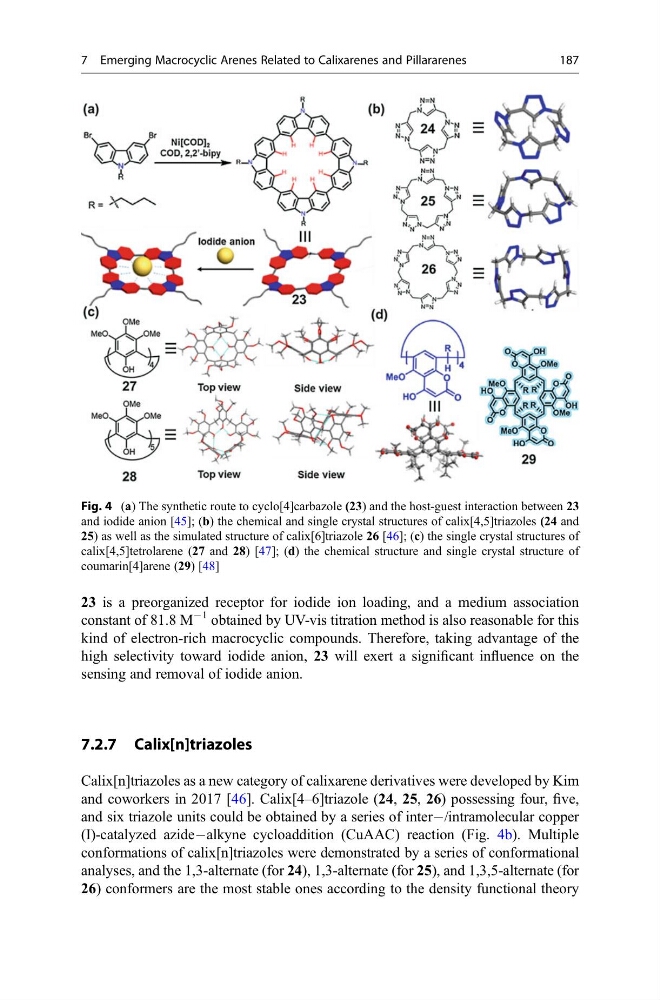
23 is a preorganized receptor for iodide ion loading, and a medium association
constant of 81.8 M
À1 obtained by UV-vis titration method is also reasonable for this
kind of electron-rich macrocyclic compounds. Therefore, taking advantage of the
high selectivity toward iodide anion, 23 will exert a significant influence on the
sensing and removal of iodide anion.
7.2.7 Calix[n]triazoles
Calix[n]triazoles as a new category of calixarene derivatives were developed by Kim
and coworkers in 2017 [46]. Calix[4–6]triazole (24, 25, 26) possessing four, five,
and six triazole units could be obtained by a series of interÀ/intramolecular copper
(I)-catalyzed azideÀalkyne cycloaddition (CuAAC) reaction (Fig. 4b). Multiple
conformations of calix[n]triazoles were demonstrated by a series of conformational
analyses, and the 1,3-alternate (for 24), 1,3-alternate (for 25), and 1,3,5-alternate (for
26) conformers are the most stable ones according to the density functional theory
Fig. 4 (a) The synthetic route to cyclo[4]carbazole (23) and the host-guest interaction between 23
and iodide anion [45]; (b) the chemical and single crystal structures of calix[4,5]triazoles (24 and
25) as well as the simulated structure of calix[6]triazole 26 [46]; (c) the single crystal structures of
calix[4,5]tetrolarene (27 and 28) [47]; (d) the chemical structure and single crystal structure of
coumarin[4]arene (29) [48]
7 Emerging Macrocyclic Arenes Related to Calixarenes and Pillararenes
187
constant of 81.8 M
À1 obtained by UV-vis titration method is also reasonable for this
kind of electron-rich macrocyclic compounds. Therefore, taking advantage of the
high selectivity toward iodide anion, 23 will exert a significant influence on the
sensing and removal of iodide anion.
7.2.7 Calix[n]triazoles
Calix[n]triazoles as a new category of calixarene derivatives were developed by Kim
and coworkers in 2017 [46]. Calix[4–6]triazole (24, 25, 26) possessing four, five,
and six triazole units could be obtained by a series of interÀ/intramolecular copper
(I)-catalyzed azideÀalkyne cycloaddition (CuAAC) reaction (Fig. 4b). Multiple
conformations of calix[n]triazoles were demonstrated by a series of conformational
analyses, and the 1,3-alternate (for 24), 1,3-alternate (for 25), and 1,3,5-alternate (for
26) conformers are the most stable ones according to the density functional theory
Fig. 4 (a) The synthetic route to cyclo[4]carbazole (23) and the host-guest interaction between 23
and iodide anion [45]; (b) the chemical and single crystal structures of calix[4,5]triazoles (24 and
25) as well as the simulated structure of calix[6]triazole 26 [46]; (c) the single crystal structures of
calix[4,5]tetrolarene (27 and 28) [47]; (d) the chemical structure and single crystal structure of
coumarin[4]arene (29) [48]
7 Emerging Macrocyclic Arenes Related to Calixarenes and Pillararenes
187