

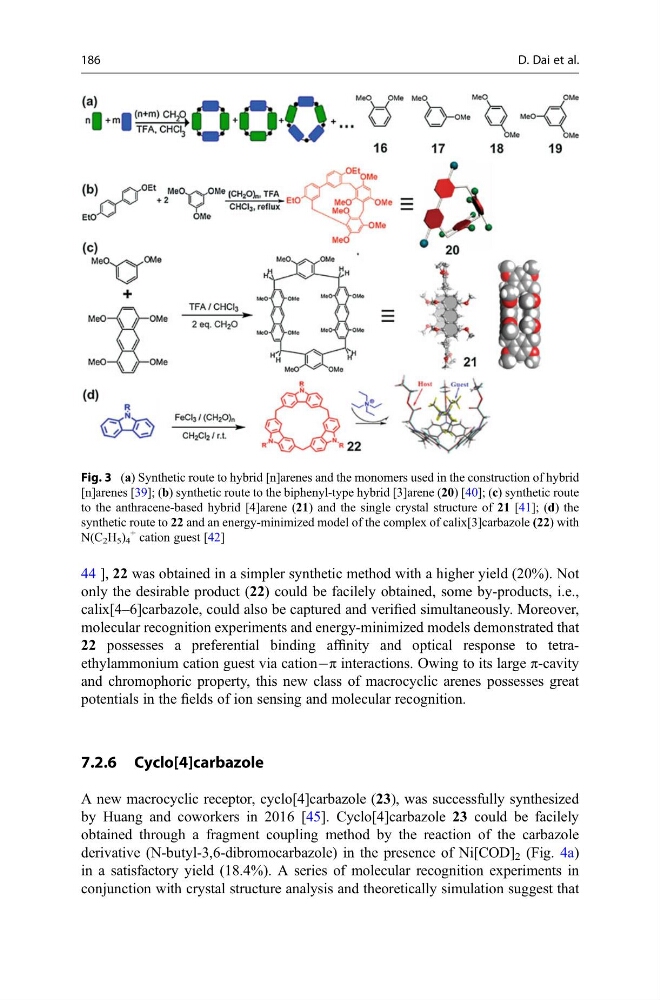
44 ], 22 was obtained in a simpler synthetic method with a higher yield (20%). Not
only the desirable product (22) could be facilely obtained, some by-products, i.e.,
calix[4–6]carbazole, could also be captured and verified simultaneously. Moreover,
molecular recognition experiments and energy-minimized models demonstrated that
22 possesses a preferential binding affinity and optical response to tetraethylammonium cation guest via cationÀπ interactions. Owing to its large π-cavity
and chromophoric property, this new class of macrocyclic arenes possesses great
potentials in the fields of ion sensing and molecular recognition.
7.2.6 Cyclo[4]carbazole
A new macrocyclic receptor, cyclo[4]carbazole (23), was successfully synthesized
by Huang and coworkers in 2016 [45]. Cyclo[4]carbazole 23 could be facilely
obtained through a fragment coupling method by the reaction of the carbazole
derivative (N-butyl-3,6-dibromocarbazole) in the presence of Ni[COD] 2 (Fig. 4a)
in a satisfactory yield (18.4%). A series of molecular recognition experiments in
conjunction with crystal structure analysis and theoretically simulation suggest that
Fig. 3 (a) Synthetic route to hybrid [n]arenes and the monomers used in the construction of hybrid
[n]arenes [39]; (b) synthetic route to the biphenyl-type hybrid [3]arene (20) [40]; (c) synthetic route
to the anthracene-based hybrid [4]arene (21) and the single crystal structure of 21 [41]; (d) the
synthetic route to 22 and an energy-minimized model of the complex of calix[3]carbazole (22) with
N(C 2 H 5 ) 4
+ cation guest [42]
186
D. Dai et al.
only the desirable product (22) could be facilely obtained, some by-products, i.e.,
calix[4–6]carbazole, could also be captured and verified simultaneously. Moreover,
molecular recognition experiments and energy-minimized models demonstrated that
22 possesses a preferential binding affinity and optical response to tetraethylammonium cation guest via cationÀπ interactions. Owing to its large π-cavity
and chromophoric property, this new class of macrocyclic arenes possesses great
potentials in the fields of ion sensing and molecular recognition.
7.2.6 Cyclo[4]carbazole
A new macrocyclic receptor, cyclo[4]carbazole (23), was successfully synthesized
by Huang and coworkers in 2016 [45]. Cyclo[4]carbazole 23 could be facilely
obtained through a fragment coupling method by the reaction of the carbazole
derivative (N-butyl-3,6-dibromocarbazole) in the presence of Ni[COD] 2 (Fig. 4a)
in a satisfactory yield (18.4%). A series of molecular recognition experiments in
conjunction with crystal structure analysis and theoretically simulation suggest that
Fig. 3 (a) Synthetic route to hybrid [n]arenes and the monomers used in the construction of hybrid
[n]arenes [39]; (b) synthetic route to the biphenyl-type hybrid [3]arene (20) [40]; (c) synthetic route
to the anthracene-based hybrid [4]arene (21) and the single crystal structure of 21 [41]; (d) the
synthetic route to 22 and an energy-minimized model of the complex of calix[3]carbazole (22) with
N(C 2 H 5 ) 4
+ cation guest [42]
186
D. Dai et al.