

7.2.3 Tetraphenylethylene (TPE)-Based Oxacalixarenes
Oxacalixarenes, a class of homocalixarene derivatives with tidy synthetic ease and
outstanding host-guest properties, have received much attention [33, 34]. In 2014,
taking advantages of both oxacalixarene and TPE, Zhang, Zheng, and coworkers
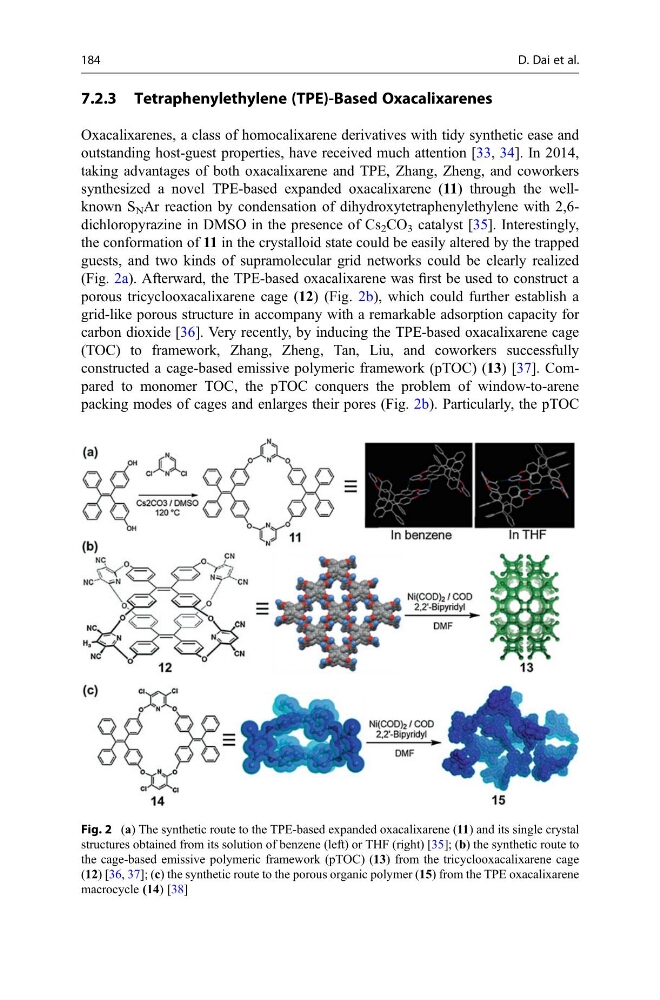
synthesized a novel TPE-based expanded oxacalixarene (11) through the wellknown S N Ar reaction by condensation of dihydroxytetraphenylethylene with 2,6dichloropyrazine in DMSO in the presence of Cs 2 CO 3 catalyst [35]. Interestingly,
the conformation of 11 in the crystalloid state could be easily altered by the trapped
guests, and two kinds of supramolecular grid networks could be clearly realized
(Fig. 2a). Afterward, the TPE-based oxacalixarene was first be used to construct a
porous tricyclooxacalixarene cage (12) (Fig. 2b), which could further establish a
grid-like porous structure in accompany with a remarkable adsorption capacity for
carbon dioxide [36]. Very recently, by inducing the TPE-based oxacalixarene cage
(TOC) to framework, Zhang, Zheng, Tan, Liu, and coworkers successfully
constructed a cage-based emissive polymeric framework (pTOC) (13) [37]. Compared to monomer TOC, the pTOC conquers the problem of window-to-arene
packing modes of cages and enlarges their pores (Fig. 2b). Particularly, the pTOC
Fig. 2 (a) The synthetic route to the TPE-based expanded oxacalixarene (11) and its single crystal
structures obtained from its solution of benzene (left) or THF (right) [35]; (b) the synthetic route to
the cage-based emissive polymeric framework (pTOC) (13) from the tricyclooxacalixarene cage
(12) [36, 37]; (c) the synthetic route to the porous organic polymer (15) from the TPE oxacalixarene
macrocycle (14) [38]
184
D. Dai et al.
Oxacalixarenes, a class of homocalixarene derivatives with tidy synthetic ease and
outstanding host-guest properties, have received much attention [33, 34]. In 2014,
taking advantages of both oxacalixarene and TPE, Zhang, Zheng, and coworkers
synthesized a novel TPE-based expanded oxacalixarene (11) through the wellknown S N Ar reaction by condensation of dihydroxytetraphenylethylene with 2,6dichloropyrazine in DMSO in the presence of Cs 2 CO 3 catalyst [35]. Interestingly,
the conformation of 11 in the crystalloid state could be easily altered by the trapped
guests, and two kinds of supramolecular grid networks could be clearly realized
(Fig. 2a). Afterward, the TPE-based oxacalixarene was first be used to construct a
porous tricyclooxacalixarene cage (12) (Fig. 2b), which could further establish a
grid-like porous structure in accompany with a remarkable adsorption capacity for
carbon dioxide [36]. Very recently, by inducing the TPE-based oxacalixarene cage
(TOC) to framework, Zhang, Zheng, Tan, Liu, and coworkers successfully
constructed a cage-based emissive polymeric framework (pTOC) (13) [37]. Compared to monomer TOC, the pTOC conquers the problem of window-to-arene
packing modes of cages and enlarges their pores (Fig. 2b). Particularly, the pTOC
Fig. 2 (a) The synthetic route to the TPE-based expanded oxacalixarene (11) and its single crystal
structures obtained from its solution of benzene (left) or THF (right) [35]; (b) the synthetic route to
the cage-based emissive polymeric framework (pTOC) (13) from the tricyclooxacalixarene cage
(12) [36, 37]; (c) the synthetic route to the porous organic polymer (15) from the TPE oxacalixarene
macrocycle (14) [38]
184
D. Dai et al.