

two benzene rings, were strongly influenced by the species of the bridging heteroatoms, which endows the calix[2]arene[2]triazines with great potentials in cavity and
electron-controllable molecular recognition process.
7.2.2 Calix[n]imidazoliums
Homo-calix compound, calix[4,5]imidazolium (9, 10), with four or five positively
charged imidazolium moieties was first reported by Kim and coworkers in 2013 [32].
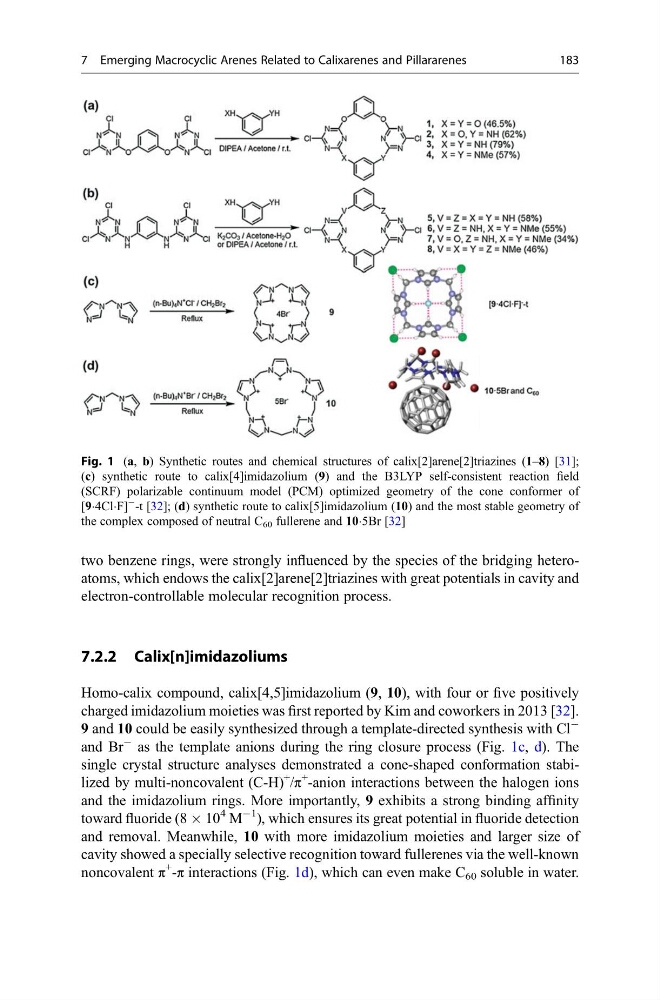
9 and 10 could be easily synthesized through a template-directed synthesis with Cl
À
and Br
À as the template anions during the ring closure process (Fig. 1c, d). The
single crystal structure analyses demonstrated a cone-shaped conformation stabilized by multi-noncovalent (C-H)
+
/π
+
-anion interactions between the halogen ions
and the imidazolium rings. More importantly, 9 exhibits a strong binding affinity
toward fluoride (8 Â 10
4 M
À1 ), which ensures its great potential in fluoride detection
and removal. Meanwhile, 10 with more imidazolium moieties and larger size of
cavity showed a specially selective recognition toward fullerenes via the well-known
noncovalent π
+
-π interactions (Fig. 1d), which can even make C 60 soluble in water.
Fig. 1 (a, b) Synthetic routes and chemical structures of calix[2]arene[2]triazines (1–8) [31];
(c) synthetic route to calix[4]imidazolium (9) and the B3LYP self-consistent reaction field
(SCRF) polarizable continuum model (PCM) optimized geometry of the cone conformer of
[9Á4ClÁF]
À -t [32]; (d) synthetic route to calix[5]imidazolium (10) and the most stable geometry of
the complex composed of neutral C 60 fullerene and 10Á5Br [32]
7 Emerging Macrocyclic Arenes Related to Calixarenes and Pillararenes
183
electron-controllable molecular recognition process.
7.2.2 Calix[n]imidazoliums
Homo-calix compound, calix[4,5]imidazolium (9, 10), with four or five positively
charged imidazolium moieties was first reported by Kim and coworkers in 2013 [32].
9 and 10 could be easily synthesized through a template-directed synthesis with Cl
À
and Br
À as the template anions during the ring closure process (Fig. 1c, d). The
single crystal structure analyses demonstrated a cone-shaped conformation stabilized by multi-noncovalent (C-H)
+
/π
+
-anion interactions between the halogen ions
and the imidazolium rings. More importantly, 9 exhibits a strong binding affinity
toward fluoride (8 Â 10
4 M
À1 ), which ensures its great potential in fluoride detection
and removal. Meanwhile, 10 with more imidazolium moieties and larger size of
cavity showed a specially selective recognition toward fullerenes via the well-known
noncovalent π
+
-π interactions (Fig. 1d), which can even make C 60 soluble in water.
Fig. 1 (a, b) Synthetic routes and chemical structures of calix[2]arene[2]triazines (1–8) [31];
(c) synthetic route to calix[4]imidazolium (9) and the B3LYP self-consistent reaction field
(SCRF) polarizable continuum model (PCM) optimized geometry of the cone conformer of
[9Á4ClÁF]
À -t [32]; (d) synthetic route to calix[5]imidazolium (10) and the most stable geometry of
the complex composed of neutral C 60 fullerene and 10Á5Br [32]
7 Emerging Macrocyclic Arenes Related to Calixarenes and Pillararenes
183