

carbon atom with lower priority. Correspondingly, we first defined the stereochemistry of enantiomers (+)-67 and (À)-67 as P and M configuration, respectively.
Then, from the crystal structure of diastereomer 68a (Fig. 22a), the absolute
configuration of its macrocyclic skeleton could be easily determined to be in a P
configuration [38]. Moreover, we also obtained the crystal structure of (+)-P-70
(Fig. 22b), which further confirmed the absolute configuration of the enantiomeric
helicarenes [43].
MeO
OMe
OH
OH
MeO
OMe
OMe
OMe
(±)- 66
(+)- P-66
(-)-M-66
HO
OH
OH
OH
HO
(±)- 70 (95%)
(+)- P-70 (95%)
(-)-M-70 (96%)
Br
Br
Br
Br
Br
Br
HO
OH
OH
OH
HO
(±)- 60a-f
Ar
Ar
Ar
Ar
Ar
Ar
Ar = Ph (a); p-CH 3 OC 6 H 4 (b); pCH 3 C 6 H 4 (c); p-CH 3 CH 2 C 6 H 4
(d); p-FC 6 H 4 (e); p-ClC 6 H 4 (f)
(+)- P-71a-f /(-)-M-71a-f
(±)- 69 (88%)
(+)- P-69 (91%)
(-)-M-69 (90%)
Br 2
CH 2 Cl 2
BBr 3 CH 2 Cl 2
ArB(OH) 2
PhCH 3 /EtOH/H 2 O
55-71%
Cs 2 CO 3 , Pd(PPh 3 ) 4
MeO
OMe
OMe
MeO
OMe
OMe
Br
Br
Br
Br
Br
Br
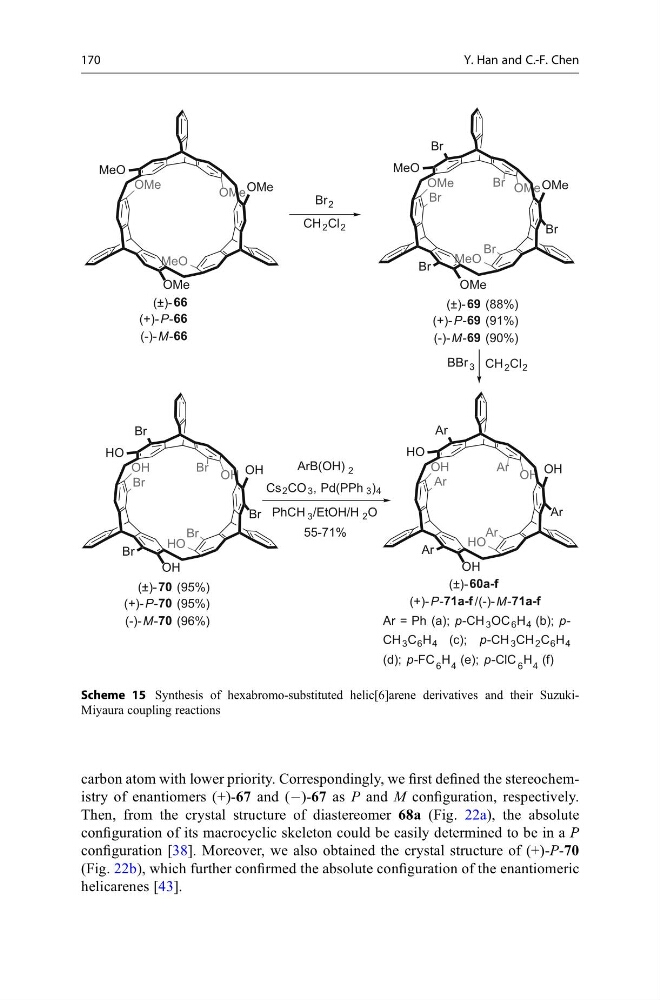
Scheme 15 Synthesis of hexabromo-substituted helic[6]arene derivatives and their SuzukiMiyaura coupling reactions
170
Y. Han and C.-F. Chen
Then, from the crystal structure of diastereomer 68a (Fig. 22a), the absolute
configuration of its macrocyclic skeleton could be easily determined to be in a P
configuration [38]. Moreover, we also obtained the crystal structure of (+)-P-70
(Fig. 22b), which further confirmed the absolute configuration of the enantiomeric
helicarenes [43].
MeO
OMe
OH
OH
MeO
OMe
OMe
OMe
(±)- 66
(+)- P-66
(-)-M-66
HO
OH
OH
OH
HO
(±)- 70 (95%)
(+)- P-70 (95%)
(-)-M-70 (96%)
Br
Br
Br
Br
Br
Br
HO
OH
OH
OH
HO
(±)- 60a-f
Ar
Ar
Ar
Ar
Ar
Ar
Ar = Ph (a); p-CH 3 OC 6 H 4 (b); pCH 3 C 6 H 4 (c); p-CH 3 CH 2 C 6 H 4
(d); p-FC 6 H 4 (e); p-ClC 6 H 4 (f)
(+)- P-71a-f /(-)-M-71a-f
(±)- 69 (88%)
(+)- P-69 (91%)
(-)-M-69 (90%)
Br 2
CH 2 Cl 2
BBr 3 CH 2 Cl 2
ArB(OH) 2
PhCH 3 /EtOH/H 2 O
55-71%
Cs 2 CO 3 , Pd(PPh 3 ) 4
MeO
OMe
OMe
MeO
OMe
OMe
Br
Br
Br
Br
Br
Br
Scheme 15 Synthesis of hexabromo-substituted helic[6]arene derivatives and their SuzukiMiyaura coupling reactions
170
Y. Han and C.-F. Chen