

6.2.1.3 Triptycene-Derived Tetralactam Macrocycles
Due to their capability of binding substrate species strongly and selectively,
tetralactam macrocycles have been widely applied to construct a variety of
interlocked supramolecular assemblies, develop new molecular machines, and
improve the properties of organic dyes by molecular encapsulation. In 2008, we
[31] designed and synthesized a pair of novel triptycene-derived tetralactam
macrocycles 52a–b. As shown in Scheme 11, by a one-pot [2 + 2] cyclization
reaction of pyridine-2,6-dicarbonyl dichloride and 2,7-diaminotriptycene in dry
THF in the presence of Et 3 N, macrocycles 52a–b could be conveniently synthesized in 20–26% yields.
6.2.2 Structures in Solution
Due to the different linking modes of the triptycene moieties, 4a and 5a are a pair of
diastereomers. 4a is a syn orientation of the two triptycene moieties, while 5a is an
O
O
O
O
O
O
O
O
R 2
OR 1
OR 1
R 2
39a R 1 = Me, R 2 = t-Bu
39b R 1 = n-Bu, R 2 = t-Bu
39c R 1 = Me, R 2 = Ph
39d R 1 = n-Bu, R 2 = Ph
R 2
OR 1
OR 1
R 2
40a R 1 = Me, R 2 = t-Bu
40b R 1 = n-Bu, R 2 = t-Bu
40c R 1 = Me, R 2 = Ph
40d R 1 = n-Bu, R 2 = Ph
O
O
O
O
O
O
O
O
Ph
O
O
Ph
41a n = 2; 41b n = 3
Ph
O
O
Ph
42a n = 2; 42b n = 3
O
n
O
n
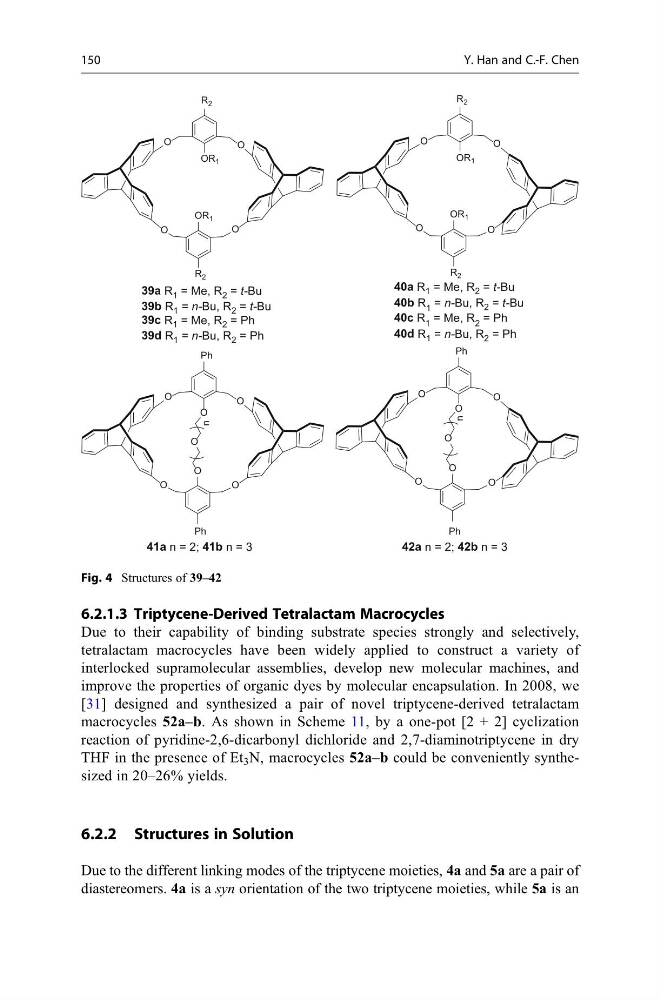
Fig. 4 Structures of 39–42
150
Y. Han and C.-F. Chen
Due to their capability of binding substrate species strongly and selectively,
tetralactam macrocycles have been widely applied to construct a variety of
interlocked supramolecular assemblies, develop new molecular machines, and
improve the properties of organic dyes by molecular encapsulation. In 2008, we
[31] designed and synthesized a pair of novel triptycene-derived tetralactam
macrocycles 52a–b. As shown in Scheme 11, by a one-pot [2 + 2] cyclization
reaction of pyridine-2,6-dicarbonyl dichloride and 2,7-diaminotriptycene in dry
THF in the presence of Et 3 N, macrocycles 52a–b could be conveniently synthesized in 20–26% yields.
6.2.2 Structures in Solution
Due to the different linking modes of the triptycene moieties, 4a and 5a are a pair of
diastereomers. 4a is a syn orientation of the two triptycene moieties, while 5a is an
O
O
O
O
O
O
O
O
R 2
OR 1
OR 1
R 2
39a R 1 = Me, R 2 = t-Bu
39b R 1 = n-Bu, R 2 = t-Bu
39c R 1 = Me, R 2 = Ph
39d R 1 = n-Bu, R 2 = Ph
R 2
OR 1
OR 1
R 2
40a R 1 = Me, R 2 = t-Bu
40b R 1 = n-Bu, R 2 = t-Bu
40c R 1 = Me, R 2 = Ph
40d R 1 = n-Bu, R 2 = Ph
O
O
O
O
O
O
O
O
Ph
O
O
Ph
41a n = 2; 41b n = 3
Ph
O
O
Ph
42a n = 2; 42b n = 3
O
n
O
n
Fig. 4 Structures of 39–42
150
Y. Han and C.-F. Chen