

be reversibly modulated by the addition and removal of cyclen, Cl
À
, or pH changes,
revealing that the supramolecular polymer network could act as a multiple
ratiometric fluorescent sensor. In addition, supramolecular gels were formed with
the increase in concentration of the supramolecular polymer network, and the gels
displayed stimuli-responsive gel-sol transition and good self-healing behaviors.
Huang and coworkers [64] also constructed a dual-stimuli-responsive fluorescent
supramolecular cross-linked polymer gel combining a polystyrene chain with
dialkylammonium salt units and four-arm benzo-21-crown-7 (B21C7)-contained
TPE derivative (Fig. 22b). Originating from the host-guest interactions of B21C7/
dialkylammonium salt and the TPE-based AIE effect, the fluorescence intensities of
supramolecular polymer gel could be reversibly regulated by thermal stimuli and pH
variations, accompanied with the reversible gel-sol transitions. This fluorescence
tunable supramolecular gel based on host-guest interactions provided a novel way to
construct responsive light-emitting materials.
Multiple orthogonal noncovalent interactions were utilized to fabricate new
supramolecular polymers with the more sophisticated functions. Recently, Stang et
al. [65] reported an efficient strategy to construct fluorescent supramolecular polymer network by the multiple interactions within a single process, including metalligand coordination, hydrogen bonding, and host-guest interactions (Fig. 23a).
Firstly, they fabricated a hexagonal metallacycle from a 120
B21C7-containing
di-Pt (II) acceptor and 2-ureido-4-pyrimidinone (UPy)-decorated 120
bis-pyridyl
donor through the coordination of the pyridyl with organoplatinum. Then, the
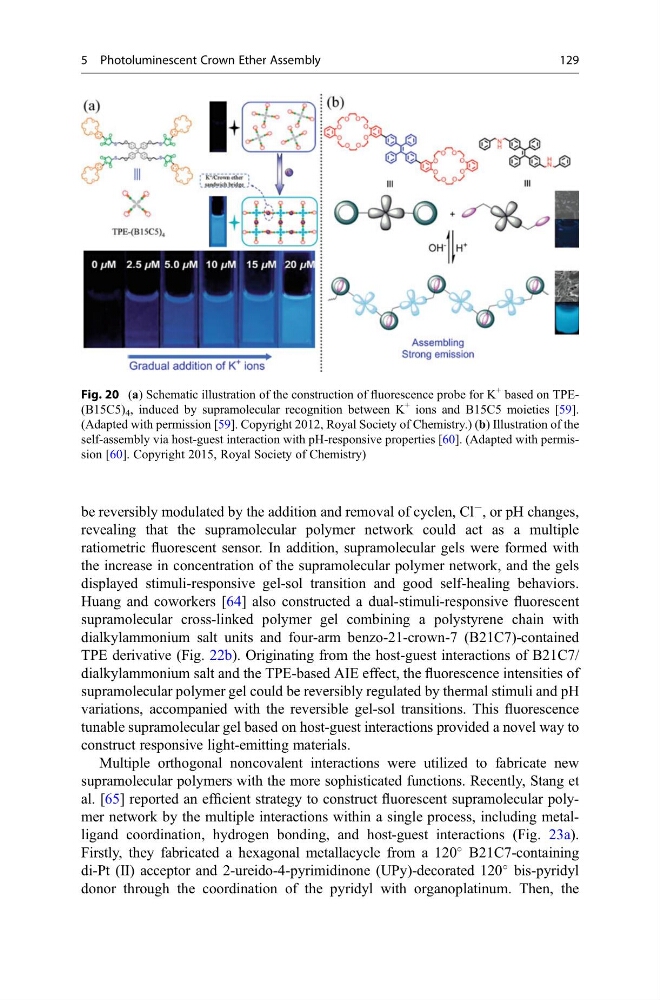
Fig. 20 (a) Schematic illustration of the construction of fluorescence probe for K
+ based on TPE(B15C5) 4 , induced by supramolecular recognition between K
+ ions and B15C5 moieties [59].
(Adapted with permission [59]. Copyright 2012, Royal Society of Chemistry.) (b) Illustration of the
self-assembly via host-guest interaction with pH-responsive properties [60]. (Adapted with permission [60]. Copyright 2015, Royal Society of Chemistry)
5 Photoluminescent Crown Ether Assembly
129
À
, or pH changes,
revealing that the supramolecular polymer network could act as a multiple
ratiometric fluorescent sensor. In addition, supramolecular gels were formed with
the increase in concentration of the supramolecular polymer network, and the gels
displayed stimuli-responsive gel-sol transition and good self-healing behaviors.
Huang and coworkers [64] also constructed a dual-stimuli-responsive fluorescent
supramolecular cross-linked polymer gel combining a polystyrene chain with
dialkylammonium salt units and four-arm benzo-21-crown-7 (B21C7)-contained
TPE derivative (Fig. 22b). Originating from the host-guest interactions of B21C7/
dialkylammonium salt and the TPE-based AIE effect, the fluorescence intensities of
supramolecular polymer gel could be reversibly regulated by thermal stimuli and pH
variations, accompanied with the reversible gel-sol transitions. This fluorescence
tunable supramolecular gel based on host-guest interactions provided a novel way to
construct responsive light-emitting materials.
Multiple orthogonal noncovalent interactions were utilized to fabricate new
supramolecular polymers with the more sophisticated functions. Recently, Stang et
al. [65] reported an efficient strategy to construct fluorescent supramolecular polymer network by the multiple interactions within a single process, including metalligand coordination, hydrogen bonding, and host-guest interactions (Fig. 23a).
Firstly, they fabricated a hexagonal metallacycle from a 120
B21C7-containing
di-Pt (II) acceptor and 2-ureido-4-pyrimidinone (UPy)-decorated 120
bis-pyridyl
donor through the coordination of the pyridyl with organoplatinum. Then, the
Fig. 20 (a) Schematic illustration of the construction of fluorescence probe for K
+ based on TPE(B15C5) 4 , induced by supramolecular recognition between K
+ ions and B15C5 moieties [59].
(Adapted with permission [59]. Copyright 2012, Royal Society of Chemistry.) (b) Illustration of the
self-assembly via host-guest interaction with pH-responsive properties [60]. (Adapted with permission [60]. Copyright 2015, Royal Society of Chemistry)
5 Photoluminescent Crown Ether Assembly
129