

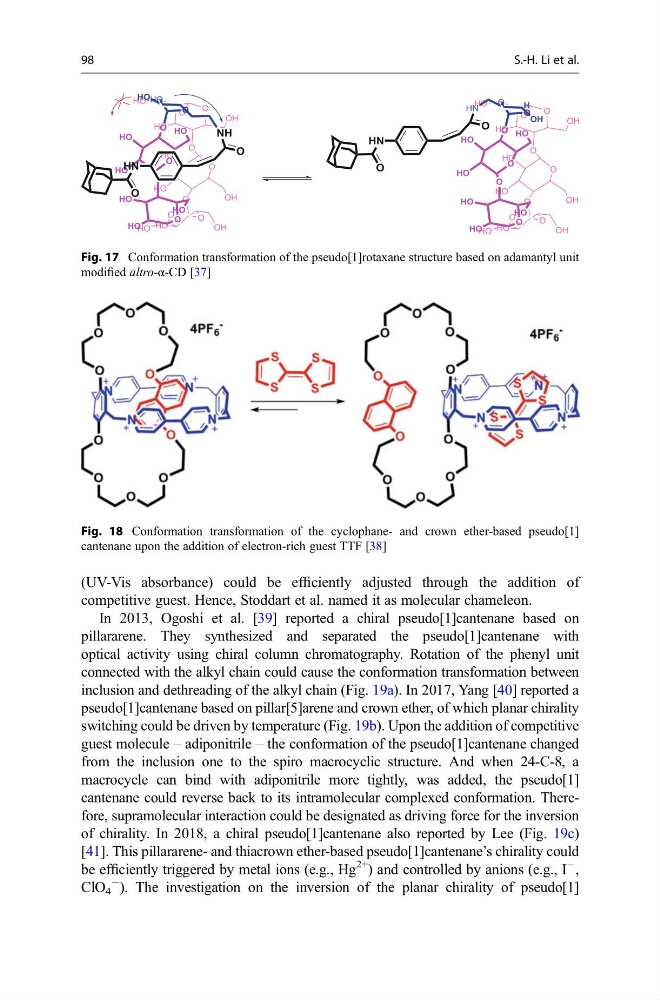
(UV-Vis absorbance) could be efficiently adjusted through the addition of
competitive guest. Hence, Stoddart et al. named it as molecular chameleon.
In 2013, Ogoshi et al. [39] reported a chiral pseudo[1]cantenane based on
pillararene. They synthesized and separated the pseudo[1]cantenane with
optical activity using chiral column chromatography. Rotation of the phenyl unit
connected with the alkyl chain could cause the conformation transformation between
inclusion and dethreading of the alkyl chain (Fig. 19a). In 2017, Yang [40] reported a
pseudo[1]cantenane based on pillar[5]arene and crown ether, of which planar chirality
switching could be driven by temperature (Fig. 19b). Upon the addition of competitive
guest molecule – adiponitrile – the conformation of the pseudo[1]cantenane changed
from the inclusion one to the spiro macrocyclic structure. And when 24-C-8, a
macrocycle can bind with adiponitrile more tightly, was added, the pseudo[1]
cantenane could reverse back to its intramolecular complexed conformation. Therefore, supramolecular interaction could be designated as driving force for the inversion
of chirality. In 2018, a chiral pseudo[1]cantenane also reported by Lee (Fig. 19c)
[41]. This pillararene- and thiacrown ether-based pseudo[1]cantenane’s chirality could
be efficiently triggered by metal ions (e.g., Hg
2+
) and controlled by anions (e.g., I
À ,
ClO 4
À
). The investigation on the inversion of the planar chirality of pseudo[1]
Fig. 17 Conformation transformation of the pseudo[1]rotaxane structure based on adamantyl unit
modified altro-α-CD [37]
Fig. 18 Conformation transformation of the cyclophane- and crown ether-based pseudo[1]
cantenane upon the addition of electron-rich guest TTF [38]
98
S.-H. Li et al.
competitive guest. Hence, Stoddart et al. named it as molecular chameleon.
In 2013, Ogoshi et al. [39] reported a chiral pseudo[1]cantenane based on
pillararene. They synthesized and separated the pseudo[1]cantenane with
optical activity using chiral column chromatography. Rotation of the phenyl unit
connected with the alkyl chain could cause the conformation transformation between
inclusion and dethreading of the alkyl chain (Fig. 19a). In 2017, Yang [40] reported a
pseudo[1]cantenane based on pillar[5]arene and crown ether, of which planar chirality
switching could be driven by temperature (Fig. 19b). Upon the addition of competitive
guest molecule – adiponitrile – the conformation of the pseudo[1]cantenane changed
from the inclusion one to the spiro macrocyclic structure. And when 24-C-8, a
macrocycle can bind with adiponitrile more tightly, was added, the pseudo[1]
cantenane could reverse back to its intramolecular complexed conformation. Therefore, supramolecular interaction could be designated as driving force for the inversion
of chirality. In 2018, a chiral pseudo[1]cantenane also reported by Lee (Fig. 19c)
[41]. This pillararene- and thiacrown ether-based pseudo[1]cantenane’s chirality could
be efficiently triggered by metal ions (e.g., Hg
2+
) and controlled by anions (e.g., I
À ,
ClO 4
À
). The investigation on the inversion of the planar chirality of pseudo[1]
Fig. 17 Conformation transformation of the pseudo[1]rotaxane structure based on adamantyl unit
modified altro-α-CD [37]
Fig. 18 Conformation transformation of the cyclophane- and crown ether-based pseudo[1]
cantenane upon the addition of electron-rich guest TTF [38]
98
S.-H. Li et al.