

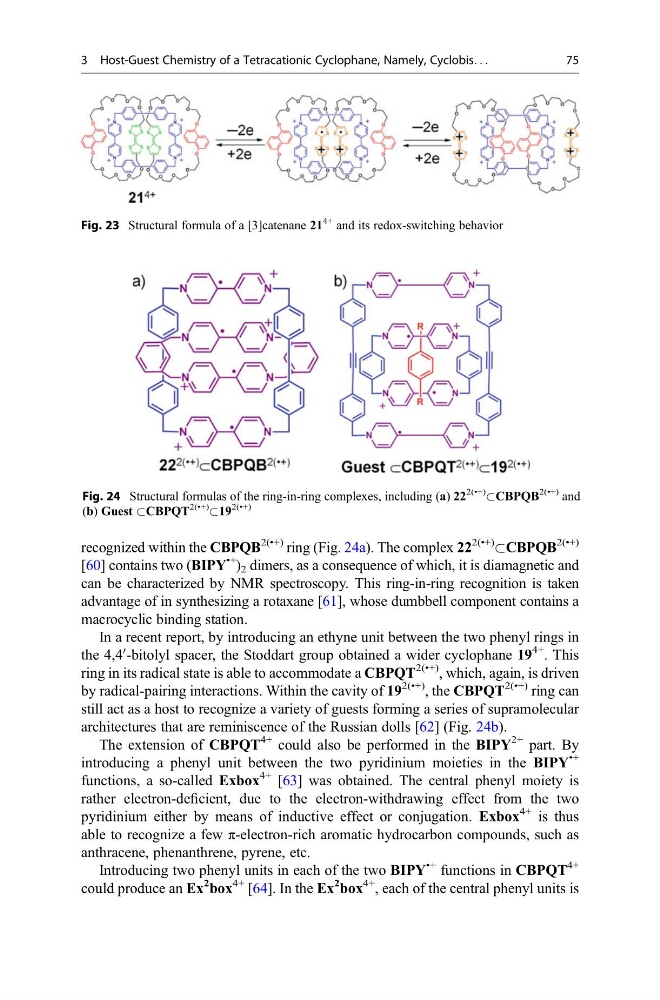
recognized within the CBPQB
2(•+) ring (Fig. 24a). The complex 22
2(•+)
&CBPQB
2(•+)
[60] contains two (BIPY
•+
) 2 dimers, as a consequence of which, it is diamagnetic and
can be characterized by NMR spectroscopy. This ring-in-ring recognition is taken
advantage of in synthesizing a rotaxane [61], whose dumbbell component contains a
macrocyclic binding station.
In a recent report, by introducing an ethyne unit between the two phenyl rings in
the 4,4
0 -bitolyl spacer, the Stoddart group obtained a wider cyclophane 19
4+ . This
ring in its radical state is able to accommodate a CBPQT
2(•+) , which, again, is driven
by radical-pairing interactions. Within the cavity of 19
2(•+) , the CBPQT
2(•+) ring can
still act as a host to recognize a variety of guests forming a series of supramolecular
architectures that are reminiscence of the Russian dolls [62] (Fig. 24b).
The extension of CBPQT
4+ could also be performed in the BIPY
2+ part. By
introducing a phenyl unit between the two pyridinium moieties in the BIPY
•+
functions, a so-called Exbox
4+ [63] was obtained. The central phenyl moiety is
rather electron-deficient, due to the electron-withdrawing effect from the two
pyridinium either by means of inductive effect or conjugation. Exbox
4+ is thus
able to recognize a few π-electron-rich aromatic hydrocarbon compounds, such as
anthracene, phenanthrene, pyrene, etc.
Introducing two phenyl units in each of the two BIPY
•+ functions in CBPQT
4+
could produce an Ex
2
box
4+ [64]. In the Ex
2
box
4+ , each of the central phenyl units is
Fig. 23 Structural formula of a [3]catenane 21
4+ and its redox-switching behavior
Fig. 24 Structural formulas of the ring-in-ring complexes, including (a) 22
2(•+)
&CBPQB
2(•+) and
(b) Guest &CBPQT
2(•+)
&19
2(•+)
3 Host-Guest Chemistry of a Tetracationic Cyclophane, Namely, Cyclobis. . .
75
2(•+) ring (Fig. 24a). The complex 22
2(•+)
&CBPQB
2(•+)
[60] contains two (BIPY
•+
) 2 dimers, as a consequence of which, it is diamagnetic and
can be characterized by NMR spectroscopy. This ring-in-ring recognition is taken
advantage of in synthesizing a rotaxane [61], whose dumbbell component contains a
macrocyclic binding station.
In a recent report, by introducing an ethyne unit between the two phenyl rings in
the 4,4
0 -bitolyl spacer, the Stoddart group obtained a wider cyclophane 19
4+ . This
ring in its radical state is able to accommodate a CBPQT
2(•+) , which, again, is driven
by radical-pairing interactions. Within the cavity of 19
2(•+) , the CBPQT
2(•+) ring can
still act as a host to recognize a variety of guests forming a series of supramolecular
architectures that are reminiscence of the Russian dolls [62] (Fig. 24b).
The extension of CBPQT
4+ could also be performed in the BIPY
2+ part. By
introducing a phenyl unit between the two pyridinium moieties in the BIPY
•+
functions, a so-called Exbox
4+ [63] was obtained. The central phenyl moiety is
rather electron-deficient, due to the electron-withdrawing effect from the two
pyridinium either by means of inductive effect or conjugation. Exbox
4+ is thus
able to recognize a few π-electron-rich aromatic hydrocarbon compounds, such as
anthracene, phenanthrene, pyrene, etc.
Introducing two phenyl units in each of the two BIPY
•+ functions in CBPQT
4+
could produce an Ex
2
box
4+ [64]. In the Ex
2
box
4+ , each of the central phenyl units is
Fig. 23 Structural formula of a [3]catenane 21
4+ and its redox-switching behavior
Fig. 24 Structural formulas of the ring-in-ring complexes, including (a) 22
2(•+)
&CBPQB
2(•+) and
(b) Guest &CBPQT
2(•+)
&19
2(•+)
3 Host-Guest Chemistry of a Tetracationic Cyclophane, Namely, Cyclobis. . .
75