

70
(UBOS) projects Uganda’s total population in 2017 at 37.6 million, with youth
(18–30 years) constituting roughly 22% (8.2 million) of that population. Children
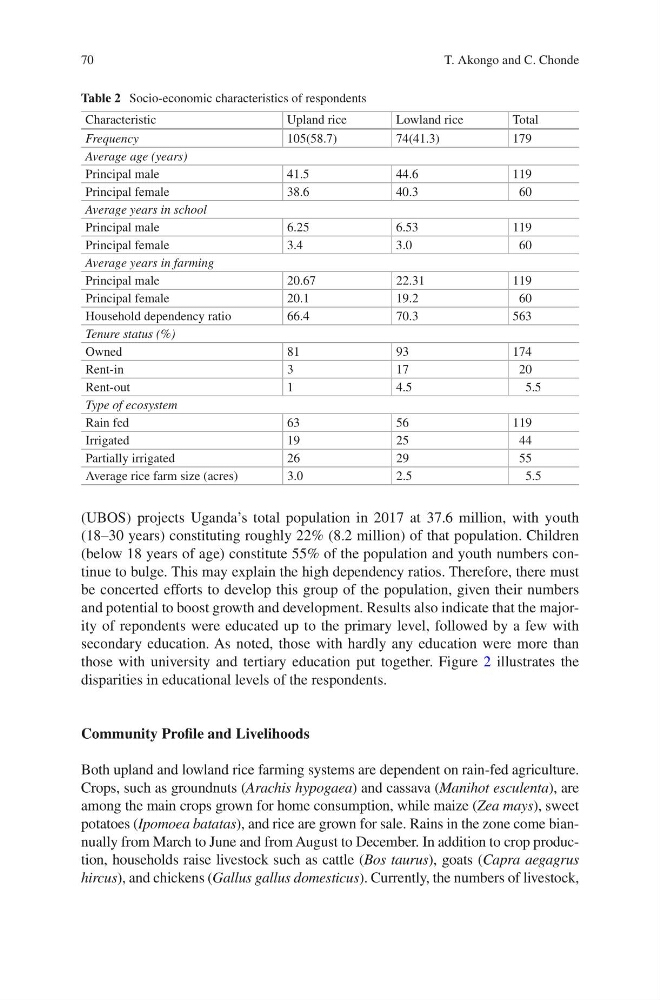
(below 18 years of age) constitute 55% of the population and youth numbers continue to bulge. This may explain the high dependency ratios. Therefore, there must
be concerted efforts to develop this group of the population, given their numbers
and potential to boost growth and development. Results also indicate that the majority of repondents were educated up to the primary level, followed by a few with
secondary education. As noted, those with hardly any education were more than
those with university and tertiary education put together. Figure 2 illustrates the
disparities in educational levels of the respondents.
Community Profile and Livelihoods
Both upland and lowland rice farming systems are dependent on rain-fed agriculture.
Crops, such as groundnuts (Arachis hypogaea) and cassava (Manihot esculenta), are
among the main crops grown for home consumption, while maize (Zea mays), sweet
potatoes (Ipomoea batatas), and rice are grown for sale. Rains in the zone come biannually from March to June and from August to December. In addition to crop production, households raise livestock such as cattle (Bos taurus), goats (Capra aegagrus
hircus), and chickens (Gallus gallus domesticus). Currently, the numbers of livestock,
Table 2 Socio-economic characteristics of respondents
Characteristic
Upland rice
Lowland rice
Total
Frequency
105(58.7)
74(41.3)
179
Average age (years)
Principal male
41.5
44.6
119
Principal female
38.6
40.3
60
Average years in school
Principal male
6.25
6.53
119
Principal female
3.4
3.0
60
Average years in farming
Principal male
20.67
22.31
119
Principal female
20.1
19.2
60
Household dependency ratio
66.4
70.3
563
Tenure status (%)
Owned
81
93
174
Rent-in
3
17
20
Rent-out
1
4.5
5.5
Type of ecosystem
Rain fed
63
56
119
Irrigated
19
25
44
Partially irrigated
26
29
55
Average rice farm size (acres)
3.0
2.5
5.5
T. Akongo and C. Chonde
(UBOS) projects Uganda’s total population in 2017 at 37.6 million, with youth
(18–30 years) constituting roughly 22% (8.2 million) of that population. Children
(below 18 years of age) constitute 55% of the population and youth numbers continue to bulge. This may explain the high dependency ratios. Therefore, there must
be concerted efforts to develop this group of the population, given their numbers
and potential to boost growth and development. Results also indicate that the majority of repondents were educated up to the primary level, followed by a few with
secondary education. As noted, those with hardly any education were more than
those with university and tertiary education put together. Figure 2 illustrates the
disparities in educational levels of the respondents.
Community Profile and Livelihoods
Both upland and lowland rice farming systems are dependent on rain-fed agriculture.
Crops, such as groundnuts (Arachis hypogaea) and cassava (Manihot esculenta), are
among the main crops grown for home consumption, while maize (Zea mays), sweet
potatoes (Ipomoea batatas), and rice are grown for sale. Rains in the zone come biannually from March to June and from August to December. In addition to crop production, households raise livestock such as cattle (Bos taurus), goats (Capra aegagrus
hircus), and chickens (Gallus gallus domesticus). Currently, the numbers of livestock,
Table 2 Socio-economic characteristics of respondents
Characteristic
Upland rice
Lowland rice
Total
Frequency
105(58.7)
74(41.3)
179
Average age (years)
Principal male
41.5
44.6
119
Principal female
38.6
40.3
60
Average years in school
Principal male
6.25
6.53
119
Principal female
3.4
3.0
60
Average years in farming
Principal male
20.67
22.31
119
Principal female
20.1
19.2
60
Household dependency ratio
66.4
70.3
563
Tenure status (%)
Owned
81
93
174
Rent-in
3
17
20
Rent-out
1
4.5
5.5
Type of ecosystem
Rain fed
63
56
119
Irrigated
19
25
44
Partially irrigated
26
29
55
Average rice farm size (acres)
3.0
2.5
5.5
T. Akongo and C. Chonde