

583
ogy, from eliciting narratives, empowering participants (Clark 2012; Latz 2017),
connecting the audience to the data (Szto et al. 2005), to triggering dialogue and
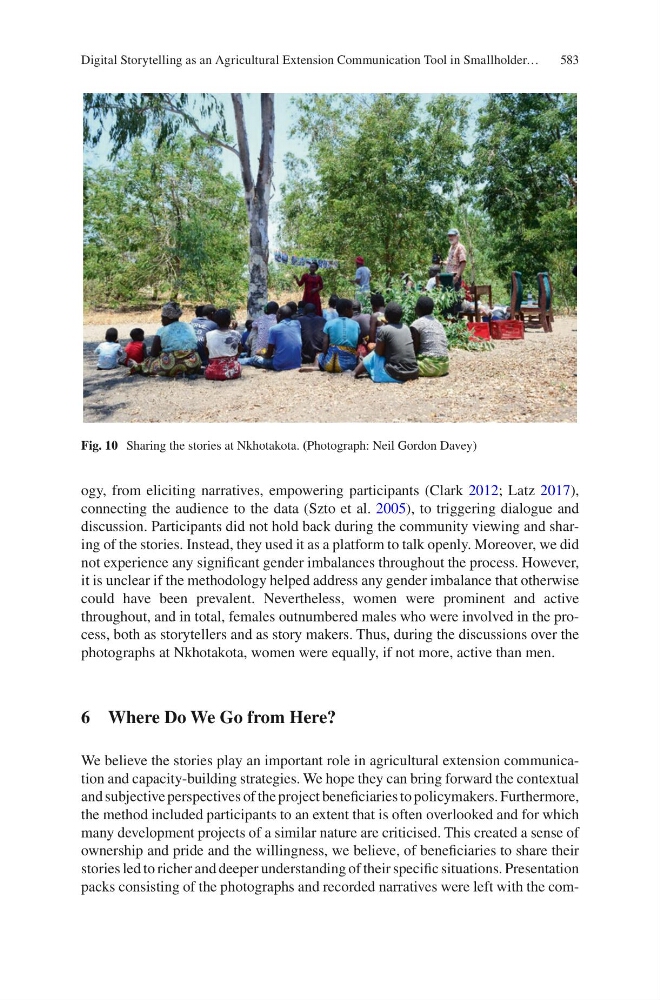
discussion. Participants did not hold back during the community viewing and sharing of the stories. Instead, they used it as a platform to talk openly. Moreover, we did
not experience any significant gender imbalances throughout the process. However,
it is unclear if the methodology helped address any gender imbalance that otherwise
could have been prevalent. Nevertheless, women were prominent and active
throughout, and in total, females outnumbered males who were involved in the process, both as storytellers and as story makers. Thus, during the discussions over the
photographs at Nkhotakota, women were equally, if not more, active than men.
6 Where Do We Go from Here?
We believe the stories play an important role in agricultural extension communication and capacity-building strategies. We hope they can bring forward the contextual
and subjective perspectives of the project beneficiaries to policymakers. Furthermore,
the method included participants to an extent that is often overlooked and for which
many development projects of a similar nature are criticised. This created a sense of
ownership and pride and the willingness, we believe, of beneficiaries to share their
stories led to richer and deeper understanding of their specific situations. Presentation
packs consisting of the photographs and recorded narratives were left with the comFig. 10 Sharing the stories at Nkhotakota. (Photograph: Neil Gordon Davey)
Digital Storytelling as an Agricultural Extension Communication Tool in Smallholder…