

557
of additional grain harvested per kilogram of nitrogen applied to the grain crop
(Snapp et al. 2014: P1). Based on agronomic evidence, NUE is 14–50 kg/kgN on
on-station and on-farm trial plots, but it is —two to three times less on farmermanaged plots (Snapp et al. 2014). On farmer-managed plots, Snapp et al. (2014)
reported NUE of 17.7 kg/kgN, Pauw and Thurlow (2014) found an average of
16.8 kg/kgN, while Carr (2014) reported 15.2 kg/kgN. Variety disaggregation shows
10–12 kg/kgN for local maize, 15 kg/kgN for open pollinated varieties, and
18–20 kg/kgN for hybrid maize varieties (Dorward et al. 2008).
The Malawi FISP contains 50 kg of NPK (with 23% nitrogen, i.e., 11.5 kgN) and
50 kg urea (with 46% nitrogen, i.e., 23 kgN) giving an average of 34.5 kgN (Pauw
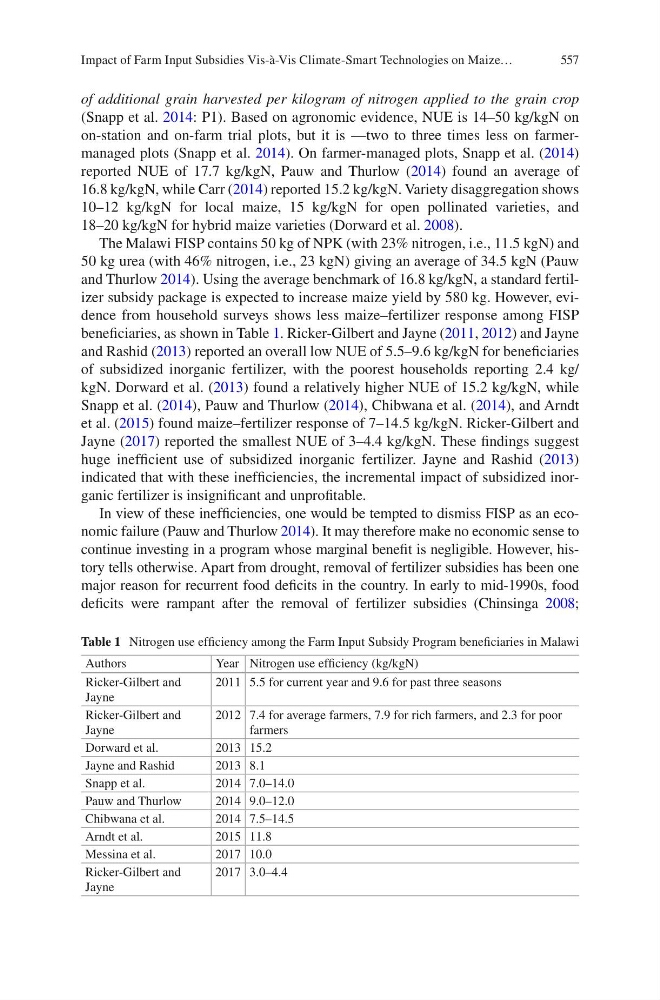
and Thurlow 2014). Using the average benchmark of 16.8 kg/kgN, a standard fertilizer subsidy package is expected to increase maize yield by 580 kg. However, evidence from household surveys shows less maize–fertilizer response among FISP
beneficiaries, as shown in Table 1. Ricker-Gilbert and Jayne (2011, 2012) and Jayne
and Rashid (2013) reported an overall low NUE of 5.5–9.6 kg/kgN for beneficiaries
of subsidized inorganic fertilizer, with the poorest households reporting 2.4 kg/
kgN. Dorward et al. (2013) found a relatively higher NUE of 15.2 kg/kgN, while
Snapp et al. (2014), Pauw and Thurlow (2014), Chibwana et al. (2014), and Arndt
et al. (2015) found maize–fertilizer response of 7–14.5 kg/kgN. Ricker-Gilbert and
Jayne (2017) reported the smallest NUE of 3–4.4 kg/kgN. These findings suggest
huge inefficient use of subsidized inorganic fertilizer. Jayne and Rashid (2013)
indicated that with these inefficiencies, the incremental impact of subsidized inorganic fertilizer is insignificant and unprofitable.
In view of these inefficiencies, one would be tempted to dismiss FISP as an economic failure (Pauw and Thurlow 2014). It may therefore make no economic sense to
continue investing in a program whose marginal benefit is negligible. However, history tells otherwise. Apart from drought, removal of fertilizer subsidies has been one
major reason for recurrent food deficits in the country. In early to mid-1990s, food
deficits were rampant after the removal of fertilizer subsidies (Chinsinga 2008;
Table 1 Nitrogen use efficiency among the Farm Input Subsidy Program beneficiaries in Malawi
Authors
Year Nitrogen use efficiency (kg/kgN)
Ricker-Gilbert and
Jayne
2011 5.5 for current year and 9.6 for past three seasons
Ricker-Gilbert and
Jayne
2012 7.4 for average farmers, 7.9 for rich farmers, and 2.3 for poor
farmers
Dorward et al.
2013 15.2
Jayne and Rashid
2013 8.1
Snapp et al.
2014 7.0–14.0
Pauw and Thurlow
2014 9.0–12.0
Chibwana et al.
2014 7.5–14.5
Arndt et al.
2015 11.8
Messina et al.
2017 10.0
Ricker-Gilbert and
Jayne
2017 3.0–4.4
Impact of Farm Input Subsidies Vis-à-Vis Climate-Smart Technologies on Maize…