

542
access, and hence income, are largely due to the financial capability of the individual household, along with the nature of the water sources. In areas where groundwater table is closer to the surface, people opt to use shallow wells, and the majority
use buckets for delivering water to crops, and this is in line with the observation by
Kashaigili (2007). While this has been noted, there is a greater need for improving
access to water for irrigation by smallholder farmers for enhanced crop production
and income. As such, understanding the problems and constraints to the current
farming practices, and the existing opportunities for improvement, is imperative for
enhanced agricultural production.
4.1 Problems and Constraints to the Current Smallholder
Farming Practices
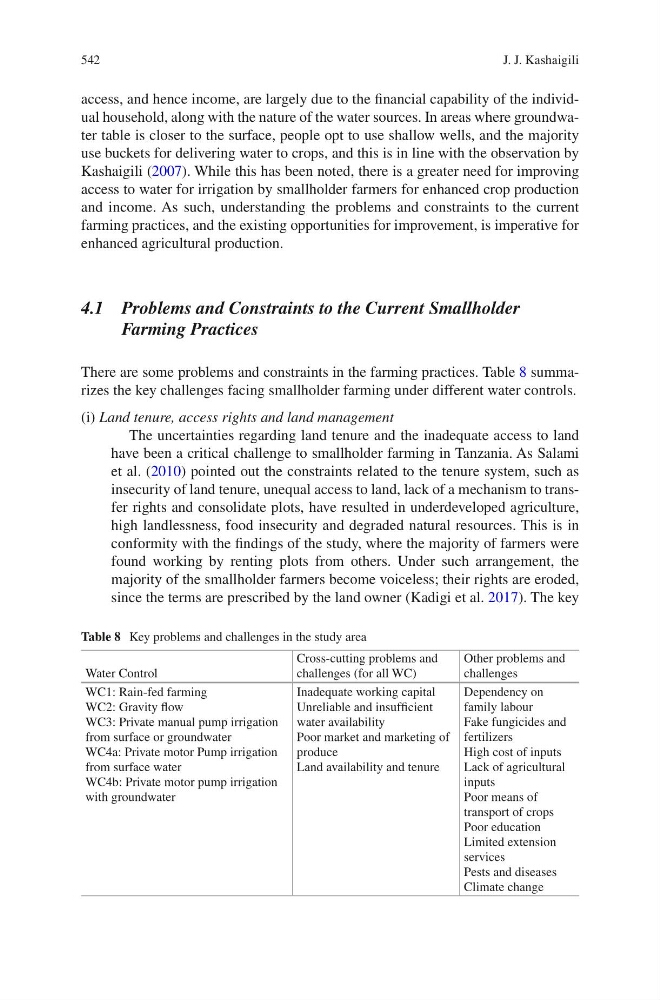
There are some problems and constraints in the farming practices. Table 8 summarizes the key challenges facing smallholder farming under different water controls.
(i) Land tenure, access rights and land management
The uncertainties regarding land tenure and the inadequate access to land
have been a critical challenge to smallholder farming in Tanzania. As Salami
et al. (2010) pointed out the constraints related to the tenure system, such as
insecurity of land tenure, unequal access to land, lack of a mechanism to transfer rights and consolidate plots, have resulted in underdeveloped agriculture,
high landlessness, food insecurity and degraded natural resources. This is in
conformity with the findings of the study, where the majority of farmers were
found working by renting plots from others. Under such arrangement, the
majority of the smallholder farmers become voiceless; their rights are eroded,
since the terms are prescribed by the land owner (Kadigi et al. 2017). The key
Table 8 Key problems and challenges in the study area
Water Control
Cross-cutting problems and
challenges (for all WC)
Other problems and
challenges
WC1: Rain-fed farming
WC2: Gravity flow
WC3: Private manual pump irrigation
from surface or groundwater
WC4a: Private motor Pump irrigation
from surface water
WC4b: Private motor pump irrigation
with groundwater
Inadequate working capital
Unreliable and insufficient
water availability
Poor market and marketing of
produce
Land availability and tenure
Dependency on
family labour
Fake fungicides and
fertilizers
High cost of inputs
Lack of agricultural
inputs
Poor means of
transport of crops
Poor education
Limited extension
services
Pests and diseases
Climate change
J. J. Kashaigili
access, and hence income, are largely due to the financial capability of the individual household, along with the nature of the water sources. In areas where groundwater table is closer to the surface, people opt to use shallow wells, and the majority
use buckets for delivering water to crops, and this is in line with the observation by
Kashaigili (2007). While this has been noted, there is a greater need for improving
access to water for irrigation by smallholder farmers for enhanced crop production
and income. As such, understanding the problems and constraints to the current
farming practices, and the existing opportunities for improvement, is imperative for
enhanced agricultural production.
4.1 Problems and Constraints to the Current Smallholder
Farming Practices
There are some problems and constraints in the farming practices. Table 8 summarizes the key challenges facing smallholder farming under different water controls.
(i) Land tenure, access rights and land management
The uncertainties regarding land tenure and the inadequate access to land
have been a critical challenge to smallholder farming in Tanzania. As Salami
et al. (2010) pointed out the constraints related to the tenure system, such as
insecurity of land tenure, unequal access to land, lack of a mechanism to transfer rights and consolidate plots, have resulted in underdeveloped agriculture,
high landlessness, food insecurity and degraded natural resources. This is in
conformity with the findings of the study, where the majority of farmers were
found working by renting plots from others. Under such arrangement, the
majority of the smallholder farmers become voiceless; their rights are eroded,
since the terms are prescribed by the land owner (Kadigi et al. 2017). The key
Table 8 Key problems and challenges in the study area
Water Control
Cross-cutting problems and
challenges (for all WC)
Other problems and
challenges
WC1: Rain-fed farming
WC2: Gravity flow
WC3: Private manual pump irrigation
from surface or groundwater
WC4a: Private motor Pump irrigation
from surface water
WC4b: Private motor pump irrigation
with groundwater
Inadequate working capital
Unreliable and insufficient
water availability
Poor market and marketing of
produce
Land availability and tenure
Dependency on
family labour
Fake fungicides and
fertilizers
High cost of inputs
Lack of agricultural
inputs
Poor means of
transport of crops
Poor education
Limited extension
services
Pests and diseases
Climate change
J. J. Kashaigili