

523
However, 65% of the respondents in Phalombe did not own a cell phone, unlike
44% in Nkhotakota. The results also showed that 31% of the female respondents
and 17% of the male respondents cannot read and write Chichewa, while 65% of the
female respondents and 56% of the male respondents cannot read and write English.
As such, if the information is presented in a written form and in English, very few
female farmers will be able to access it. Phalombe had the highest percentage of
respondents who can read and write Chichewa (65%), while Nkhotakota had 55%.
The results are consistent with the baseline findings that showed that illiteracy was
higher in Nkhotakota than Phalombe and Dowa districts. These findings provide an
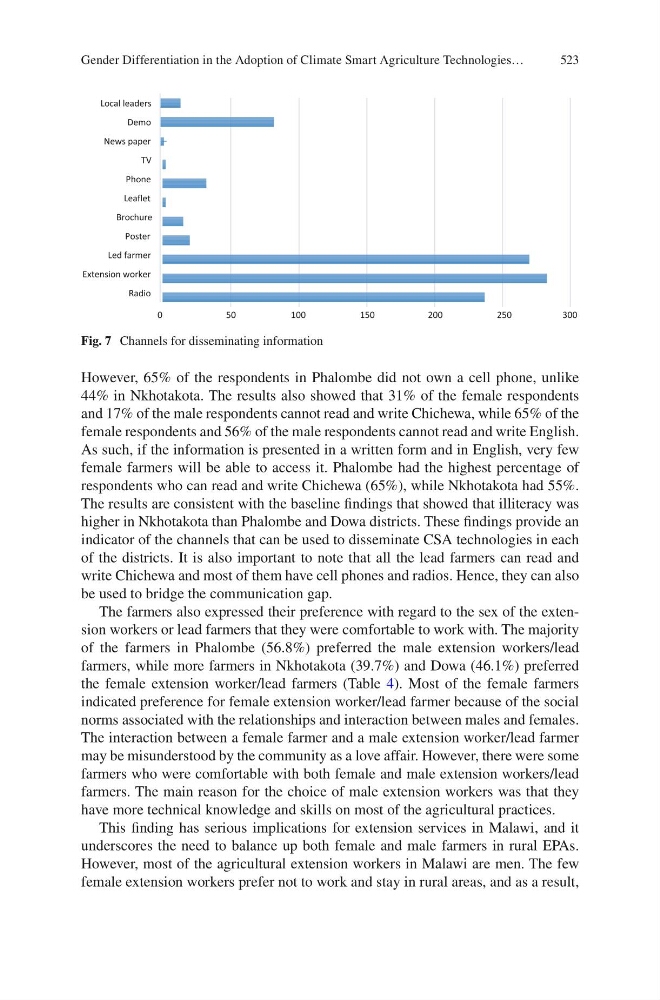
indicator of the channels that can be used to disseminate CSA technologies in each
of the districts. It is also important to note that all the lead farmers can read and
write Chichewa and most of them have cell phones and radios. Hence, they can also
be used to bridge the communication gap.
The farmers also expressed their preference with regard to the sex of the extension workers or lead farmers that they were comfortable to work with. The majority
of the farmers in Phalombe (56.8%) preferred the male extension workers/lead
farmers, while more farmers in Nkhotakota (39.7%) and Dowa (46.1%) preferred
the female extension worker/lead farmers (Table 4). Most of the female farmers
indicated preference for female extension worker/lead farmer because of the social
norms associated with the relationships and interaction between males and females.
The interaction between a female farmer and a male extension worker/lead farmer
may be misunderstood by the community as a love affair. However, there were some
farmers who were comfortable with both female and male extension workers/lead
farmers. The main reason for the choice of male extension workers was that they
have more technical knowledge and skills on most of the agricultural practices.
This finding has serious implications for extension services in Malawi, and it
underscores the need to balance up both female and male farmers in rural EPAs.
However, most of the agricultural extension workers in Malawi are men. The few
female extension workers prefer not to work and stay in rural areas, and as a result,
Fig. 7 Channels for disseminating information
Gender Differentiation in the Adoption of Climate Smart Agriculture Technologies…
However, 65% of the respondents in Phalombe did not own a cell phone, unlike
44% in Nkhotakota. The results also showed that 31% of the female respondents
and 17% of the male respondents cannot read and write Chichewa, while 65% of the
female respondents and 56% of the male respondents cannot read and write English.
As such, if the information is presented in a written form and in English, very few
female farmers will be able to access it. Phalombe had the highest percentage of
respondents who can read and write Chichewa (65%), while Nkhotakota had 55%.
The results are consistent with the baseline findings that showed that illiteracy was
higher in Nkhotakota than Phalombe and Dowa districts. These findings provide an
indicator of the channels that can be used to disseminate CSA technologies in each
of the districts. It is also important to note that all the lead farmers can read and
write Chichewa and most of them have cell phones and radios. Hence, they can also
be used to bridge the communication gap.
The farmers also expressed their preference with regard to the sex of the extension workers or lead farmers that they were comfortable to work with. The majority
of the farmers in Phalombe (56.8%) preferred the male extension workers/lead
farmers, while more farmers in Nkhotakota (39.7%) and Dowa (46.1%) preferred
the female extension worker/lead farmers (Table 4). Most of the female farmers
indicated preference for female extension worker/lead farmer because of the social
norms associated with the relationships and interaction between males and females.
The interaction between a female farmer and a male extension worker/lead farmer
may be misunderstood by the community as a love affair. However, there were some
farmers who were comfortable with both female and male extension workers/lead
farmers. The main reason for the choice of male extension workers was that they
have more technical knowledge and skills on most of the agricultural practices.
This finding has serious implications for extension services in Malawi, and it
underscores the need to balance up both female and male farmers in rural EPAs.
However, most of the agricultural extension workers in Malawi are men. The few
female extension workers prefer not to work and stay in rural areas, and as a result,
Fig. 7 Channels for disseminating information
Gender Differentiation in the Adoption of Climate Smart Agriculture Technologies…