

521
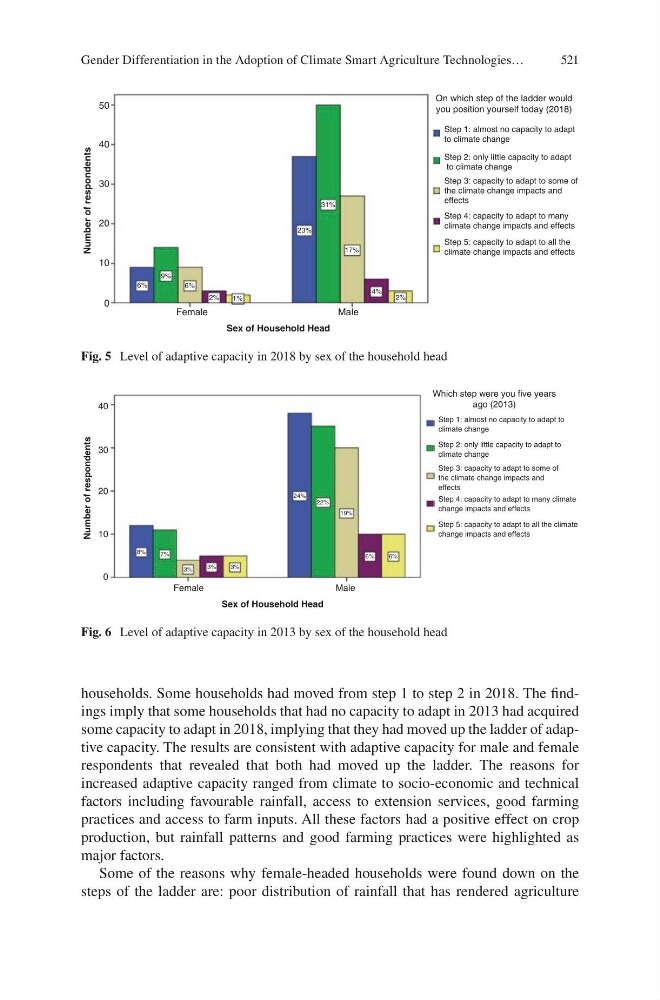
households. Some households had moved from step 1 to step 2 in 2018. The findings imply that some households that had no capacity to adapt in 2013 had acquired
some capacity to adapt in 2018, implying that they had moved up the ladder of adaptive capacity. The results are consistent with adaptive capacity for male and female
respondents that revealed that both had moved up the ladder. The reasons for
increased adaptive capacity ranged from climate to socio-economic and technical
factors including favourable rainfall, access to extension services, good farming
practices and access to farm inputs. All these factors had a positive effect on crop
production, but rainfall patterns and good farming practices were highlighted as
major factors.
Some of the reasons why female-headed households were found down on the
steps of the ladder are: poor distribution of rainfall that has rendered agriculture
40
50
30
20
10
0
Female
6%
9%
6%
2%
1%
23%
31%
17%
4%
2%
Male
On which step of the ladder would
you position yourself today (2018)
Step 1: almost no capacity to adapt
to climate change
Step 2: only little capacity to adapt
to climate change
Step 3: capacity to adapt to some of
the climate change impacts and
effects
Step 4: capacity to adapt to many
climate change impacts and effects
Step 5: capacity to adapt to all the
climate change impacts and effects
Sex of Household Head
Number of respondents
Fig. 5 Level of adaptive capacity in 2018 by sex of the household head
40
30
20
10
0
Female
8%
7%
3%
3%
3%
24%
22%
19%
6%
6%
Male
Which step were you five years
ago (2013)
Step 1: almost no capacity to adapt to
climate change
Step 2: only little capacity to adapt to
climate change
Step 3: capacity to adapt to some of
the climate change impacts and
effects
Step 4: capacity to adapt to many climate
change impacts and effects
Step 5: capacity to adapt to all the climate
change impacts and effects
Sex of Household Head
Number of respondents
Fig. 6 Level of adaptive capacity in 2013 by sex of the household head
Gender Differentiation in the Adoption of Climate Smart Agriculture Technologies…
households. Some households had moved from step 1 to step 2 in 2018. The findings imply that some households that had no capacity to adapt in 2013 had acquired
some capacity to adapt in 2018, implying that they had moved up the ladder of adaptive capacity. The results are consistent with adaptive capacity for male and female
respondents that revealed that both had moved up the ladder. The reasons for
increased adaptive capacity ranged from climate to socio-economic and technical
factors including favourable rainfall, access to extension services, good farming
practices and access to farm inputs. All these factors had a positive effect on crop
production, but rainfall patterns and good farming practices were highlighted as
major factors.
Some of the reasons why female-headed households were found down on the
steps of the ladder are: poor distribution of rainfall that has rendered agriculture
40
50
30
20
10
0
Female
6%
9%
6%
2%
1%
23%
31%
17%
4%
2%
Male
On which step of the ladder would
you position yourself today (2018)
Step 1: almost no capacity to adapt
to climate change
Step 2: only little capacity to adapt
to climate change
Step 3: capacity to adapt to some of
the climate change impacts and
effects
Step 4: capacity to adapt to many
climate change impacts and effects
Step 5: capacity to adapt to all the
climate change impacts and effects
Sex of Household Head
Number of respondents
Fig. 5 Level of adaptive capacity in 2018 by sex of the household head
40
30
20
10
0
Female
8%
7%
3%
3%
3%
24%
22%
19%
6%
6%
Male
Which step were you five years
ago (2013)
Step 1: almost no capacity to adapt to
climate change
Step 2: only little capacity to adapt to
climate change
Step 3: capacity to adapt to some of
the climate change impacts and
effects
Step 4: capacity to adapt to many climate
change impacts and effects
Step 5: capacity to adapt to all the climate
change impacts and effects
Sex of Household Head
Number of respondents
Fig. 6 Level of adaptive capacity in 2013 by sex of the household head
Gender Differentiation in the Adoption of Climate Smart Agriculture Technologies…