

515
decision-makers; however, decisions to adopt the new technologies are still constrained by the availability of resources for production. In a matrilineal society,
where women own land, men have control over the technologies to adopt because
they mainly have access to agricultural inputs and extension services. This implies
that as long as women lack means for agricultural production and productivity, men
will continue to control the decisions to adopt the technologies.
Prioritised agricultural technologies among male and female farmers in the three
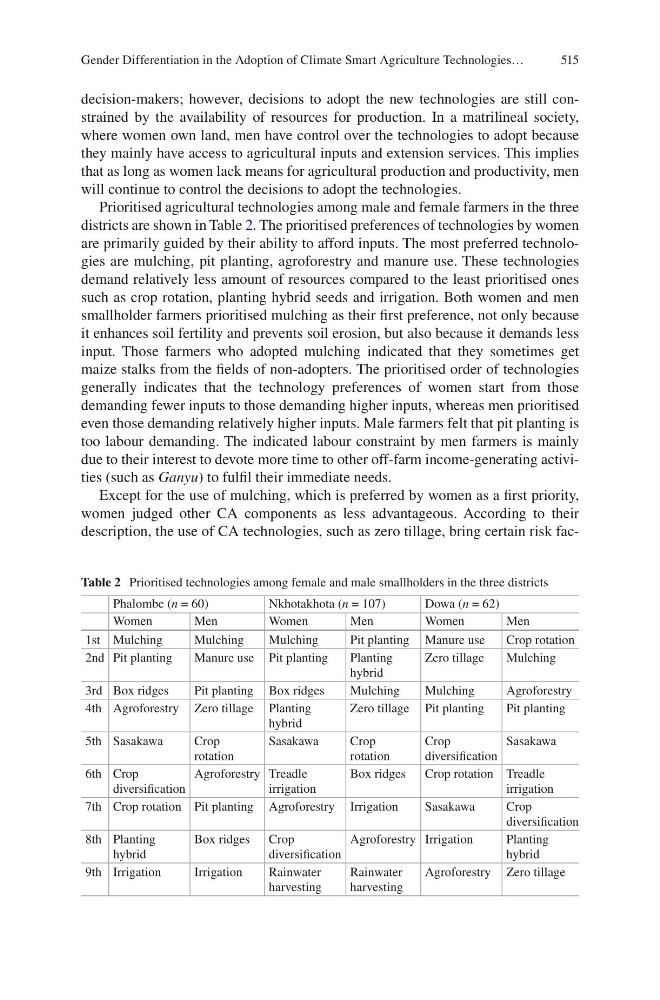
districts are shown in Table 2. The prioritised preferences of technologies by women
are primarily guided by their ability to afford inputs. The most preferred technologies are mulching, pit planting, agroforestry and manure use. These technologies
demand relatively less amount of resources compared to the least prioritised ones
such as crop rotation, planting hybrid seeds and irrigation. Both women and men
smallholder farmers prioritised mulching as their first preference, not only because
it enhances soil fertility and prevents soil erosion, but also because it demands less
input. Those farmers who adopted mulching indicated that they sometimes get
maize stalks from the fields of non-adopters. The prioritised order of technologies
generally indicates that the technology preferences of women start from those
demanding fewer inputs to those demanding higher inputs, whereas men prioritised
even those demanding relatively higher inputs. Male farmers felt that pit planting is
too labour demanding. The indicated labour constraint by men farmers is mainly
due to their interest to devote more time to other off-farm income-generating activities (such as Ganyu) to fulfil their immediate needs.
Except for the use of mulching, which is preferred by women as a first priority,
women judged other CA components as less advantageous. According to their
description, the use of CA technologies, such as zero tillage, bring certain risk facTable 2 Prioritised technologies among female and male smallholders in the three districts
Phalombe (n = 60)
Nkhotakhota (n = 107)
Dowa (n = 62)
Women
Men
Women
Men
Women
Men
1st Mulching
Mulching
Mulching
Pit planting Manure use
Crop rotation
2nd Pit planting
Manure use Pit planting
Planting
hybrid
Zero tillage
Mulching
3rd Box ridges
Pit planting Box ridges
Mulching
Mulching
Agroforestry
4th Agroforestry Zero tillage Planting
hybrid
Zero tillage Pit planting
Pit planting
5th Sasakawa
Crop
rotation
Sasakawa
Crop
rotation
Crop
diversification
Sasakawa
6th Crop
diversification
Agroforestry Treadle
irrigation
Box ridges
Crop rotation Treadle
irrigation
7th Crop rotation Pit planting Agroforestry Irrigation
Sasakawa
Crop
diversification
8th Planting
hybrid
Box ridges Crop
diversification
Agroforestry Irrigation
Planting
hybrid
9th Irrigation
Irrigation
Rainwater
harvesting
Rainwater
harvesting
Agroforestry Zero tillage
Gender Differentiation in the Adoption of Climate Smart Agriculture Technologies…
decision-makers; however, decisions to adopt the new technologies are still constrained by the availability of resources for production. In a matrilineal society,
where women own land, men have control over the technologies to adopt because
they mainly have access to agricultural inputs and extension services. This implies
that as long as women lack means for agricultural production and productivity, men
will continue to control the decisions to adopt the technologies.
Prioritised agricultural technologies among male and female farmers in the three
districts are shown in Table 2. The prioritised preferences of technologies by women
are primarily guided by their ability to afford inputs. The most preferred technologies are mulching, pit planting, agroforestry and manure use. These technologies
demand relatively less amount of resources compared to the least prioritised ones
such as crop rotation, planting hybrid seeds and irrigation. Both women and men
smallholder farmers prioritised mulching as their first preference, not only because
it enhances soil fertility and prevents soil erosion, but also because it demands less
input. Those farmers who adopted mulching indicated that they sometimes get
maize stalks from the fields of non-adopters. The prioritised order of technologies
generally indicates that the technology preferences of women start from those
demanding fewer inputs to those demanding higher inputs, whereas men prioritised
even those demanding relatively higher inputs. Male farmers felt that pit planting is
too labour demanding. The indicated labour constraint by men farmers is mainly
due to their interest to devote more time to other off-farm income-generating activities (such as Ganyu) to fulfil their immediate needs.
Except for the use of mulching, which is preferred by women as a first priority,
women judged other CA components as less advantageous. According to their
description, the use of CA technologies, such as zero tillage, bring certain risk facTable 2 Prioritised technologies among female and male smallholders in the three districts
Phalombe (n = 60)
Nkhotakhota (n = 107)
Dowa (n = 62)
Women
Men
Women
Men
Women
Men
1st Mulching
Mulching
Mulching
Pit planting Manure use
Crop rotation
2nd Pit planting
Manure use Pit planting
Planting
hybrid
Zero tillage
Mulching
3rd Box ridges
Pit planting Box ridges
Mulching
Mulching
Agroforestry
4th Agroforestry Zero tillage Planting
hybrid
Zero tillage Pit planting
Pit planting
5th Sasakawa
Crop
rotation
Sasakawa
Crop
rotation
Crop
diversification
Sasakawa
6th Crop
diversification
Agroforestry Treadle
irrigation
Box ridges
Crop rotation Treadle
irrigation
7th Crop rotation Pit planting Agroforestry Irrigation
Sasakawa
Crop
diversification
8th Planting
hybrid
Box ridges Crop
diversification
Agroforestry Irrigation
Planting
hybrid
9th Irrigation
Irrigation
Rainwater
harvesting
Rainwater
harvesting
Agroforestry Zero tillage
Gender Differentiation in the Adoption of Climate Smart Agriculture Technologies…