

513
ers do not afford the herbicides to complement the CA technology. Consequently, very
few adopt the technology. The results are consistent with other studies that found that
women continue to have low access to and control over the means of agricultural production, including agricultural inputs, improved technologies, extension services,
credit and land (Peterman et al. 2014; Goh 2012; Banda et al. 2011).
The discussions also revealed that male and female farmers’ preferences with regard
to the types of crops and technologies to adopt are influenced by the climatic conditions
of the area. Both female and male farmers in Phalombe preferred irrigation farming
because it allows them to plant rice twice a year. When rains fail or fall within a short
period of time, there is a serious shortage of water for irrigation because most rivers dry
up. When there is poor rainfall distribution or low precipitation, crops are likely to fail
because of reduced water access, as was the case during the survey in 2018.
Adoption of Climate Smart Agriculture Technologies Among Male
and Female Smallholder Farmers
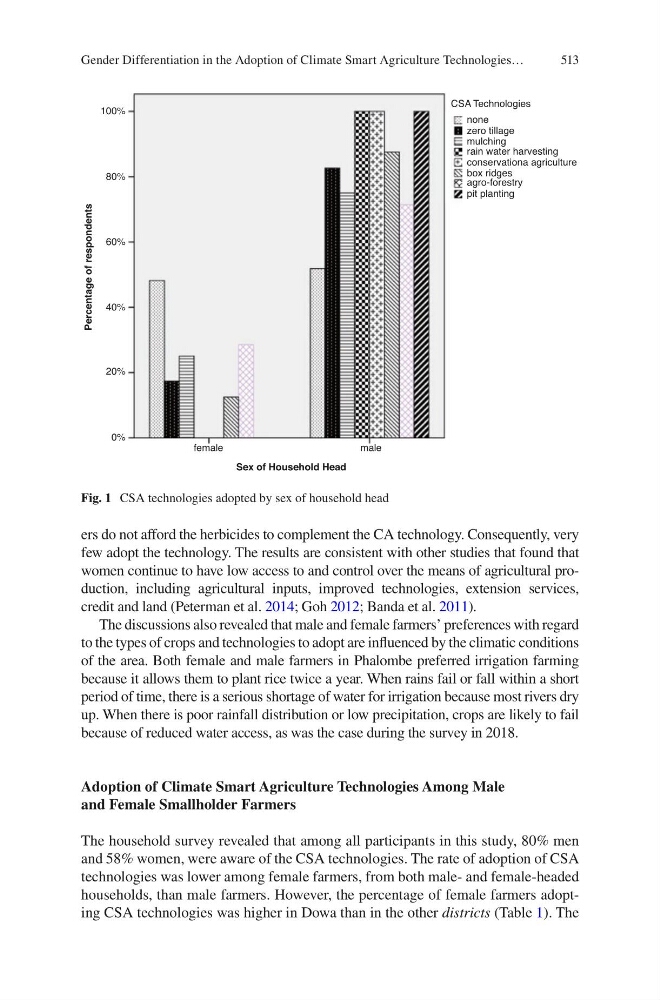
The household survey revealed that among all participants in this study, 80% men
and 58% women, were aware of the CSA technologies. The rate of adoption of CSA
technologies was lower among female farmers, from both male- and female-headed
households, than male farmers. However, the percentage of female farmers adopting CSA technologies was higher in Dowa than in the other districts (Table 1). The
80%
100%
60%
40%
20%
0%
female
male
Sex of Household Head
Percentage of respondents
CSA Technologies
none
zero tillage
mulching
rain water harvesting
conservationa agriculture
box ridges
agro-forestry
pit planting
Fig. 1 CSA technologies adopted by sex of household head
Gender Differentiation in the Adoption of Climate Smart Agriculture Technologies…
ers do not afford the herbicides to complement the CA technology. Consequently, very
few adopt the technology. The results are consistent with other studies that found that
women continue to have low access to and control over the means of agricultural production, including agricultural inputs, improved technologies, extension services,
credit and land (Peterman et al. 2014; Goh 2012; Banda et al. 2011).
The discussions also revealed that male and female farmers’ preferences with regard
to the types of crops and technologies to adopt are influenced by the climatic conditions
of the area. Both female and male farmers in Phalombe preferred irrigation farming
because it allows them to plant rice twice a year. When rains fail or fall within a short
period of time, there is a serious shortage of water for irrigation because most rivers dry
up. When there is poor rainfall distribution or low precipitation, crops are likely to fail
because of reduced water access, as was the case during the survey in 2018.
Adoption of Climate Smart Agriculture Technologies Among Male
and Female Smallholder Farmers
The household survey revealed that among all participants in this study, 80% men
and 58% women, were aware of the CSA technologies. The rate of adoption of CSA
technologies was lower among female farmers, from both male- and female-headed
households, than male farmers. However, the percentage of female farmers adopting CSA technologies was higher in Dowa than in the other districts (Table 1). The
80%
100%
60%
40%
20%
0%
female
male
Sex of Household Head
Percentage of respondents
CSA Technologies
none
zero tillage
mulching
rain water harvesting
conservationa agriculture
box ridges
agro-forestry
pit planting
Fig. 1 CSA technologies adopted by sex of household head
Gender Differentiation in the Adoption of Climate Smart Agriculture Technologies…