

480
3.3 Morphological and Biochemical Characteristics
of Rhizobia Isolates
A large diversity of 22 nodule isolate groups were obtained from the greenhouse
trapping experiment. The rhizobia isolates were characterized based on their growth
characteristics in YEMA plain medium, YEMA with Congo red and YEMA with
bromothymol blue. The colony elevation was convex, domed or flat. The colony
consistency was either dry, mucoid firm gummy or mucoid soft gummy for colonies
with excessive extracellular polysaccharide (EPS) production. Colony appearance
was opaque, translucent or transparent. The colour was white, creamy and watery
(Table 3). The nature of growth was confluent and shiny for all isolates. Only group
i isolates were dry and opaque (Table 3).
Bromothymol Blue (BTB), YEMA and Congo Red Reaction
of the Rhizobia Isolates
The native rhizobia isolates groups i, x, xvii, xviii and xxii turned BTB blue and were
considered as alkaline producers and slow growers (Ondieki et al. 2017), while all
the other groups acidified the media containing BTB turning it to yellow, a characteristic of fast-growing rhizobia (Jida and Assefa 2011). None of the nodule isolates
absorbed Congo red when grown in YEMA media containing Congo red stain. Pure
nodule isolate groups ii, iv, vii, ix, xii, xiv, xv and xx produced purple pigmentation
on the media, while groups v, xi, xiii, xvii, xviii, xxi and xxii had pink colonies in
YEMA media with Congo red (Table 3). A distinctive characteristic of rhizobia is
their inability to absorb Congo red. However, some species of rhizobia may absorb
-1.0
1.0
-0.4
1.0
pH
SOM
N
Av.P
K
Ca
Na
NodlNumb
NodDryWe
ShoDryWe
RooDryWe
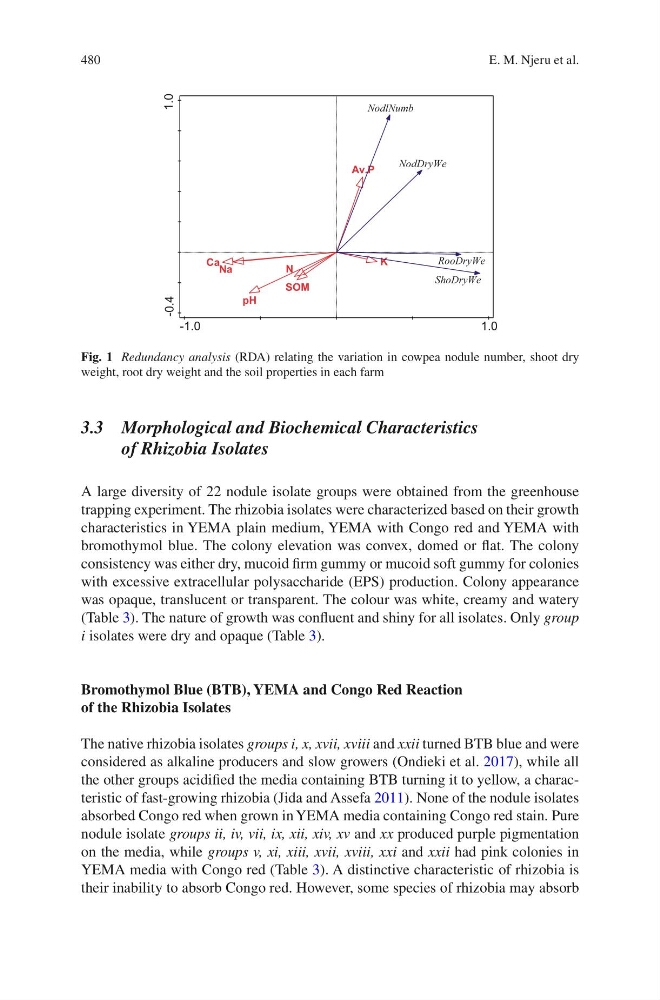
Fig. 1 Redundancy analysis (RDA) relating the variation in cowpea nodule number, shoot dry
weight, root dry weight and the soil properties in each farm
E. M. Njeru et al.
3.3 Morphological and Biochemical Characteristics
of Rhizobia Isolates
A large diversity of 22 nodule isolate groups were obtained from the greenhouse
trapping experiment. The rhizobia isolates were characterized based on their growth
characteristics in YEMA plain medium, YEMA with Congo red and YEMA with
bromothymol blue. The colony elevation was convex, domed or flat. The colony
consistency was either dry, mucoid firm gummy or mucoid soft gummy for colonies
with excessive extracellular polysaccharide (EPS) production. Colony appearance
was opaque, translucent or transparent. The colour was white, creamy and watery
(Table 3). The nature of growth was confluent and shiny for all isolates. Only group
i isolates were dry and opaque (Table 3).
Bromothymol Blue (BTB), YEMA and Congo Red Reaction
of the Rhizobia Isolates
The native rhizobia isolates groups i, x, xvii, xviii and xxii turned BTB blue and were
considered as alkaline producers and slow growers (Ondieki et al. 2017), while all
the other groups acidified the media containing BTB turning it to yellow, a characteristic of fast-growing rhizobia (Jida and Assefa 2011). None of the nodule isolates
absorbed Congo red when grown in YEMA media containing Congo red stain. Pure
nodule isolate groups ii, iv, vii, ix, xii, xiv, xv and xx produced purple pigmentation
on the media, while groups v, xi, xiii, xvii, xviii, xxi and xxii had pink colonies in
YEMA media with Congo red (Table 3). A distinctive characteristic of rhizobia is
their inability to absorb Congo red. However, some species of rhizobia may absorb
-1.0
1.0
-0.4
1.0
pH
SOM
N
Av.P
K
Ca
Na
NodlNumb
NodDryWe
ShoDryWe
RooDryWe
Fig. 1 Redundancy analysis (RDA) relating the variation in cowpea nodule number, shoot dry
weight, root dry weight and the soil properties in each farm
E. M. Njeru et al.