

402
Feed for livestock production currently accounts for one-third of the global cropland (FAO 2019b), competing for land, water, energy and labour. The vagaries of
climate change and socio-economic pressures make the production of animal feedstuffs increasingly challenging.
Increasing productivity and more efficient use of inputs throughout the whole
livestock sector will be fundamental to meet the growing demand for quality livestock products while minimising its impact on the environment and the world’s
natural resources (FAO 2019b). For small- to medium-scale livestock production
systems, increased productivity is currently constrained by skill level, knowledge
and appropriate technologies, compounded by insufficient access to markets, goods
and services and weak institutions. The result is that both production and productivity remain well below potential, and losses and wastage can be high. However,
adapted breeds, local feed resources and animal health interventions are available,
along with improved and adapted technologies that include sound animal husbandry, on- and off-farm product preservation and value-adding product processing.
When combined with supportive policies and institutional development in respective countries, innovative technologies may substantially improve productivity and
income generation and contribute to poverty reduction (FAO 2019a).
The importance of ruminants is highlighted by the fact that Tanzania has 50 million inhabitants, 26 million cattle, 17 million goats and nine million sheep (FAO
2019c). Kurwijila and Boki (2003) estimated that only 2.7% of livestock are dairy
animals, mostly crossbreeds. The country has the third largest cattle population in
Africa after Ethiopia and Sudan. About 90% of the livestock population is of indigenous types, known for their low genetic potential in milk and meat production
(Agricultural Sector Development Program 2016). The animals are kept under pastoral systems and are dispersed in most rangelands of the country. The method
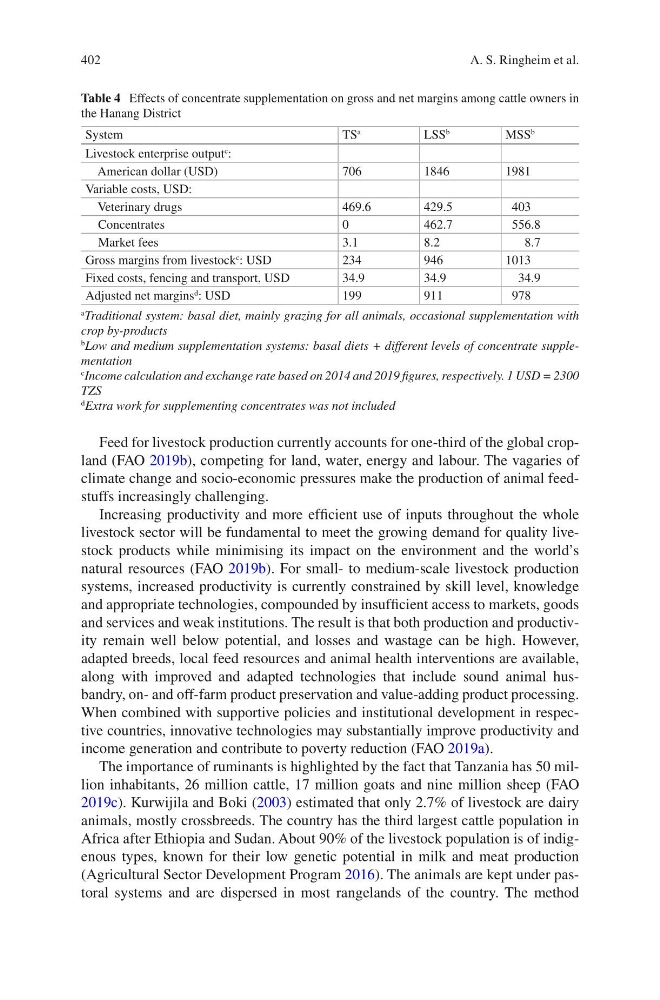
Table 4 Effects of concentrate supplementation on gross and net margins among cattle owners in
the Hanang District
System
TS
a
LSS
b
MSS
b
Livestock enterprise output
c
:
American dollar (USD)
706
1846
1981
Variable costs, USD:
Veterinary drugs
469.6
429.5
403
Concentrates
0
462.7
556.8
Market fees
3.1
8.2
8.7
Gross margins from livestock
c
: USD
234
946
1013
Fixed costs, fencing and transport, USD
34.9
34.9
34.9
Adjusted net margins
d : USD
199
911
978
a Traditional system: basal diet, mainly grazing for all animals, occasional supplementation with
crop by-products
b
Low and medium supplementation systems: basal diets + different levels of concentrate supplementation
c Income calculation and exchange rate based on 2014 and 2019 figures, respectively. 1 USD = 2300
TZS
d
Extra work for supplementing concentrates was not included
A. S. Ringheim et al.
Feed for livestock production currently accounts for one-third of the global cropland (FAO 2019b), competing for land, water, energy and labour. The vagaries of
climate change and socio-economic pressures make the production of animal feedstuffs increasingly challenging.
Increasing productivity and more efficient use of inputs throughout the whole
livestock sector will be fundamental to meet the growing demand for quality livestock products while minimising its impact on the environment and the world’s
natural resources (FAO 2019b). For small- to medium-scale livestock production
systems, increased productivity is currently constrained by skill level, knowledge
and appropriate technologies, compounded by insufficient access to markets, goods
and services and weak institutions. The result is that both production and productivity remain well below potential, and losses and wastage can be high. However,
adapted breeds, local feed resources and animal health interventions are available,
along with improved and adapted technologies that include sound animal husbandry, on- and off-farm product preservation and value-adding product processing.
When combined with supportive policies and institutional development in respective countries, innovative technologies may substantially improve productivity and
income generation and contribute to poverty reduction (FAO 2019a).
The importance of ruminants is highlighted by the fact that Tanzania has 50 million inhabitants, 26 million cattle, 17 million goats and nine million sheep (FAO
2019c). Kurwijila and Boki (2003) estimated that only 2.7% of livestock are dairy
animals, mostly crossbreeds. The country has the third largest cattle population in
Africa after Ethiopia and Sudan. About 90% of the livestock population is of indigenous types, known for their low genetic potential in milk and meat production
(Agricultural Sector Development Program 2016). The animals are kept under pastoral systems and are dispersed in most rangelands of the country. The method
Table 4 Effects of concentrate supplementation on gross and net margins among cattle owners in
the Hanang District
System
TS
a
LSS
b
MSS
b
Livestock enterprise output
c
:
American dollar (USD)
706
1846
1981
Variable costs, USD:
Veterinary drugs
469.6
429.5
403
Concentrates
0
462.7
556.8
Market fees
3.1
8.2
8.7
Gross margins from livestock
c
: USD
234
946
1013
Fixed costs, fencing and transport, USD
34.9
34.9
34.9
Adjusted net margins
d : USD
199
911
978
a Traditional system: basal diet, mainly grazing for all animals, occasional supplementation with
crop by-products
b
Low and medium supplementation systems: basal diets + different levels of concentrate supplementation
c Income calculation and exchange rate based on 2014 and 2019 figures, respectively. 1 USD = 2300
TZS
d
Extra work for supplementing concentrates was not included
A. S. Ringheim et al.