

386
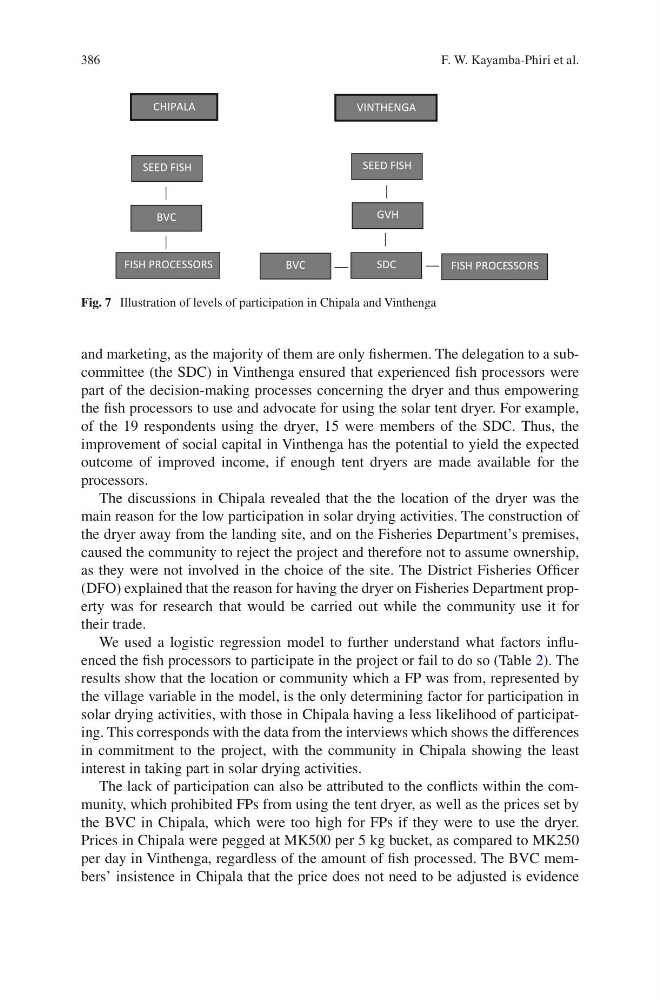
and marketing, as the majority of them are only fishermen. The delegation to a subcommittee (the SDC) in Vinthenga ensured that experienced fish processors were
part of the decision-making processes concerning the dryer and thus empowering
the fish processors to use and advocate for using the solar tent dryer. For example,
of the 19 respondents using the dryer, 15 were members of the SDC. Thus, the
improvement of social capital in Vinthenga has the potential to yield the expected
outcome of improved income, if enough tent dryers are made available for the
processors.
The discussions in Chipala revealed that the the location of the dryer was the
main reason for the low participation in solar drying activities. The construction of
the dryer away from the landing site, and on the Fisheries Department’s premises,
caused the community to reject the project and therefore not to assume ownership,
as they were not involved in the choice of the site. The District Fisheries Officer
(DFO) explained that the reason for having the dryer on Fisheries Department property was for research that would be carried out while the community use it for
their trade.
We used a logistic regression model to further understand what factors influenced the fish processors to participate in the project or fail to do so (Table 2). The
results show that the location or community which a FP was from, represented by
the village variable in the model, is the only determining factor for participation in
solar drying activities, with those in Chipala having a less likelihood of participating. This corresponds with the data from the interviews which shows the differences
in commitment to the project, with the community in Chipala showing the least
interest in taking part in solar drying activities.
The lack of participation can also be attributed to the conflicts within the community, which prohibited FPs from using the tent dryer, as well as the prices set by
the BVC in Chipala, which were too high for FPs if they were to use the dryer.
Prices in Chipala were pegged at MK500 per 5 kg bucket, as compared to MK250
per day in Vinthenga, regardless of the amount of fish processed. The BVC members’ insistence in Chipala that the price does not need to be adjusted is evidence
Fig. 7 Illustration of levels of participation in Chipala and Vinthenga
SEED FISH
BVC
FISH PROCESSORS
SEED FISH
GVH
BVC
SDC
FISH PROCESSORS
VINTHENGA
CHIPALA
F. W. Kayamba-Phiri et al.
and marketing, as the majority of them are only fishermen. The delegation to a subcommittee (the SDC) in Vinthenga ensured that experienced fish processors were
part of the decision-making processes concerning the dryer and thus empowering
the fish processors to use and advocate for using the solar tent dryer. For example,
of the 19 respondents using the dryer, 15 were members of the SDC. Thus, the
improvement of social capital in Vinthenga has the potential to yield the expected
outcome of improved income, if enough tent dryers are made available for the
processors.
The discussions in Chipala revealed that the the location of the dryer was the
main reason for the low participation in solar drying activities. The construction of
the dryer away from the landing site, and on the Fisheries Department’s premises,
caused the community to reject the project and therefore not to assume ownership,
as they were not involved in the choice of the site. The District Fisheries Officer
(DFO) explained that the reason for having the dryer on Fisheries Department property was for research that would be carried out while the community use it for
their trade.
We used a logistic regression model to further understand what factors influenced the fish processors to participate in the project or fail to do so (Table 2). The
results show that the location or community which a FP was from, represented by
the village variable in the model, is the only determining factor for participation in
solar drying activities, with those in Chipala having a less likelihood of participating. This corresponds with the data from the interviews which shows the differences
in commitment to the project, with the community in Chipala showing the least
interest in taking part in solar drying activities.
The lack of participation can also be attributed to the conflicts within the community, which prohibited FPs from using the tent dryer, as well as the prices set by
the BVC in Chipala, which were too high for FPs if they were to use the dryer.
Prices in Chipala were pegged at MK500 per 5 kg bucket, as compared to MK250
per day in Vinthenga, regardless of the amount of fish processed. The BVC members’ insistence in Chipala that the price does not need to be adjusted is evidence
Fig. 7 Illustration of levels of participation in Chipala and Vinthenga
SEED FISH
BVC
FISH PROCESSORS
SEED FISH
GVH
BVC
SDC
FISH PROCESSORS
VINTHENGA
CHIPALA
F. W. Kayamba-Phiri et al.