

384
The fish processors stated that the village banks serve as safety nets when they
have lost their capital from their processing business. The money saved in the village banks was mainly from their fish processing business. They however expressed
the desire for microfinance institutions where they could access bigger loans to
invest in other businesses, as an alternative to fish processing, especially when fish
is scarce.
A ‘savings culture’ rarely exists in fishing communities due to two main factors.
First, there is a perception that fish is in abundance in the lake if money is needed,
which is a culture element. Secondly, options to save through financial organizations are limited (Ardjosoediro and Neven 2008). Though there are microfinance
opportunities, the options available in the two communities are few and designed
for communities or individuals with small incomes, whereas FPs desire access to
bigger loans to invest in their enterprise, as well as potentially invest in more solar
tent dryers. The average income in the sample, of about half the population of FPs,
was MK 67,328.28. Although village banks serve to protect rural communities from
taking out big loans and thus failure to repay, the regulations require that persons are
restricted to a certain share and loan limit.
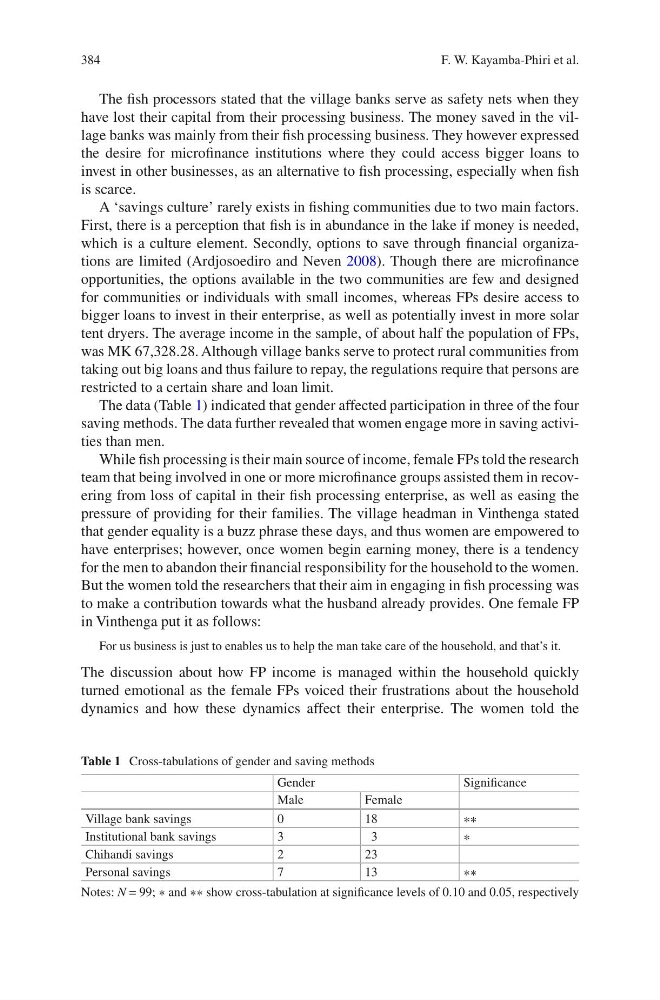
The data (Table 1) indicated that gender affected participation in three of the four
saving methods. The data further revealed that women engage more in saving activities than men.
While fish processing is their main source of income, female FPs told the research
team that being involved in one or more microfinance groups assisted them in recovering from loss of capital in their fish processing enterprise, as well as easing the
pressure of providing for their families. The village headman in Vinthenga stated
that gender equality is a buzz phrase these days, and thus women are empowered to
have enterprises; however, once women begin earning money, there is a tendency
for the men to abandon their financial responsibility for the household to the women.
But the women told the researchers that their aim in engaging in fish processing was
to make a contribution towards what the husband already provides. One female FP
in Vinthenga put it as follows:
For us business is just to enables us to help the man take care of the household, and that’s it.
The discussion about how FP income is managed within the household quickly
turned emotional as the female FPs voiced their frustrations about the household
dynamics and how these dynamics affect their enterprise. The women told the
Table 1 Cross-tabulations of gender and saving methods
Gender
Significance
Male
Female
Village bank savings
0
18
∗∗
Institutional bank savings
3
3
∗
Chihandi savings
2
23
Personal savings
7
13
∗∗
Notes: N = 99; ∗ and ∗∗ show cross-tabulation at significance levels of 0.10 and 0.05, respectively
F. W. Kayamba-Phiri et al.
The fish processors stated that the village banks serve as safety nets when they
have lost their capital from their processing business. The money saved in the village banks was mainly from their fish processing business. They however expressed
the desire for microfinance institutions where they could access bigger loans to
invest in other businesses, as an alternative to fish processing, especially when fish
is scarce.
A ‘savings culture’ rarely exists in fishing communities due to two main factors.
First, there is a perception that fish is in abundance in the lake if money is needed,
which is a culture element. Secondly, options to save through financial organizations are limited (Ardjosoediro and Neven 2008). Though there are microfinance
opportunities, the options available in the two communities are few and designed
for communities or individuals with small incomes, whereas FPs desire access to
bigger loans to invest in their enterprise, as well as potentially invest in more solar
tent dryers. The average income in the sample, of about half the population of FPs,
was MK 67,328.28. Although village banks serve to protect rural communities from
taking out big loans and thus failure to repay, the regulations require that persons are
restricted to a certain share and loan limit.
The data (Table 1) indicated that gender affected participation in three of the four
saving methods. The data further revealed that women engage more in saving activities than men.
While fish processing is their main source of income, female FPs told the research
team that being involved in one or more microfinance groups assisted them in recovering from loss of capital in their fish processing enterprise, as well as easing the
pressure of providing for their families. The village headman in Vinthenga stated
that gender equality is a buzz phrase these days, and thus women are empowered to
have enterprises; however, once women begin earning money, there is a tendency
for the men to abandon their financial responsibility for the household to the women.
But the women told the researchers that their aim in engaging in fish processing was
to make a contribution towards what the husband already provides. One female FP
in Vinthenga put it as follows:
For us business is just to enables us to help the man take care of the household, and that’s it.
The discussion about how FP income is managed within the household quickly
turned emotional as the female FPs voiced their frustrations about the household
dynamics and how these dynamics affect their enterprise. The women told the
Table 1 Cross-tabulations of gender and saving methods
Gender
Significance
Male
Female
Village bank savings
0
18
∗∗
Institutional bank savings
3
3
∗
Chihandi savings
2
23
Personal savings
7
13
∗∗
Notes: N = 99; ∗ and ∗∗ show cross-tabulation at significance levels of 0.10 and 0.05, respectively
F. W. Kayamba-Phiri et al.