

383
female participants were similar, and they seemed to be inspired by the general male
perspective about the women’s role and limitations in fisheries. The women reiterated what the men had stated: that a woman cannot be a fisher. The women went
further to explain that from what they hear their husbands narrating about their fishing experiences, they are sure they cannot go through it. This discourse is acculturated in the beliefs of both men and women, so much that examples of women who
fish are unbelievable and unwelcome. Because recurring instances show the vulnerability of women on the lake, such as women drowning and men surviving, women
are convinced that they cannot fish. Thus, the fishing activities that males and
females adopt in the fish value chain become their identity, and transformation of
such roles in the future is a challenge (Thompson et al. 1983).
Men who are fishers will sometimes contribute to the necessities in the household, but most times they will not do so on the basis that the wife has income from
her FP business to take care of the household. Women decide how to spend the
money from their business. From their FP income, the women buy most necessities
for the household, as well as housing materials and education expenses such as
tuition fees and school uniform. Thus, as explained:
When the fish processing business is not going well, then there are serious problems in the
household. Female participant, solar drying FGD, Vinthenga
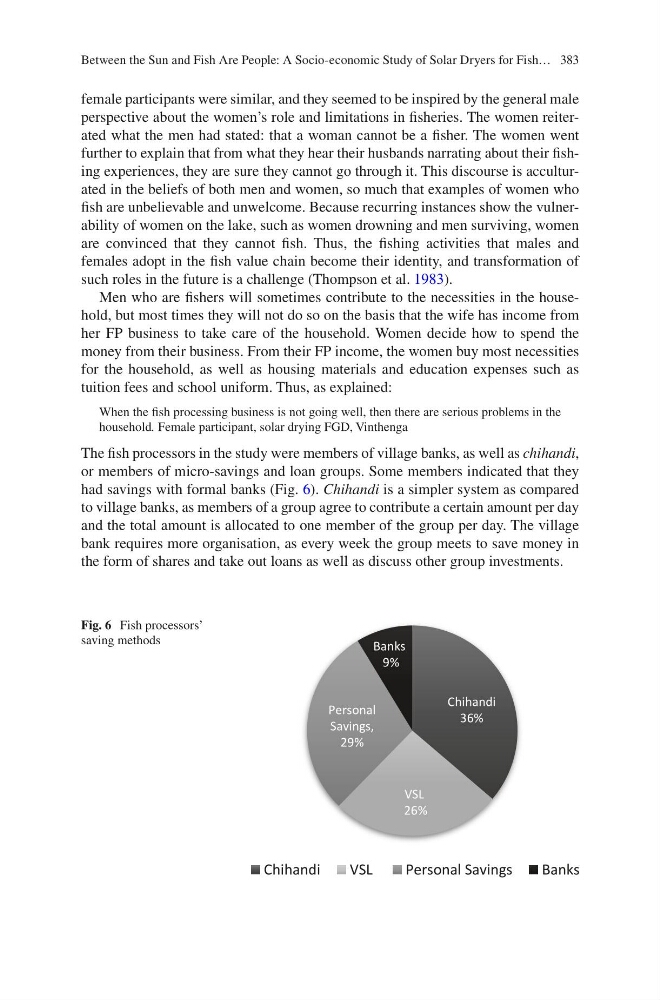
The fish processors in the study were members of village banks, as well as chihandi,
or members of micro-savings and loan groups. Some members indicated that they
had savings with formal banks (Fig. 6). Chihandi is a simpler system as compared
to village banks, as members of a group agree to contribute a certain amount per day
and the total amount is allocated to one member of the group per day. The village
bank requires more organisation, as every week the group meets to save money in
the form of shares and take out loans as well as discuss other group investments.
Banks
9%
Personal
Savings,
29%
VSL
26%
Chihandi
36%
Fig. 6 Fish processors’
saving methods
Between the Sun and Fish Are People: A Socio-economic Study of Solar Dryers for Fish…
female participants were similar, and they seemed to be inspired by the general male
perspective about the women’s role and limitations in fisheries. The women reiterated what the men had stated: that a woman cannot be a fisher. The women went
further to explain that from what they hear their husbands narrating about their fishing experiences, they are sure they cannot go through it. This discourse is acculturated in the beliefs of both men and women, so much that examples of women who
fish are unbelievable and unwelcome. Because recurring instances show the vulnerability of women on the lake, such as women drowning and men surviving, women
are convinced that they cannot fish. Thus, the fishing activities that males and
females adopt in the fish value chain become their identity, and transformation of
such roles in the future is a challenge (Thompson et al. 1983).
Men who are fishers will sometimes contribute to the necessities in the household, but most times they will not do so on the basis that the wife has income from
her FP business to take care of the household. Women decide how to spend the
money from their business. From their FP income, the women buy most necessities
for the household, as well as housing materials and education expenses such as
tuition fees and school uniform. Thus, as explained:
When the fish processing business is not going well, then there are serious problems in the
household. Female participant, solar drying FGD, Vinthenga
The fish processors in the study were members of village banks, as well as chihandi,
or members of micro-savings and loan groups. Some members indicated that they
had savings with formal banks (Fig. 6). Chihandi is a simpler system as compared
to village banks, as members of a group agree to contribute a certain amount per day
and the total amount is allocated to one member of the group per day. The village
bank requires more organisation, as every week the group meets to save money in
the form of shares and take out loans as well as discuss other group investments.
Banks
9%
Personal
Savings,
29%
VSL
26%
Chihandi
36%
Fig. 6 Fish processors’
saving methods
Between the Sun and Fish Are People: A Socio-economic Study of Solar Dryers for Fish…