

352
Personal transformation with examples of wisdom traditions is studied at universities specializing in mindfulness and contemplative education, such as Naropa
University,
1
where the concept of mindfulness is used in the context of the environment and natural resource management. Mindfulness is defined as a psychological
quality of being attentive to the present experience on a moment-to-moment basis
(Kabat-Zinn 2009). Based on the wisdom traditions of noetic sciences, mindfulness
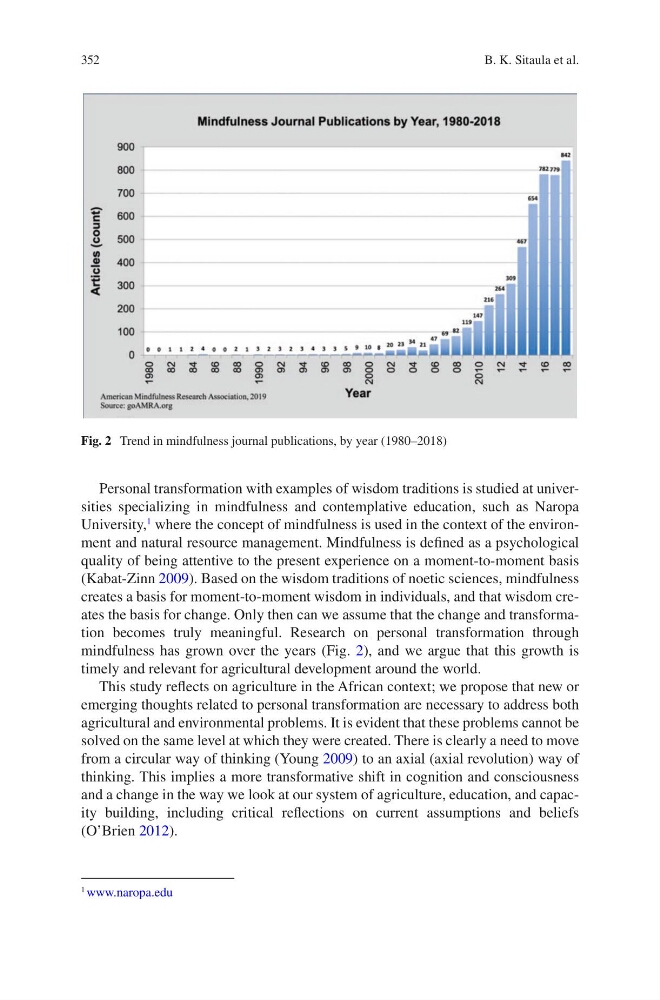
creates a basis for moment-to-moment wisdom in individuals, and that wisdom creates the basis for change. Only then can we assume that the change and transformation becomes truly meaningful. Research on personal transformation through
mindfulness has grown over the years (Fig. 2), and we argue that this growth is
timely and relevant for agricultural development around the world.
This study reflects on agriculture in the African context; we propose that new or
emerging thoughts related to personal transformation are necessary to address both
agricultural and environmental problems. It is evident that these problems cannot be
solved on the same level at which they were created. There is clearly a need to move
from a circular way of thinking (Young 2009) to an axial (axial revolution) way of
thinking. This implies a more transformative shift in cognition and consciousness
and a change in the way we look at our system of agriculture, education, and capacity building, including critical reflections on current assumptions and beliefs
(O’Brien 2012).
1 www.naropa.edu
Fig. 2 Trend in mindfulness journal publications, by year (1980–2018)
B. K. Sitaula et al.
Personal transformation with examples of wisdom traditions is studied at universities specializing in mindfulness and contemplative education, such as Naropa
University,
1
where the concept of mindfulness is used in the context of the environment and natural resource management. Mindfulness is defined as a psychological
quality of being attentive to the present experience on a moment-to-moment basis
(Kabat-Zinn 2009). Based on the wisdom traditions of noetic sciences, mindfulness
creates a basis for moment-to-moment wisdom in individuals, and that wisdom creates the basis for change. Only then can we assume that the change and transformation becomes truly meaningful. Research on personal transformation through
mindfulness has grown over the years (Fig. 2), and we argue that this growth is
timely and relevant for agricultural development around the world.
This study reflects on agriculture in the African context; we propose that new or
emerging thoughts related to personal transformation are necessary to address both
agricultural and environmental problems. It is evident that these problems cannot be
solved on the same level at which they were created. There is clearly a need to move
from a circular way of thinking (Young 2009) to an axial (axial revolution) way of
thinking. This implies a more transformative shift in cognition and consciousness
and a change in the way we look at our system of agriculture, education, and capacity building, including critical reflections on current assumptions and beliefs
(O’Brien 2012).
1 www.naropa.edu
Fig. 2 Trend in mindfulness journal publications, by year (1980–2018)
B. K. Sitaula et al.