

351
Transformative wisdom is required for humanity to deal effectively and ethically
with the challenges and opportunities that are being presented before us. Wisdom is
tentatively defined as a deep understanding of people, things, events, or situations
that result in the ability to act to consistently produce optimum results using a minimum of time and energy. It also has a broad meaning in a spiritual context, which
involves seeing things clearly (as they are); acting in prudent and effective ways
with the well-being of ‘the whole’ in mind; knowing when to act and when not to
act; being able to handle whatever arises with peace of mind and an effective, compassionate, holistic response; and being able to anticipate and avoid potential problems. In order to reach this level of wisdom, we need to boost our emotional balance
and develop an open mental attitude, i.e. bring about a shift in cognition and
consciousness.
In our educational processes, we were not equipped to realize the connection
between what we experience (as first-person experiences) and deeper connectivity
with everything else, key to life and our well-being. We propose that science needs
to be developed in a way that creates linkages between the environment (where the
source of both well-being and stress lie), human well-being, human existence and
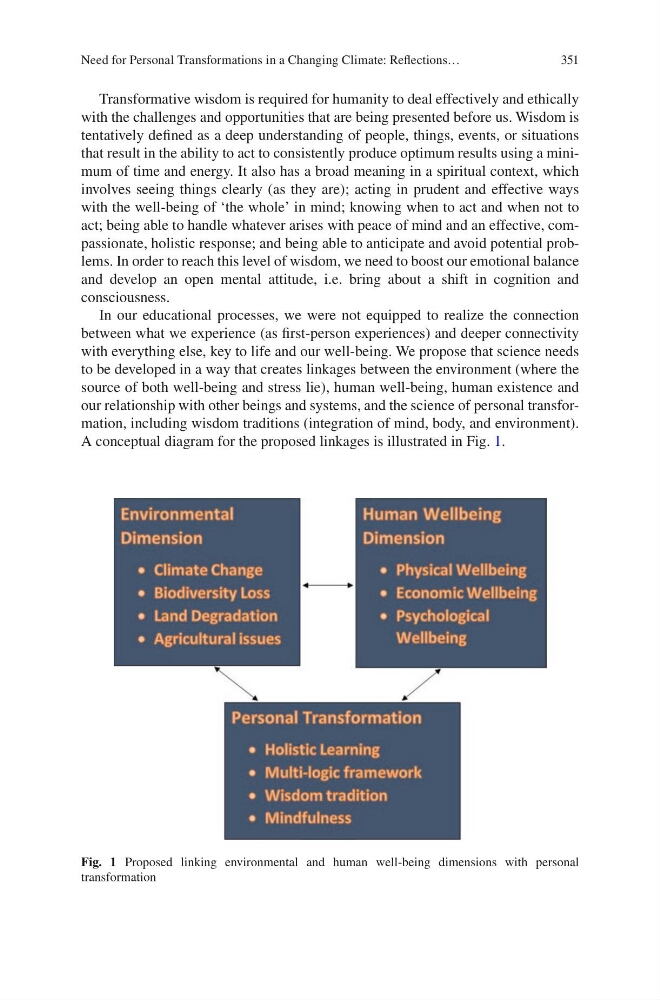
our relationship with other beings and systems, and the science of personal transformation, including wisdom traditions (integration of mind, body, and environment).
A conceptual diagram for the proposed linkages is illustrated in Fig. 1.
Fig. 1 Proposed linking environmental and human well-being dimensions with personal
transformation
Need for Personal Transformations in a Changing Climate: Reflections…
Transformative wisdom is required for humanity to deal effectively and ethically
with the challenges and opportunities that are being presented before us. Wisdom is
tentatively defined as a deep understanding of people, things, events, or situations
that result in the ability to act to consistently produce optimum results using a minimum of time and energy. It also has a broad meaning in a spiritual context, which
involves seeing things clearly (as they are); acting in prudent and effective ways
with the well-being of ‘the whole’ in mind; knowing when to act and when not to
act; being able to handle whatever arises with peace of mind and an effective, compassionate, holistic response; and being able to anticipate and avoid potential problems. In order to reach this level of wisdom, we need to boost our emotional balance
and develop an open mental attitude, i.e. bring about a shift in cognition and
consciousness.
In our educational processes, we were not equipped to realize the connection
between what we experience (as first-person experiences) and deeper connectivity
with everything else, key to life and our well-being. We propose that science needs
to be developed in a way that creates linkages between the environment (where the
source of both well-being and stress lie), human well-being, human existence and
our relationship with other beings and systems, and the science of personal transformation, including wisdom traditions (integration of mind, body, and environment).
A conceptual diagram for the proposed linkages is illustrated in Fig. 1.
Fig. 1 Proposed linking environmental and human well-being dimensions with personal
transformation
Need for Personal Transformations in a Changing Climate: Reflections…