

309
meat (17,800 tons) exported. Furthermore, the exports of meat, live animals, and
animal products increased in importance from 11% of the total value of exports in
2004/2005 to 13% in 2015 (NBE 2017).
About 90% of the meat export comes from goat meat, whereas the over 60% of
the live animal export comes from the export of cattle. The meat export is mainly
dominated by chilled carcasses of sheep and goats. The main destination (about
95%) of meat export goes to United Arab Emirates (UAE) and Kingdom of Saudi
Arabia (KSA), where the main customers are the low- to medium-income
communities.
In addition to the influence on live animal and meat export, the SPS-LMM
Program served as a gateway for investment attraction to the livestock sector. This
has attracted more foreign and domestic investors in feedlots and meat industry sector. A typical example of such development is the vertically integrated Verde Beef
that integrates feed production, feedlot operation, slaughter services, and meat processing with higher capacity for increasing the volume and quality of meat exported.
During the life of the Program, Ethiopia rapidly expanded its exports to traditional markets such as KSA, UAE, and Egypt while also diversifying into new markets. Between 2006 and 2011, Turkey, Jordan, Vietnam, China, Kuwait, Oman,
Qatar, Angola, and Comoros imported Ethiopian meat products for the first time.
During the same period, Bahrain, Kuwait, Oman, and Lebanon officially imported
Ethiopian live animals for the first time. Some of these new importing countries
rapidly ramped up volumes, such as Turkey, which became the third largest importer
of Ethiopian meat products after the UAE and KSA at the end of the project period
(SPS-LMM 2011a). Other new markets expanded more slowly, but even relatively
small volumes of imports reflect a new willingness from importing country authorities to recognize Ethiopian SPS certification systems—a highly significant
development.
The rapid increase in exports is the result of a combination of contributing factors, which include the commitment and support of the Ethiopian Government, the
investments of private meat and live animal exporters, and the catalytic role played
by SPS-LMM Program. SPS-LMM helped the public and private sectors to achieve
their objectives by providing technical expertise to strengthen animal health and
SPS certification systems and upgrading private operators’ skills in animal feeding,
18,000
70,000
60,000
50,000
40,000
30,000
20,000
10,000
0
16,000
14,000
12,000
10,000
8,000
6,000
4,000
2,000
0
2 0 0 5 / 0 6
2 0 0 6 / 0 7
2 0 0 7 / 0 8
2 0 0 8 / 0 9
2 0 0 9 / 1 0
2 0 1 0 / 1 1
Year
Value (000 USD)
Value (000 USD)
Volume (tonnes)
Volume of meat exported
(tonnes)
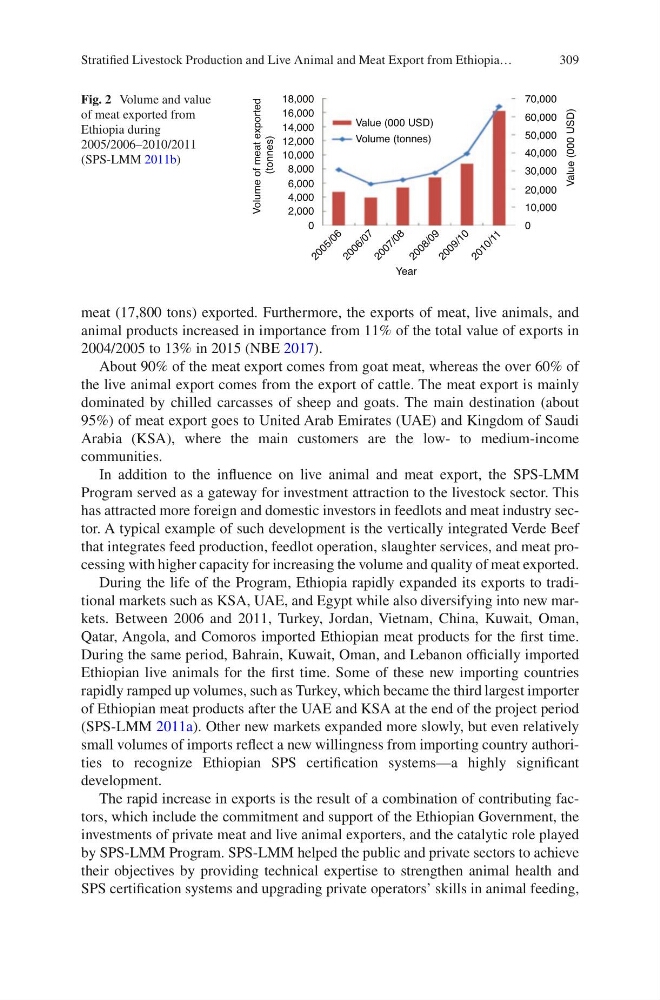
Fig. 2 Volume and value
of meat exported from
Ethiopia during
2005/2006–2010/2011
(SPS-LMM 2011b)
Stratified Livestock Production and Live Animal and Meat Export from Ethiopia…
meat (17,800 tons) exported. Furthermore, the exports of meat, live animals, and
animal products increased in importance from 11% of the total value of exports in
2004/2005 to 13% in 2015 (NBE 2017).
About 90% of the meat export comes from goat meat, whereas the over 60% of
the live animal export comes from the export of cattle. The meat export is mainly
dominated by chilled carcasses of sheep and goats. The main destination (about
95%) of meat export goes to United Arab Emirates (UAE) and Kingdom of Saudi
Arabia (KSA), where the main customers are the low- to medium-income
communities.
In addition to the influence on live animal and meat export, the SPS-LMM
Program served as a gateway for investment attraction to the livestock sector. This
has attracted more foreign and domestic investors in feedlots and meat industry sector. A typical example of such development is the vertically integrated Verde Beef
that integrates feed production, feedlot operation, slaughter services, and meat processing with higher capacity for increasing the volume and quality of meat exported.
During the life of the Program, Ethiopia rapidly expanded its exports to traditional markets such as KSA, UAE, and Egypt while also diversifying into new markets. Between 2006 and 2011, Turkey, Jordan, Vietnam, China, Kuwait, Oman,
Qatar, Angola, and Comoros imported Ethiopian meat products for the first time.
During the same period, Bahrain, Kuwait, Oman, and Lebanon officially imported
Ethiopian live animals for the first time. Some of these new importing countries
rapidly ramped up volumes, such as Turkey, which became the third largest importer
of Ethiopian meat products after the UAE and KSA at the end of the project period
(SPS-LMM 2011a). Other new markets expanded more slowly, but even relatively
small volumes of imports reflect a new willingness from importing country authorities to recognize Ethiopian SPS certification systems—a highly significant
development.
The rapid increase in exports is the result of a combination of contributing factors, which include the commitment and support of the Ethiopian Government, the
investments of private meat and live animal exporters, and the catalytic role played
by SPS-LMM Program. SPS-LMM helped the public and private sectors to achieve
their objectives by providing technical expertise to strengthen animal health and
SPS certification systems and upgrading private operators’ skills in animal feeding,
18,000
70,000
60,000
50,000
40,000
30,000
20,000
10,000
0
16,000
14,000
12,000
10,000
8,000
6,000
4,000
2,000
0
2 0 0 5 / 0 6
2 0 0 6 / 0 7
2 0 0 7 / 0 8
2 0 0 8 / 0 9
2 0 0 9 / 1 0
2 0 1 0 / 1 1
Year
Value (000 USD)
Value (000 USD)
Volume (tonnes)
Volume of meat exported
(tonnes)
Fig. 2 Volume and value
of meat exported from
Ethiopia during
2005/2006–2010/2011
(SPS-LMM 2011b)
Stratified Livestock Production and Live Animal and Meat Export from Ethiopia…