

308
increasing the capacity of the veterinary services, improving national capacity for
diagnosing export limiting diseases, improving local vaccine production at the
Ethiopian Veterinary Institute (NVI), improving Ethiopia’s SPS certification capability to comply with the requirements and standards of importing countries, and
establishing SPS certification system. Under the marketing objective, the SPSLMM Program focused on improving Ethiopia’s capacity and competitive advantage for meat and livestock exports through increasing cost-effective production of
export quality meat and live animals, improving the efficiency and effectiveness of
export marketing, and enhancing demand for Ethiopian livestock and meat in the
target markets.
5.3 The Contribution of SPS-LMM to Live Animal and Meat
Export Performance
As a result of the very close working relationship of the SPS-LMM Program with
public institutions and private operators, significant increase was registered in meat
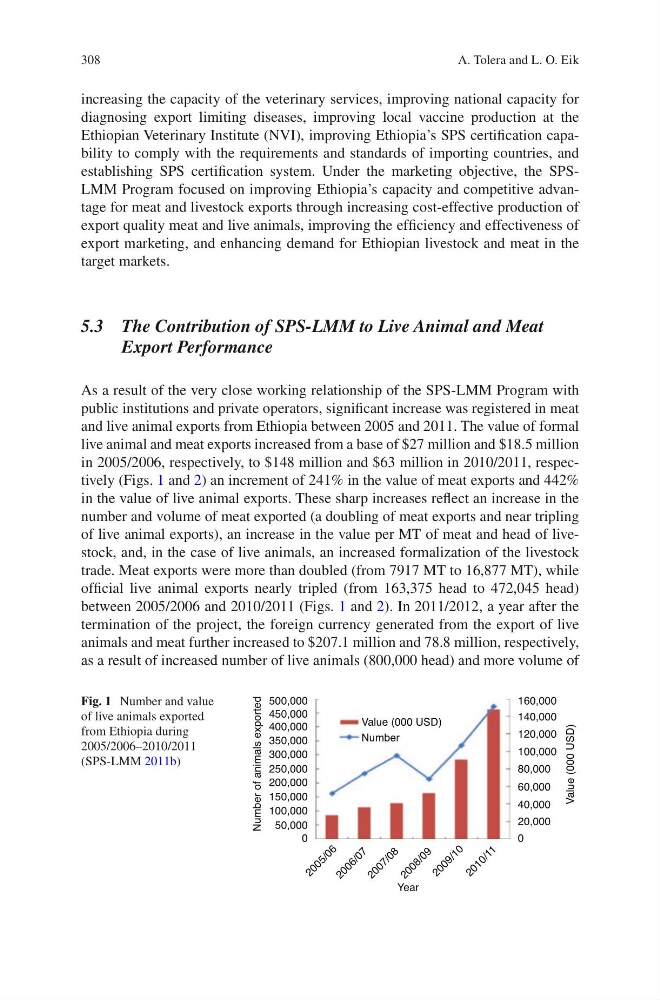
and live animal exports from Ethiopia between 2005 and 2011. The value of formal
live animal and meat exports increased from a base of $27 million and $18.5 million
in 2005/2006, respectively, to $148 million and $63 million in 2010/2011, respectively (Figs. 1 and 2) an increment of 241% in the value of meat exports and 442%
in the value of live animal exports. These sharp increases reflect an increase in the
number and volume of meat exported (a doubling of meat exports and near tripling
of live animal exports), an increase in the value per MT of meat and head of livestock, and, in the case of live animals, an increased formalization of the livestock
trade. Meat exports were more than doubled (from 7917 MT to 16,877 MT), while
official live animal exports nearly tripled (from 163,375 head to 472,045 head)
between 2005/2006 and 2010/2011 (Figs. 1 and 2). In 2011/2012, a year after the
termination of the project, the foreign currency generated from the export of live
animals and meat further increased to $207.1 million and 78.8 million, respectively,
as a result of increased number of live animals (800,000 head) and more volume of
500,000
160,000
140,000
120,000
100,000
80,000
60,000
40,000
20,000
0
450,000
400,000
350,000
300,000
250,000
200,000
150,000
100,000
50,000
0
Value (000 USD)
Number
2 0 0 5 / 0 6
2 0 0 6 / 0 7
2 0 0 7 / 0 8
2 0 0 8 / 0 9
2 0 0 9 / 1 0
2 0 1 0 / 1 1
Year
Value (000 USD)
Number of animals exported
Fig. 1 Number and value
of live animals exported
from Ethiopia during
2005/2006–2010/2011
(SPS-LMM 2011b)
A. Tolera and L. O. Eik
increasing the capacity of the veterinary services, improving national capacity for
diagnosing export limiting diseases, improving local vaccine production at the
Ethiopian Veterinary Institute (NVI), improving Ethiopia’s SPS certification capability to comply with the requirements and standards of importing countries, and
establishing SPS certification system. Under the marketing objective, the SPSLMM Program focused on improving Ethiopia’s capacity and competitive advantage for meat and livestock exports through increasing cost-effective production of
export quality meat and live animals, improving the efficiency and effectiveness of
export marketing, and enhancing demand for Ethiopian livestock and meat in the
target markets.
5.3 The Contribution of SPS-LMM to Live Animal and Meat
Export Performance
As a result of the very close working relationship of the SPS-LMM Program with
public institutions and private operators, significant increase was registered in meat
and live animal exports from Ethiopia between 2005 and 2011. The value of formal
live animal and meat exports increased from a base of $27 million and $18.5 million
in 2005/2006, respectively, to $148 million and $63 million in 2010/2011, respectively (Figs. 1 and 2) an increment of 241% in the value of meat exports and 442%
in the value of live animal exports. These sharp increases reflect an increase in the
number and volume of meat exported (a doubling of meat exports and near tripling
of live animal exports), an increase in the value per MT of meat and head of livestock, and, in the case of live animals, an increased formalization of the livestock
trade. Meat exports were more than doubled (from 7917 MT to 16,877 MT), while
official live animal exports nearly tripled (from 163,375 head to 472,045 head)
between 2005/2006 and 2010/2011 (Figs. 1 and 2). In 2011/2012, a year after the
termination of the project, the foreign currency generated from the export of live
animals and meat further increased to $207.1 million and 78.8 million, respectively,
as a result of increased number of live animals (800,000 head) and more volume of
500,000
160,000
140,000
120,000
100,000
80,000
60,000
40,000
20,000
0
450,000
400,000
350,000
300,000
250,000
200,000
150,000
100,000
50,000
0
Value (000 USD)
Number
2 0 0 5 / 0 6
2 0 0 6 / 0 7
2 0 0 7 / 0 8
2 0 0 8 / 0 9
2 0 0 9 / 1 0
2 0 1 0 / 1 1
Year
Value (000 USD)
Number of animals exported
Fig. 1 Number and value
of live animals exported
from Ethiopia during
2005/2006–2010/2011
(SPS-LMM 2011b)
A. Tolera and L. O. Eik