

292
lished to address this challenge and was a plan to avoid future importation expenses
for farmers. At Mulbadaw, pure bucks were to be bred and supplied to farmers in
Tanzania and neighboring countries (Kifaro et al. 2007). A second option for
Tanzania included the use of artificial insemination (AI) in goat breeding, and in this
case, semen was imported from Norway stored at SUA, and experts were sent to
Mgeta and Mulbadaw to synchronize the does respectively, obtaining conception
rates (CR) of 54% and 55% (Kifaro et al. 2007). The bucks resulting from the AI
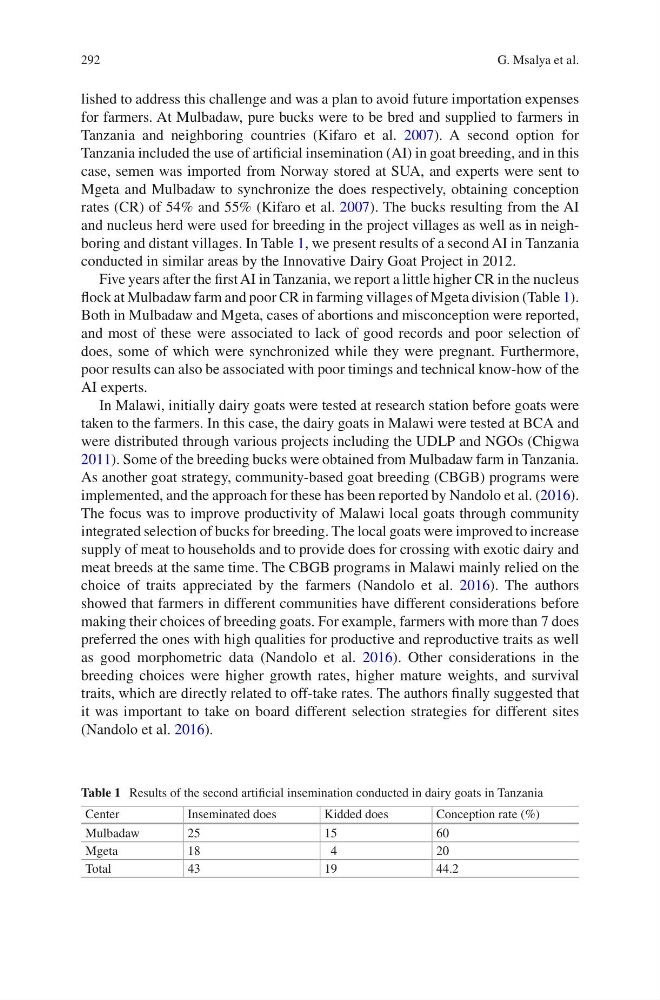
and nucleus herd were used for breeding in the project villages as well as in neighboring and distant villages. In Table 1, we present results of a second AI in Tanzania
conducted in similar areas by the Innovative Dairy Goat Project in 2012.
Five years after the first AI in Tanzania, we report a little higher CR in the nucleus
flock at Mulbadaw farm and poor CR in farming villages of Mgeta division (Table 1).
Both in Mulbadaw and Mgeta, cases of abortions and misconception were reported,
and most of these were associated to lack of good records and poor selection of
does, some of which were synchronized while they were pregnant. Furthermore,
poor results can also be associated with poor timings and technical know-how of the
AI experts.
In Malawi, initially dairy goats were tested at research station before goats were
taken to the farmers. In this case, the dairy goats in Malawi were tested at BCA and
were distributed through various projects including the UDLP and NGOs (Chigwa
2011). Some of the breeding bucks were obtained from Mulbadaw farm in Tanzania.
As another goat strategy, community-based goat breeding (CBGB) programs were
implemented, and the approach for these has been reported by Nandolo et al. (2016).
The focus was to improve productivity of Malawi local goats through community
integrated selection of bucks for breeding. The local goats were improved to increase
supply of meat to households and to provide does for crossing with exotic dairy and
meat breeds at the same time. The CBGB programs in Malawi mainly relied on the
choice of traits appreciated by the farmers (Nandolo et al. 2016). The authors
showed that farmers in different communities have different considerations before
making their choices of breeding goats. For example, farmers with more than 7 does
preferred the ones with high qualities for productive and reproductive traits as well
as good morphometric data (Nandolo et al. 2016). Other considerations in the
breeding choices were higher growth rates, higher mature weights, and survival
traits, which are directly related to off-take rates. The authors finally suggested that
it was important to take on board different selection strategies for different sites
(Nandolo et al. 2016).
Table 1 Results of the second artificial insemination conducted in dairy goats in Tanzania
Center
Inseminated does
Kidded does
Conception rate (%)
Mulbadaw
25
15
60
Mgeta
18
4
20
Total
43
19
44.2
G. Msalya et al.
lished to address this challenge and was a plan to avoid future importation expenses
for farmers. At Mulbadaw, pure bucks were to be bred and supplied to farmers in
Tanzania and neighboring countries (Kifaro et al. 2007). A second option for
Tanzania included the use of artificial insemination (AI) in goat breeding, and in this
case, semen was imported from Norway stored at SUA, and experts were sent to
Mgeta and Mulbadaw to synchronize the does respectively, obtaining conception
rates (CR) of 54% and 55% (Kifaro et al. 2007). The bucks resulting from the AI
and nucleus herd were used for breeding in the project villages as well as in neighboring and distant villages. In Table 1, we present results of a second AI in Tanzania
conducted in similar areas by the Innovative Dairy Goat Project in 2012.
Five years after the first AI in Tanzania, we report a little higher CR in the nucleus
flock at Mulbadaw farm and poor CR in farming villages of Mgeta division (Table 1).
Both in Mulbadaw and Mgeta, cases of abortions and misconception were reported,
and most of these were associated to lack of good records and poor selection of
does, some of which were synchronized while they were pregnant. Furthermore,
poor results can also be associated with poor timings and technical know-how of the
AI experts.
In Malawi, initially dairy goats were tested at research station before goats were
taken to the farmers. In this case, the dairy goats in Malawi were tested at BCA and
were distributed through various projects including the UDLP and NGOs (Chigwa
2011). Some of the breeding bucks were obtained from Mulbadaw farm in Tanzania.
As another goat strategy, community-based goat breeding (CBGB) programs were
implemented, and the approach for these has been reported by Nandolo et al. (2016).
The focus was to improve productivity of Malawi local goats through community
integrated selection of bucks for breeding. The local goats were improved to increase
supply of meat to households and to provide does for crossing with exotic dairy and
meat breeds at the same time. The CBGB programs in Malawi mainly relied on the
choice of traits appreciated by the farmers (Nandolo et al. 2016). The authors
showed that farmers in different communities have different considerations before
making their choices of breeding goats. For example, farmers with more than 7 does
preferred the ones with high qualities for productive and reproductive traits as well
as good morphometric data (Nandolo et al. 2016). Other considerations in the
breeding choices were higher growth rates, higher mature weights, and survival
traits, which are directly related to off-take rates. The authors finally suggested that
it was important to take on board different selection strategies for different sites
(Nandolo et al. 2016).
Table 1 Results of the second artificial insemination conducted in dairy goats in Tanzania
Center
Inseminated does
Kidded does
Conception rate (%)
Mulbadaw
25
15
60
Mgeta
18
4
20
Total
43
19
44.2
G. Msalya et al.