

291
3 Review Results
3.1 Practices and Challenges Related to Dairy Goats Breeding
in Tanzania and Malawi
In Tanzania, bucks were imported from Norway, bred either with pure NL does at
Sokoine University of Agriculture (SUA), and /or crossbred with the local does of
SEA goats mainly in the farming communities of Mgeta (Mtenga and Kifaro 1993).
Also, pure NL bucks were sent to Mgeta where the farmers were trained to manage
and rotate them in the project villages (the smallest units in the division). Therefore,
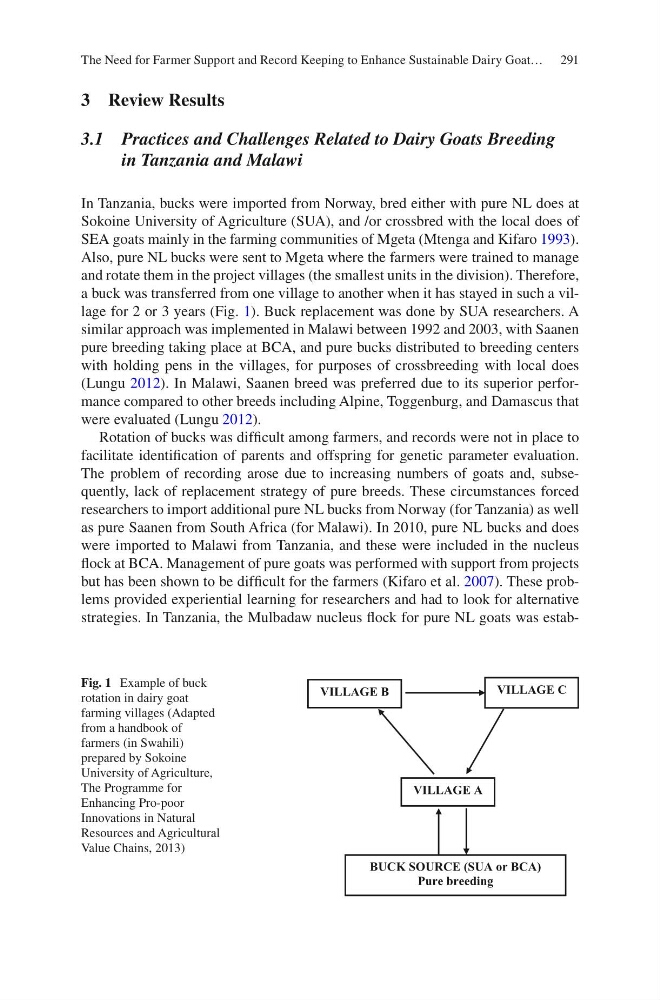
a buck was transferred from one village to another when it has stayed in such a village for 2 or 3 years (Fig. 1). Buck replacement was done by SUA researchers. A
similar approach was implemented in Malawi between 1992 and 2003, with Saanen
pure breeding taking place at BCA, and pure bucks distributed to breeding centers
with holding pens in the villages, for purposes of crossbreeding with local does
(Lungu 2012). In Malawi, Saanen breed was preferred due to its superior performance compared to other breeds including Alpine, Toggenburg, and Damascus that
were evaluated (Lungu 2012).
Rotation of bucks was difficult among farmers, and records were not in place to
facilitate identification of parents and offspring for genetic parameter evaluation.
The problem of recording arose due to increasing numbers of goats and, subsequently, lack of replacement strategy of pure breeds. These circumstances forced
researchers to import additional pure NL bucks from Norway (for Tanzania) as well
as pure Saanen from South Africa (for Malawi). In 2010, pure NL bucks and does
were imported to Malawi from Tanzania, and these were included in the nucleus
flock at BCA. Management of pure goats was performed with support from projects
but has been shown to be difficult for the farmers (Kifaro et al. 2007). These problems provided experiential learning for researchers and had to look for alternative
strategies. In Tanzania, the Mulbadaw nucleus flock for pure NL goats was estabVILLAGE B
VILLAGE C
VILLAGE A
BUCK SOURCE (SUA or BCA)
Pure breeding
Fig. 1 Example of buck
rotation in dairy goat
farming villages (Adapted
from a handbook of
farmers (in Swahili)
prepared by Sokoine
University of Agriculture,
The Programme for
Enhancing Pro-poor
Innovations in Natural
Resources and Agricultural
Value Chains, 2013)
The Need for Farmer Support and Record Keeping to Enhance Sustainable Dairy Goat…
3 Review Results
3.1 Practices and Challenges Related to Dairy Goats Breeding
in Tanzania and Malawi
In Tanzania, bucks were imported from Norway, bred either with pure NL does at
Sokoine University of Agriculture (SUA), and /or crossbred with the local does of
SEA goats mainly in the farming communities of Mgeta (Mtenga and Kifaro 1993).
Also, pure NL bucks were sent to Mgeta where the farmers were trained to manage
and rotate them in the project villages (the smallest units in the division). Therefore,
a buck was transferred from one village to another when it has stayed in such a village for 2 or 3 years (Fig. 1). Buck replacement was done by SUA researchers. A
similar approach was implemented in Malawi between 1992 and 2003, with Saanen
pure breeding taking place at BCA, and pure bucks distributed to breeding centers
with holding pens in the villages, for purposes of crossbreeding with local does
(Lungu 2012). In Malawi, Saanen breed was preferred due to its superior performance compared to other breeds including Alpine, Toggenburg, and Damascus that
were evaluated (Lungu 2012).
Rotation of bucks was difficult among farmers, and records were not in place to
facilitate identification of parents and offspring for genetic parameter evaluation.
The problem of recording arose due to increasing numbers of goats and, subsequently, lack of replacement strategy of pure breeds. These circumstances forced
researchers to import additional pure NL bucks from Norway (for Tanzania) as well
as pure Saanen from South Africa (for Malawi). In 2010, pure NL bucks and does
were imported to Malawi from Tanzania, and these were included in the nucleus
flock at BCA. Management of pure goats was performed with support from projects
but has been shown to be difficult for the farmers (Kifaro et al. 2007). These problems provided experiential learning for researchers and had to look for alternative
strategies. In Tanzania, the Mulbadaw nucleus flock for pure NL goats was estabVILLAGE B
VILLAGE C
VILLAGE A
BUCK SOURCE (SUA or BCA)
Pure breeding
Fig. 1 Example of buck
rotation in dairy goat
farming villages (Adapted
from a handbook of
farmers (in Swahili)
prepared by Sokoine
University of Agriculture,
The Programme for
Enhancing Pro-poor
Innovations in Natural
Resources and Agricultural
Value Chains, 2013)
The Need for Farmer Support and Record Keeping to Enhance Sustainable Dairy Goat…