

245
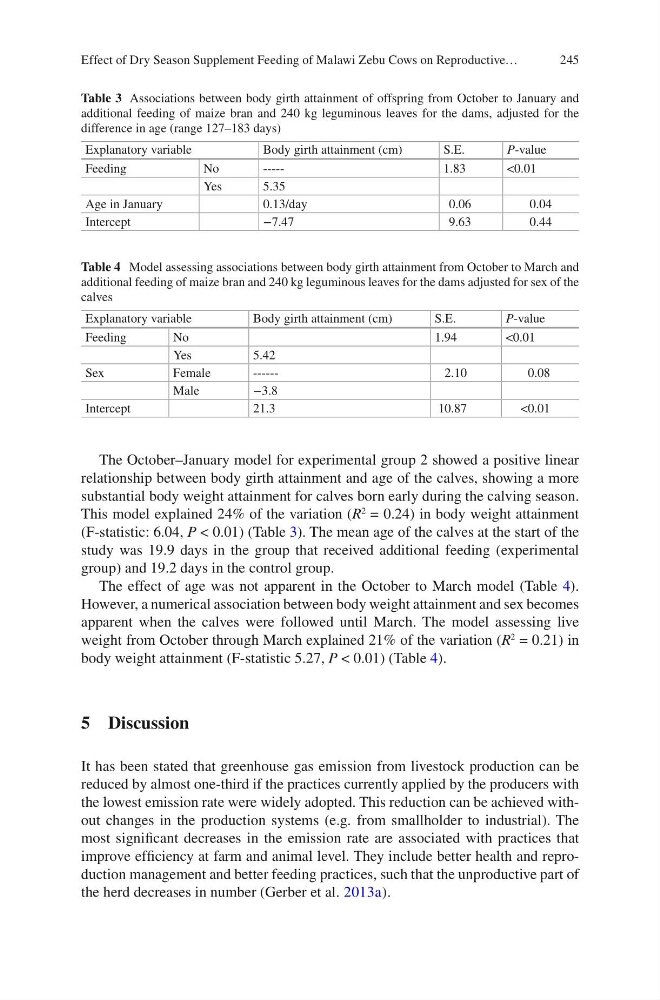
Table 3 Associations between body girth attainment of offspring from October to January and
additional feeding of maize bran and 240 kg leguminous leaves for the dams, adjusted for the
difference in age (range 127–183 days)
Explanatory variable
Body girth attainment (cm)
S.E.
P-value
Feeding
No
----1.83
<0.01
Yes
5.35
Age in January
0.13/day
0.06
0.04
Intercept
−7.47
9.63
0.44
Table 4 Model assessing associations between body girth attainment from October to March and
additional feeding of maize bran and 240 kg leguminous leaves for the dams adjusted for sex of the
calves
Explanatory variable
Body girth attainment (cm)
S.E.
P-value
Feeding
No
1.94
<0.01
Yes
5.42
Sex
Female
-----2.10
0.08
Male
−3.8
Intercept
21.3
10.87
<0.01
The October–January model for experimental group 2 showed a positive linear
relationship between body girth attainment and age of the calves, showing a more
substantial body weight attainment for calves born early during the calving season.
This model explained 24% of the variation (R
2
= 0.24) in body weight attainment
(F-statistic: 6.04, P < 0.01) (Table 3). The mean age of the calves at the start of the
study was 19.9 days in the group that received additional feeding (experimental
group) and 19.2 days in the control group.
The effect of age was not apparent in the October to March model (Table 4).
However, a numerical association between body weight attainment and sex becomes
apparent when the calves were followed until March. The model assessing live
weight from October through March explained 21% of the variation (R
2
= 0.21) in
body weight attainment (F-statistic 5.27, P < 0.01) (Table 4).
5 Discussion
It has been stated that greenhouse gas emission from livestock production can be
reduced by almost one-third if the practices currently applied by the producers with
the lowest emission rate were widely adopted. This reduction can be achieved without changes in the production systems (e.g. from smallholder to industrial). The
most significant decreases in the emission rate are associated with practices that
improve efficiency at farm and animal level. They include better health and reproduction management and better feeding practices, such that the unproductive part of
the herd decreases in number (Gerber et al. 2013a).
Effect of Dry Season Supplement Feeding of Malawi Zebu Cows on Reproductive…
Table 3 Associations between body girth attainment of offspring from October to January and
additional feeding of maize bran and 240 kg leguminous leaves for the dams, adjusted for the
difference in age (range 127–183 days)
Explanatory variable
Body girth attainment (cm)
S.E.
P-value
Feeding
No
----1.83
<0.01
Yes
5.35
Age in January
0.13/day
0.06
0.04
Intercept
−7.47
9.63
0.44
Table 4 Model assessing associations between body girth attainment from October to March and
additional feeding of maize bran and 240 kg leguminous leaves for the dams adjusted for sex of the
calves
Explanatory variable
Body girth attainment (cm)
S.E.
P-value
Feeding
No
1.94
<0.01
Yes
5.42
Sex
Female
-----2.10
0.08
Male
−3.8
Intercept
21.3
10.87
<0.01
The October–January model for experimental group 2 showed a positive linear
relationship between body girth attainment and age of the calves, showing a more
substantial body weight attainment for calves born early during the calving season.
This model explained 24% of the variation (R
2
= 0.24) in body weight attainment
(F-statistic: 6.04, P < 0.01) (Table 3). The mean age of the calves at the start of the
study was 19.9 days in the group that received additional feeding (experimental
group) and 19.2 days in the control group.
The effect of age was not apparent in the October to March model (Table 4).
However, a numerical association between body weight attainment and sex becomes
apparent when the calves were followed until March. The model assessing live
weight from October through March explained 21% of the variation (R
2
= 0.21) in
body weight attainment (F-statistic 5.27, P < 0.01) (Table 4).
5 Discussion
It has been stated that greenhouse gas emission from livestock production can be
reduced by almost one-third if the practices currently applied by the producers with
the lowest emission rate were widely adopted. This reduction can be achieved without changes in the production systems (e.g. from smallholder to industrial). The
most significant decreases in the emission rate are associated with practices that
improve efficiency at farm and animal level. They include better health and reproduction management and better feeding practices, such that the unproductive part of
the herd decreases in number (Gerber et al. 2013a).
Effect of Dry Season Supplement Feeding of Malawi Zebu Cows on Reproductive…