

243
ing, 1/0, and age of the calves in January. The second model estimated body weight
attainment from October to March and included the explanatory variables: feeding,
1/0, and sex of the calves. Overall statistical significance of the models was assessed
by the type III F-test in Stata. Homoscedasticity and normality of the residuals were
assessed using plots of standardised residuals.
4 Results
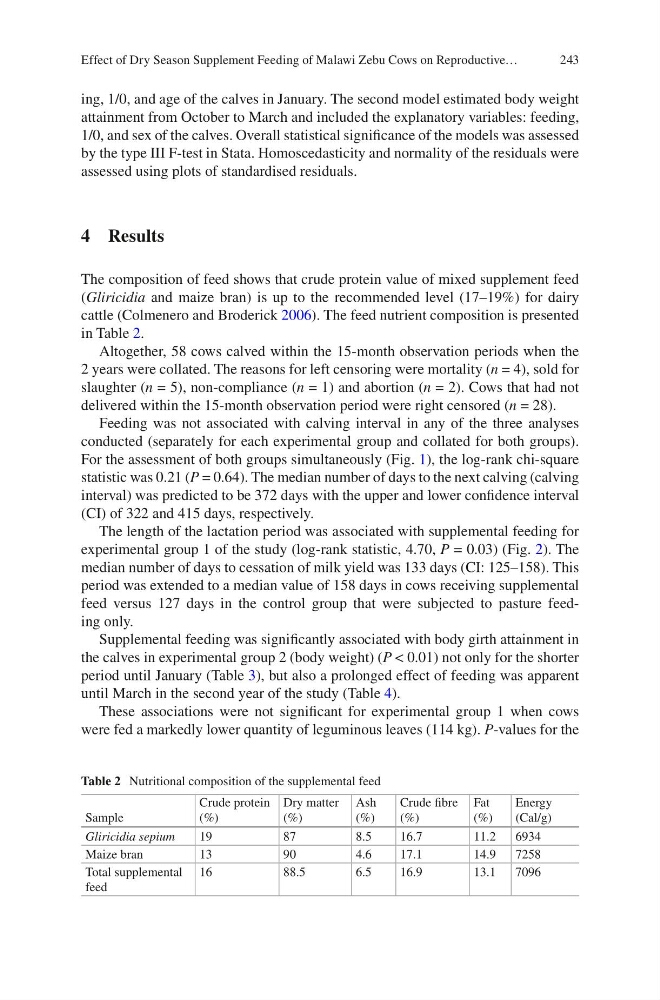
The composition of feed shows that crude protein value of mixed supplement feed
(Gliricidia and maize bran) is up to the recommended level (17–19%) for dairy
cattle (Colmenero and Broderick 2006). The feed nutrient composition is presented
in Table 2.
Altogether, 58 cows calved within the 15-month observation periods when the
2 years were collated. The reasons for left censoring were mortality (n = 4), sold for
slaughter (n = 5), non-compliance (n = 1) and abortion (n = 2). Cows that had not
delivered within the 15-month observation period were right censored (n = 28).
Feeding was not associated with calving interval in any of the three analyses
conducted (separately for each experimental group and collated for both groups).
For the assessment of both groups simultaneously (Fig. 1), the log-rank chi-square
statistic was 0.21 (P = 0.64). The median number of days to the next calving (calving
interval) was predicted to be 372 days with the upper and lower confidence interval
(CI) of 322 and 415 days, respectively.
The length of the lactation period was associated with supplemental feeding for
experimental group 1 of the study (log-rank statistic, 4.70, P = 0.03) (Fig. 2). The
median number of days to cessation of milk yield was 133 days (CI: 125–158). This
period was extended to a median value of 158 days in cows receiving supplemental
feed versus 127 days in the control group that were subjected to pasture feeding only.
Supplemental feeding was significantly associated with body girth attainment in
the calves in experimental group 2 (body weight) (P < 0.01) not only for the shorter
period until January (Table 3), but also a prolonged effect of feeding was apparent
until March in the second year of the study (Table 4).
These associations were not significant for experimental group 1 when cows
were fed a markedly lower quantity of leguminous leaves (114 kg). P-values for the
Table 2 Nutritional composition of the supplemental feed
Sample
Crude protein
(%)
Dry matter
(%)
Ash
(%)
Crude fibre
(%)
Fat
(%)
Energy
(Cal/g)
Gliricidia sepium
19
87
8.5
16.7
11.2
6934
Maize bran
13
90
4.6
17.1
14.9
7258
Total supplemental
feed
16
88.5
6.5
16.9
13.1
7096
Effect of Dry Season Supplement Feeding of Malawi Zebu Cows on Reproductive…
ing, 1/0, and age of the calves in January. The second model estimated body weight
attainment from October to March and included the explanatory variables: feeding,
1/0, and sex of the calves. Overall statistical significance of the models was assessed
by the type III F-test in Stata. Homoscedasticity and normality of the residuals were
assessed using plots of standardised residuals.
4 Results
The composition of feed shows that crude protein value of mixed supplement feed
(Gliricidia and maize bran) is up to the recommended level (17–19%) for dairy
cattle (Colmenero and Broderick 2006). The feed nutrient composition is presented
in Table 2.
Altogether, 58 cows calved within the 15-month observation periods when the
2 years were collated. The reasons for left censoring were mortality (n = 4), sold for
slaughter (n = 5), non-compliance (n = 1) and abortion (n = 2). Cows that had not
delivered within the 15-month observation period were right censored (n = 28).
Feeding was not associated with calving interval in any of the three analyses
conducted (separately for each experimental group and collated for both groups).
For the assessment of both groups simultaneously (Fig. 1), the log-rank chi-square
statistic was 0.21 (P = 0.64). The median number of days to the next calving (calving
interval) was predicted to be 372 days with the upper and lower confidence interval
(CI) of 322 and 415 days, respectively.
The length of the lactation period was associated with supplemental feeding for
experimental group 1 of the study (log-rank statistic, 4.70, P = 0.03) (Fig. 2). The
median number of days to cessation of milk yield was 133 days (CI: 125–158). This
period was extended to a median value of 158 days in cows receiving supplemental
feed versus 127 days in the control group that were subjected to pasture feeding only.
Supplemental feeding was significantly associated with body girth attainment in
the calves in experimental group 2 (body weight) (P < 0.01) not only for the shorter
period until January (Table 3), but also a prolonged effect of feeding was apparent
until March in the second year of the study (Table 4).
These associations were not significant for experimental group 1 when cows
were fed a markedly lower quantity of leguminous leaves (114 kg). P-values for the
Table 2 Nutritional composition of the supplemental feed
Sample
Crude protein
(%)
Dry matter
(%)
Ash
(%)
Crude fibre
(%)
Fat
(%)
Energy
(Cal/g)
Gliricidia sepium
19
87
8.5
16.7
11.2
6934
Maize bran
13
90
4.6
17.1
14.9
7258
Total supplemental
feed
16
88.5
6.5
16.9
13.1
7096
Effect of Dry Season Supplement Feeding of Malawi Zebu Cows on Reproductive…