

232
late abortion/stillbirth had occurred. Statistical significance was assessed both by
log likelihood and Wald chi-square statistics. Both approaches were used, as the
Wald chi-square test is more sensitive to early observation than the default loglikelihood statistic (Dohoo et al. 2009). Explanatory variables with P-values of 0.10
and less for the association with likelihood of conception from the K-M estimators
were included in a multivariable Cox proportional hazards model (Cox regression),
with shared frailty at farm level.
Parity was included in the Cox model both as an ordinal variable (parity: 1, 2 and
>2) and as first parity versus multiparous cows (1/0). Number of bulls in the herd
was evaluated both as an ordinal variable (number of bulls: 1, 2 and >2) and to
whether a breeding bull was present in the herd or not (1/0). Interaction terms
between the bull and parity variables were tested and subsequently omitted for nonsignificance by backward elimination. As the likelihood ratio test for frailty was not
significant, it was also removed from the final models. The proportional hazard
assumption was evaluated by plotting the negative logarithm of the hazard function
against the logarithm of survival time (−ln(H) versus ln(t)) separately for the parity
and the bull effects. The assumption of independent censoring was explored in sensitivity analyses of complete negative and positive correlations between censoring
events and the event of interest. The overall fit of the model was assessed by CoxSnell residuals and Moreau goodness of fit tests; outliers were evaluated by deviance residuals, whereas the lack of influential points was identified by scaled score
residuals (Dohoo et al. 2009).
4 Results
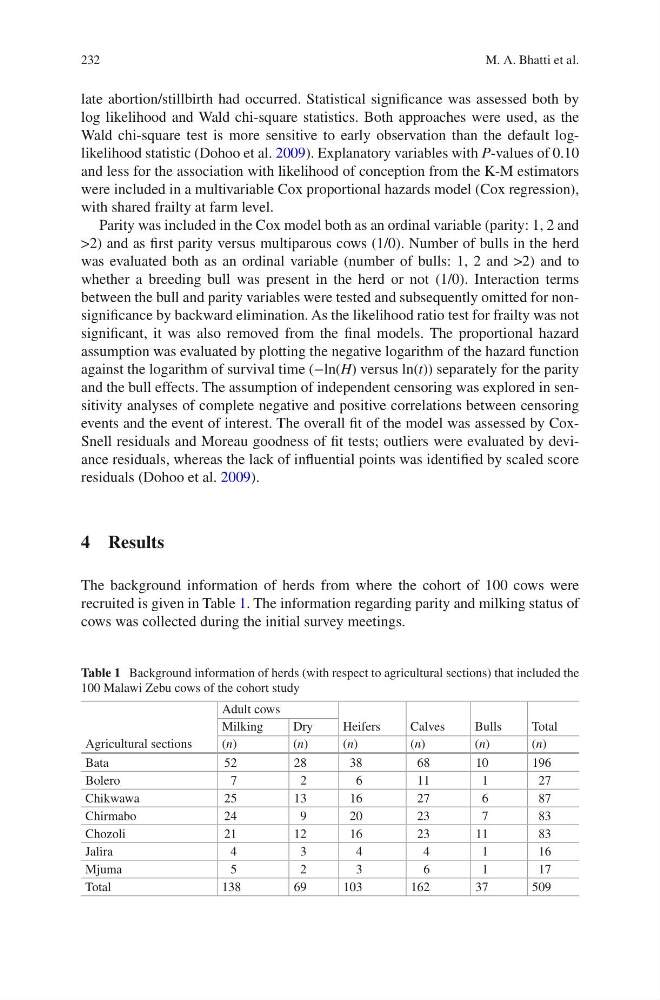
The background information of herds from where the cohort of 100 cows were
recruited is given in Table 1. The information regarding parity and milking status of
cows was collected during the initial survey meetings.
Table 1 Background information of herds (with respect to agricultural sections) that included the
100 Malawi Zebu cows of the cohort study
Agricultural sections
Adult cows
Heifers
Calves
Bulls
Total
Milking
Dry
(n)
(n)
(n)
(n)
(n)
(n)
Bata
52
28
38
68
10
196
Bolero
7
2
6
11
1
27
Chikwawa
25
13
16
27
6
87
Chirmabo
24
9
20
23
7
83
Chozoli
21
12
16
23
11
83
Jalira
4
3
4
4
1
16
Mjuma
5
2
3
6
1
17
Total
138
69
103
162
37
509
M. A. Bhatti et al.
late abortion/stillbirth had occurred. Statistical significance was assessed both by
log likelihood and Wald chi-square statistics. Both approaches were used, as the
Wald chi-square test is more sensitive to early observation than the default loglikelihood statistic (Dohoo et al. 2009). Explanatory variables with P-values of 0.10
and less for the association with likelihood of conception from the K-M estimators
were included in a multivariable Cox proportional hazards model (Cox regression),
with shared frailty at farm level.
Parity was included in the Cox model both as an ordinal variable (parity: 1, 2 and
>2) and as first parity versus multiparous cows (1/0). Number of bulls in the herd
was evaluated both as an ordinal variable (number of bulls: 1, 2 and >2) and to
whether a breeding bull was present in the herd or not (1/0). Interaction terms
between the bull and parity variables were tested and subsequently omitted for nonsignificance by backward elimination. As the likelihood ratio test for frailty was not
significant, it was also removed from the final models. The proportional hazard
assumption was evaluated by plotting the negative logarithm of the hazard function
against the logarithm of survival time (−ln(H) versus ln(t)) separately for the parity
and the bull effects. The assumption of independent censoring was explored in sensitivity analyses of complete negative and positive correlations between censoring
events and the event of interest. The overall fit of the model was assessed by CoxSnell residuals and Moreau goodness of fit tests; outliers were evaluated by deviance residuals, whereas the lack of influential points was identified by scaled score
residuals (Dohoo et al. 2009).
4 Results
The background information of herds from where the cohort of 100 cows were
recruited is given in Table 1. The information regarding parity and milking status of
cows was collected during the initial survey meetings.
Table 1 Background information of herds (with respect to agricultural sections) that included the
100 Malawi Zebu cows of the cohort study
Agricultural sections
Adult cows
Heifers
Calves
Bulls
Total
Milking
Dry
(n)
(n)
(n)
(n)
(n)
(n)
Bata
52
28
38
68
10
196
Bolero
7
2
6
11
1
27
Chikwawa
25
13
16
27
6
87
Chirmabo
24
9
20
23
7
83
Chozoli
21
12
16
23
11
83
Jalira
4
3
4
4
1
16
Mjuma
5
2
3
6
1
17
Total
138
69
103
162
37
509
M. A. Bhatti et al.