

157
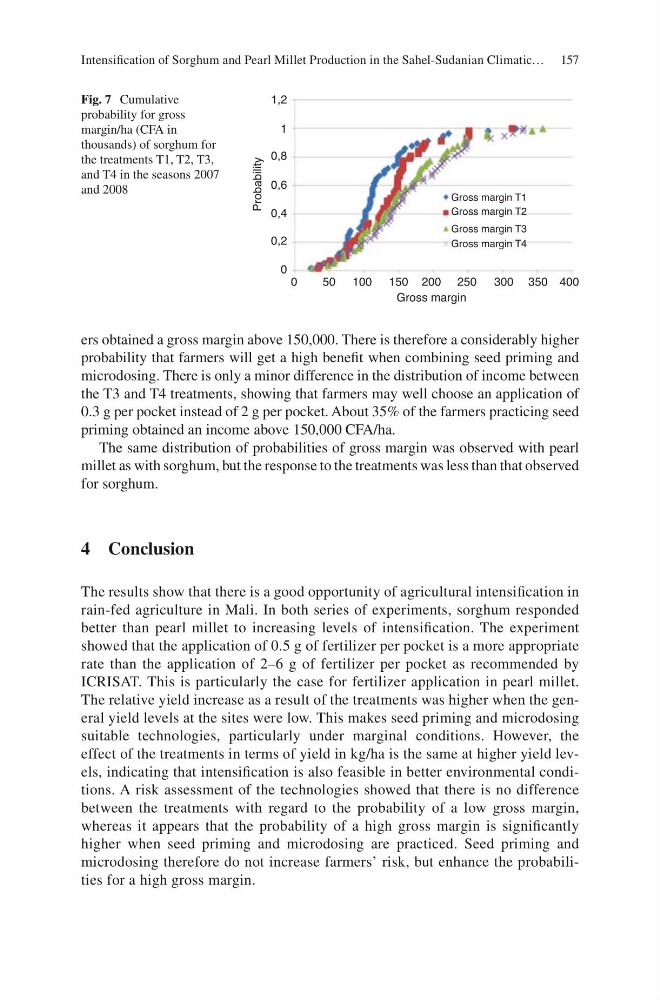
ers obtained a gross margin above 150,000. There is therefore a considerably higher
probability that farmers will get a high benefit when combining seed priming and
microdosing. There is only a minor difference in the distribution of income between
the T3 and T4 treatments, showing that farmers may well choose an application of
0.3 g per pocket instead of 2 g per pocket. About 35% of the farmers practicing seed
priming obtained an income above 150,000 CFA/ha.
The same distribution of probabilities of gross margin was observed with pearl
millet as with sorghum, but the response to the treatments was less than that observed
for sorghum.
4 Conclusion
The results show that there is a good opportunity of agricultural intensification in
rain-fed agriculture in Mali. In both series of experiments, sorghum responded
better than pearl millet to increasing levels of intensification. The experiment
showed that the application of 0.5 g of fertilizer per pocket is a more appropriate
rate than the application of 2–6 g of fertilizer per pocket as recommended by
ICRISAT. This is particularly the case for fertilizer application in pearl millet.
The relative yield increase as a result of the treatments was higher when the general yield levels at the sites were low. This makes seed priming and microdosing
suitable technologies, particularly under marginal conditions. However, the
effect of the treatments in terms of yield in kg/ha is the same at higher yield levels, indicating that intensification is also feasible in better environmental conditions. A risk assessment of the technologies showed that there is no difference
between the treatments with regard to the probability of a low gross margin,
whereas it appears that the probability of a high gross margin is significantly
higher when seed priming and microdosing are practiced. Seed priming and
microdosing therefore do not increase farmers’ risk, but enhance the probabilities for a high gross margin.
1,2
1
0,8
0,6
0,4
0,2
0 0
50 100 150 200
Gross margin
Gross margin T1
Gross margin T2
Gross margin T3
Gross margin T4
Probability
250 300 350 400
Fig. 7 Cumulative
probability for gross
margin/ha (CFA in
thousands) of sorghum for
the treatments T1, T2, T3,
and T4 in the seasons 2007
and 2008
Intensification of Sorghum and Pearl Millet Production in the Sahel-Sudanian Climatic…
ers obtained a gross margin above 150,000. There is therefore a considerably higher
probability that farmers will get a high benefit when combining seed priming and
microdosing. There is only a minor difference in the distribution of income between
the T3 and T4 treatments, showing that farmers may well choose an application of
0.3 g per pocket instead of 2 g per pocket. About 35% of the farmers practicing seed
priming obtained an income above 150,000 CFA/ha.
The same distribution of probabilities of gross margin was observed with pearl
millet as with sorghum, but the response to the treatments was less than that observed
for sorghum.
4 Conclusion
The results show that there is a good opportunity of agricultural intensification in
rain-fed agriculture in Mali. In both series of experiments, sorghum responded
better than pearl millet to increasing levels of intensification. The experiment
showed that the application of 0.5 g of fertilizer per pocket is a more appropriate
rate than the application of 2–6 g of fertilizer per pocket as recommended by
ICRISAT. This is particularly the case for fertilizer application in pearl millet.
The relative yield increase as a result of the treatments was higher when the general yield levels at the sites were low. This makes seed priming and microdosing
suitable technologies, particularly under marginal conditions. However, the
effect of the treatments in terms of yield in kg/ha is the same at higher yield levels, indicating that intensification is also feasible in better environmental conditions. A risk assessment of the technologies showed that there is no difference
between the treatments with regard to the probability of a low gross margin,
whereas it appears that the probability of a high gross margin is significantly
higher when seed priming and microdosing are practiced. Seed priming and
microdosing therefore do not increase farmers’ risk, but enhance the probabilities for a high gross margin.
1,2
1
0,8
0,6
0,4
0,2
0 0
50 100 150 200
Gross margin
Gross margin T1
Gross margin T2
Gross margin T3
Gross margin T4
Probability
250 300 350 400
Fig. 7 Cumulative
probability for gross
margin/ha (CFA in
thousands) of sorghum for
the treatments T1, T2, T3,
and T4 in the seasons 2007
and 2008
Intensification of Sorghum and Pearl Millet Production in the Sahel-Sudanian Climatic…