

136
2.4 Data Analysis
The data was handled and analysed using Excel, and a t-test was used to check if the
difference between farmers’ (FP) and improved (YSS) practices was significant.
The data for each site was analysed individually because of the environmental heterogeneity of the site.
3 Results and Discussion
3.1 Crop Residues Productivity
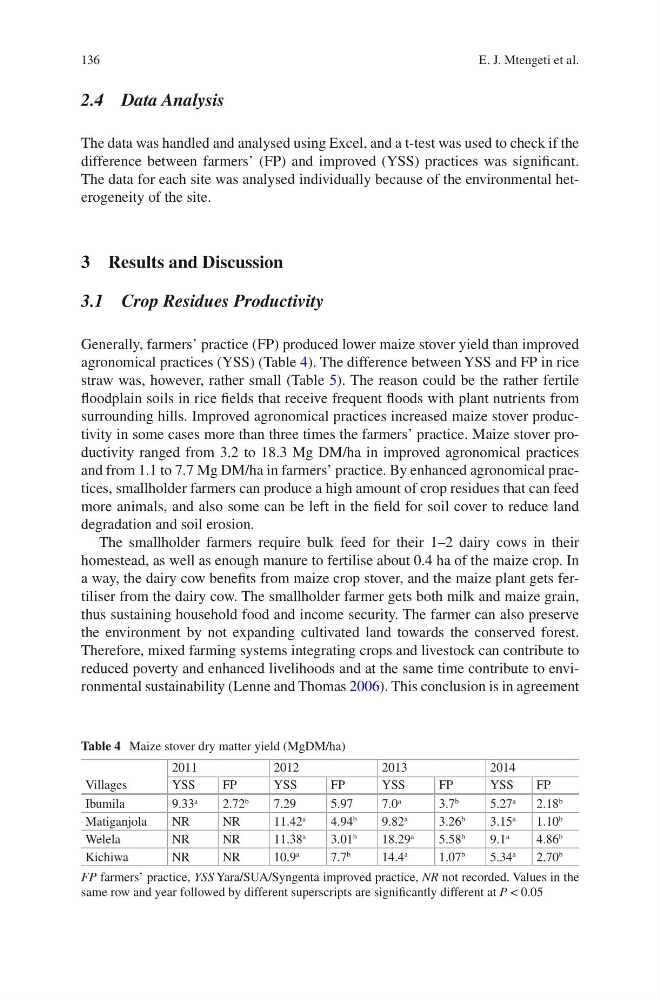
Generally, farmers’ practice (FP) produced lower maize stover yield than improved
agronomical practices (YSS) (Table 4). The difference between YSS and FP in rice
straw was, however, rather small (Table 5). The reason could be the rather fertile
floodplain soils in rice fields that receive frequent floods with plant nutrients from
surrounding hills. Improved agronomical practices increased maize stover productivity in some cases more than three times the farmers’ practice. Maize stover productivity ranged from 3.2 to 18.3 Mg DM/ha in improved agronomical practices
and from 1.1 to 7.7 Mg DM/ha in farmers’ practice. By enhanced agronomical practices, smallholder farmers can produce a high amount of crop residues that can feed
more animals, and also some can be left in the field for soil cover to reduce land
degradation and soil erosion.
The smallholder farmers require bulk feed for their 1–2 dairy cows in their
homestead, as well as enough manure to fertilise about 0.4 ha of the maize crop. In
a way, the dairy cow benefits from maize crop stover, and the maize plant gets fertiliser from the dairy cow. The smallholder farmer gets both milk and maize grain,
thus sustaining household food and income security. The farmer can also preserve
the environment by not expanding cultivated land towards the conserved forest.
Therefore, mixed farming systems integrating crops and livestock can contribute to
reduced poverty and enhanced livelihoods and at the same time contribute to environmental sustainability (Lenne and Thomas 2006). This conclusion is in agreement
Table 4 Maize stover dry matter yield (MgDM/ha)
Villages
2011
2012
2013
2014
YSS
FP
YSS
FP
YSS
FP
YSS
FP
Ibumila
9.33
a
2.72
b
7.29
5.97
7.0
a
3.7
b
5.27
a
2.18
b
Matiganjola
NR
NR
11.42
a
4.94
b
9.82
a
3.26
b
3.15
a
1.10
b
Welela
NR
NR
11.38
a
3.01
b
18.29
a
5.58
b
9.1
a
4.86
b
Kichiwa
NR
NR
10.9
a
7.7
b
14.4
a
1.07
b
5.34
a
2.70
b
FP farmers’ practice, YSS Yara/SUA/Syngenta improved practice, NR not recorded. Values in the
same row and year followed by different superscripts are significantly different at P < 0.05
E. J. Mtengeti et al.
2.4 Data Analysis
The data was handled and analysed using Excel, and a t-test was used to check if the
difference between farmers’ (FP) and improved (YSS) practices was significant.
The data for each site was analysed individually because of the environmental heterogeneity of the site.
3 Results and Discussion
3.1 Crop Residues Productivity
Generally, farmers’ practice (FP) produced lower maize stover yield than improved
agronomical practices (YSS) (Table 4). The difference between YSS and FP in rice
straw was, however, rather small (Table 5). The reason could be the rather fertile
floodplain soils in rice fields that receive frequent floods with plant nutrients from
surrounding hills. Improved agronomical practices increased maize stover productivity in some cases more than three times the farmers’ practice. Maize stover productivity ranged from 3.2 to 18.3 Mg DM/ha in improved agronomical practices
and from 1.1 to 7.7 Mg DM/ha in farmers’ practice. By enhanced agronomical practices, smallholder farmers can produce a high amount of crop residues that can feed
more animals, and also some can be left in the field for soil cover to reduce land
degradation and soil erosion.
The smallholder farmers require bulk feed for their 1–2 dairy cows in their
homestead, as well as enough manure to fertilise about 0.4 ha of the maize crop. In
a way, the dairy cow benefits from maize crop stover, and the maize plant gets fertiliser from the dairy cow. The smallholder farmer gets both milk and maize grain,
thus sustaining household food and income security. The farmer can also preserve
the environment by not expanding cultivated land towards the conserved forest.
Therefore, mixed farming systems integrating crops and livestock can contribute to
reduced poverty and enhanced livelihoods and at the same time contribute to environmental sustainability (Lenne and Thomas 2006). This conclusion is in agreement
Table 4 Maize stover dry matter yield (MgDM/ha)
Villages
2011
2012
2013
2014
YSS
FP
YSS
FP
YSS
FP
YSS
FP
Ibumila
9.33
a
2.72
b
7.29
5.97
7.0
a
3.7
b
5.27
a
2.18
b
Matiganjola
NR
NR
11.42
a
4.94
b
9.82
a
3.26
b
3.15
a
1.10
b
Welela
NR
NR
11.38
a
3.01
b
18.29
a
5.58
b
9.1
a
4.86
b
Kichiwa
NR
NR
10.9
a
7.7
b
14.4
a
1.07
b
5.34
a
2.70
b
FP farmers’ practice, YSS Yara/SUA/Syngenta improved practice, NR not recorded. Values in the
same row and year followed by different superscripts are significantly different at P < 0.05
E. J. Mtengeti et al.