

80
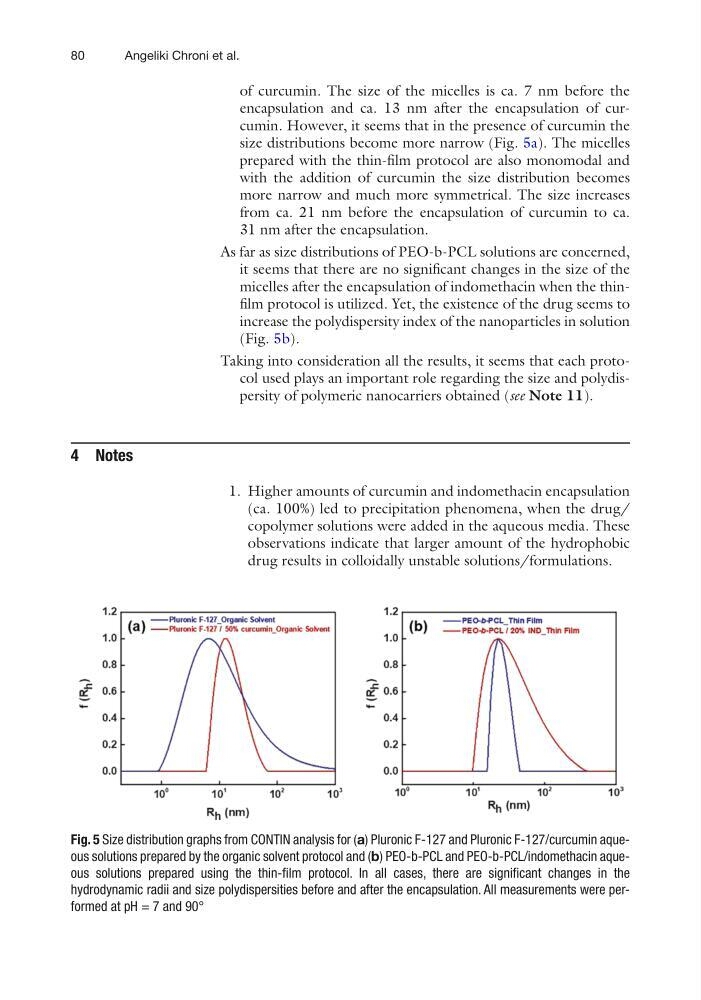
of curcumin. The size of the micelles is ca. 7 nm before the
encapsulation and ca. 13 nm after the encapsulation of curcumin. However, it seems that in the presence of curcumin the
size distributions become more narrow (Fig. 5a). The micelles
prepared with the thin-film protocol are also monomodal and
with the addition of curcumin the size distribution becomes
more narrow and much more symmetrical. The size increases
from ca. 21 nm before the encapsulation of curcumin to ca.
31 nm after the encapsulation.
As far as size distributions of PEO-b-PCL solutions are concerned,
it seems that there are no significant changes in the size of the
micelles after the encapsulation of indomethacin when the thinfilm protocol is utilized. Yet, the existence of the drug seems to
increase the polydispersity index of the nanoparticles in solution
(Fig. 5b).
Taking into consideration all the results, it seems that each protocol used plays an important role regarding the size and polydispersity of polymeric nanocarriers obtained (see Note 11).
4 Notes
1. Higher amounts of curcumin and indomethacin encapsulation
(ca. 100%) led to precipitation phenomena, when the drug/
copolymer solutions were added in the aqueous media. These
observations indicate that larger amount of the hydrophobic
drug results in colloidally unstable solutions/formulations.
Fig. 5 Size distribution graphs from CONTIN analysis for (a) Pluronic F-127 and Pluronic F-127/curcumin aqueous solutions prepared by the organic solvent protocol and (b) PEO-b-PCL and PEO-b-PCL/indomethacin aqueous solutions prepared using the thin-film protocol. In all cases, there are significant changes in the
hydrodynamic radii and size polydispersities before and after the encapsulation. All measurements were performed at pH = 7 and 90°
Angeliki Chroni et al.
of curcumin. The size of the micelles is ca. 7 nm before the
encapsulation and ca. 13 nm after the encapsulation of curcumin. However, it seems that in the presence of curcumin the
size distributions become more narrow (Fig. 5a). The micelles
prepared with the thin-film protocol are also monomodal and
with the addition of curcumin the size distribution becomes
more narrow and much more symmetrical. The size increases
from ca. 21 nm before the encapsulation of curcumin to ca.
31 nm after the encapsulation.
As far as size distributions of PEO-b-PCL solutions are concerned,
it seems that there are no significant changes in the size of the
micelles after the encapsulation of indomethacin when the thinfilm protocol is utilized. Yet, the existence of the drug seems to
increase the polydispersity index of the nanoparticles in solution
(Fig. 5b).
Taking into consideration all the results, it seems that each protocol used plays an important role regarding the size and polydispersity of polymeric nanocarriers obtained (see Note 11).
4 Notes
1. Higher amounts of curcumin and indomethacin encapsulation
(ca. 100%) led to precipitation phenomena, when the drug/
copolymer solutions were added in the aqueous media. These
observations indicate that larger amount of the hydrophobic
drug results in colloidally unstable solutions/formulations.
Fig. 5 Size distribution graphs from CONTIN analysis for (a) Pluronic F-127 and Pluronic F-127/curcumin aqueous solutions prepared by the organic solvent protocol and (b) PEO-b-PCL and PEO-b-PCL/indomethacin aqueous solutions prepared using the thin-film protocol. In all cases, there are significant changes in the
hydrodynamic radii and size polydispersities before and after the encapsulation. All measurements were performed at pH = 7 and 90°
Angeliki Chroni et al.