

46
use of steered (or biased) molecular dynamics (sMD) and umbrella
sampling method. In this work, the details of the interactions
(energetics) of such complexation are studied with the use of
steered molecular dynamics (sMD) and umbrella sampling simulations. The use of these methods can lead to the investigation of the
Gibbs free energy changes (ΔGs) as a function of a certain reaction
coordinate. In this specific case, the ΔG of binding between CC
and 2-hydroxypropyl-β-cyclodextrin (2-HP-B-CD) (denoted from
now on as CC:2-HP-B-CD complex) will be estimated as a function of the intramolecular distances of the centers of mass (COMs)
of the two species. In this way, the release energy of CC will be
computed (being the opposite of the complexation energy). This
method is based upon the implementation of an external potential
upon the system, which will force it to follow a specific “route”
upon the reaction coordinate [7]. Thereby, a better and more
complete sampling is achieved, even in regions of the phase space
that represent high-energy states (such as transition states), which
would not have been sampled with the use of classical unbiased
MD. The latter is based upon the ergodic hypothesis of statistical
thermodynamics, according to which every state in the phase space
is energetically equal and thus equiprobable (thus the system is in
equilibrium). In systems where the ergodic hypothesis does not
apply (e.g., a case where a drug:CD complex should overcome a
barrier in order for the drug to be released), unbiased MD cannot
provide with accurate results unless it is run for long enough time
(which would be too long for an average academic workstation),
since high-energy states are very rarely sampled. This is why such
phenomena are called “rare events”; due to their high-energy states
it is very rare that the phase space where they reside is sampled.
Thus, in order to study such phenomena, the system needs to be
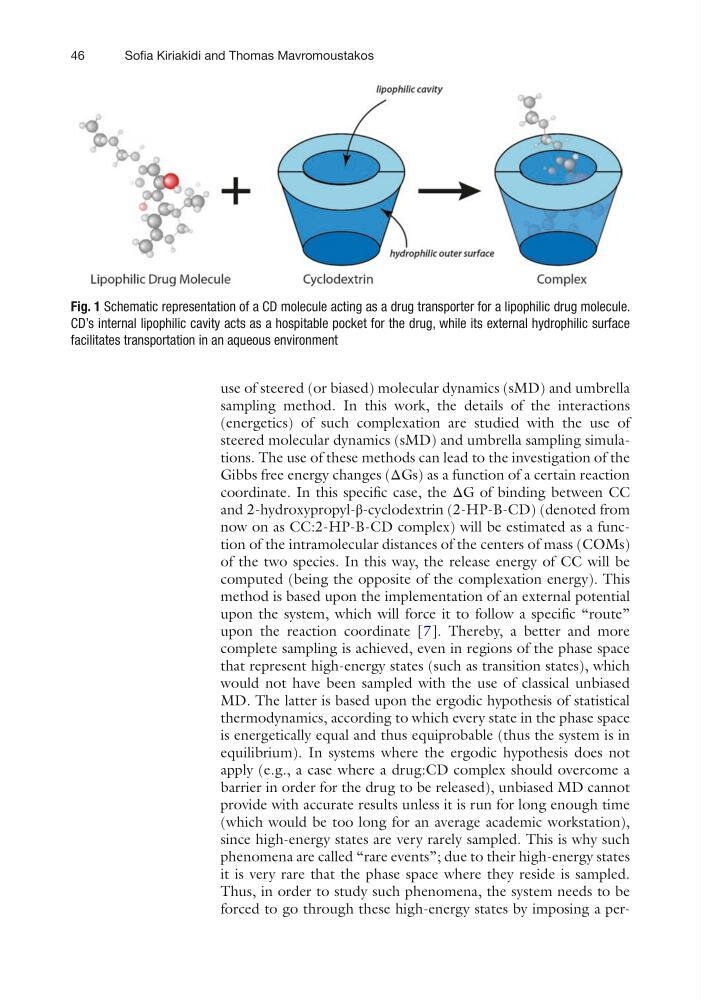
forced to go through these high-energy states by imposing a perFig. 1 Schematic representation of a CD molecule acting as a drug transporter for a lipophilic drug molecule.
CD’s internal lipophilic cavity acts as a hospitable pocket for the drug, while its external hydrophilic surface
facilitates transportation in an aqueous environment
Sofia Kiriakidi and Thomas Mavromoustakos
use of steered (or biased) molecular dynamics (sMD) and umbrella
sampling method. In this work, the details of the interactions
(energetics) of such complexation are studied with the use of
steered molecular dynamics (sMD) and umbrella sampling simulations. The use of these methods can lead to the investigation of the
Gibbs free energy changes (ΔGs) as a function of a certain reaction
coordinate. In this specific case, the ΔG of binding between CC
and 2-hydroxypropyl-β-cyclodextrin (2-HP-B-CD) (denoted from
now on as CC:2-HP-B-CD complex) will be estimated as a function of the intramolecular distances of the centers of mass (COMs)
of the two species. In this way, the release energy of CC will be
computed (being the opposite of the complexation energy). This
method is based upon the implementation of an external potential
upon the system, which will force it to follow a specific “route”
upon the reaction coordinate [7]. Thereby, a better and more
complete sampling is achieved, even in regions of the phase space
that represent high-energy states (such as transition states), which
would not have been sampled with the use of classical unbiased
MD. The latter is based upon the ergodic hypothesis of statistical
thermodynamics, according to which every state in the phase space
is energetically equal and thus equiprobable (thus the system is in
equilibrium). In systems where the ergodic hypothesis does not
apply (e.g., a case where a drug:CD complex should overcome a
barrier in order for the drug to be released), unbiased MD cannot
provide with accurate results unless it is run for long enough time
(which would be too long for an average academic workstation),
since high-energy states are very rarely sampled. This is why such
phenomena are called “rare events”; due to their high-energy states
it is very rare that the phase space where they reside is sampled.
Thus, in order to study such phenomena, the system needs to be
forced to go through these high-energy states by imposing a perFig. 1 Schematic representation of a CD molecule acting as a drug transporter for a lipophilic drug molecule.
CD’s internal lipophilic cavity acts as a hospitable pocket for the drug, while its external hydrophilic surface
facilitates transportation in an aqueous environment
Sofia Kiriakidi and Thomas Mavromoustakos