

336
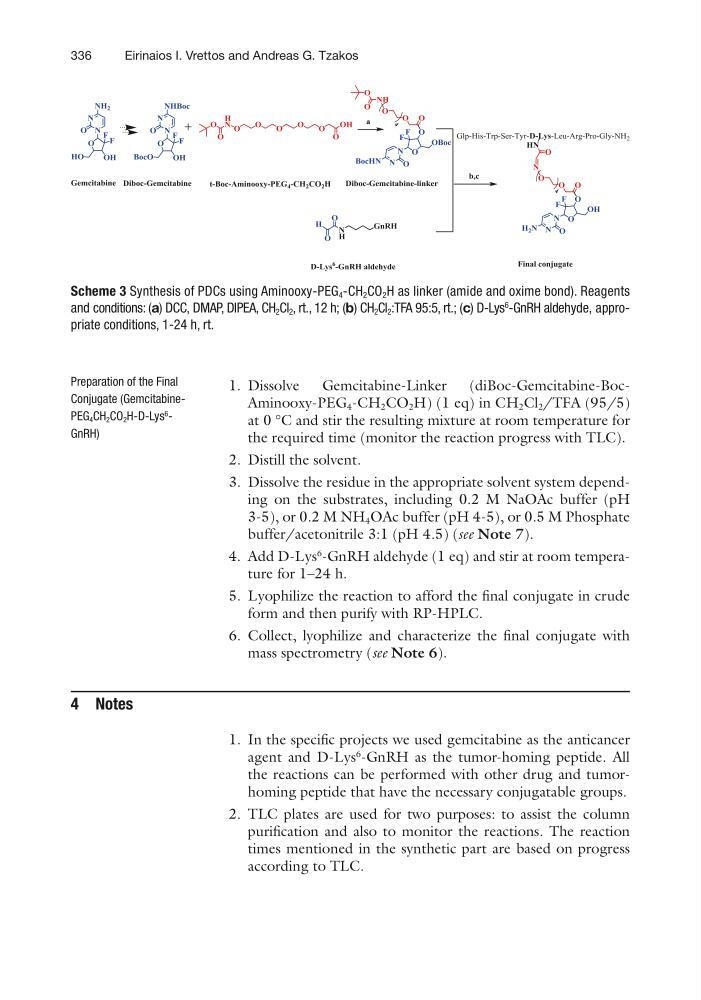
1. Dissolve
Gemcitabine-Linker
(diBoc-Gemcitabine-BocAminooxy-PEG 4 -CH 2 CO 2 H) (1 eq) in CH 2 Cl 2 /TFA (95/5)
at 0 °C and stir the resulting mixture at room temperature for
the required time (monitor the reaction progress with TLC).
2. Distill the solvent.
3. Dissolve the residue in the appropriate solvent system depending on the substrates, including 0.2 M NaOAc buffer (pH
3-5), or 0.2 M NH 4 OAc buffer (pH 4-5), or 0.5 M Phosphate
buffer/acetonitrile 3:1 (pH 4.5) (see Note 7).
4. Add D-Lys
6
-GnRH aldehyde (1 eq) and stir at room temperature for 1–24 h.
5. Lyophilize the reaction to afford the final conjugate in crude
form and then purify with RP-HPLC.
6. Collect, lyophilize and characterize the final conjugate with
mass spectrometry (see Note 6).
4 Notes
1. In the specific projects we used gemcitabine as the anticancer
agent and D-Lys
6
-GnRH as the tumor-homing peptide. All
the reactions can be performed with other drug and tumorhoming peptide that have the necessary conjugatable groups.
2. TLC plates are used for two purposes: to assist the column
purification and also to monitor the reactions. The reaction
times mentioned in the synthetic part are based on progress
according to TLC.
Preparation of the Final
Conjugate (GemcitabinePEG 4 CH 2 CO 2 H- D- Lys
6
-
GnRH)
Scheme 3 Synthesis of PDCs using Aminooxy-PEG 4 -CH 2 CO 2 H as linker (amide and oxime bond). Reagents
and conditions: (a) DCC, DMAP, DIPEA, CH 2 Cl 2 , rt., 12 h; (b) CH 2 Cl 2 :TFA 95:5, rt.; (c) D-Lys
6
-GnRH aldehyde, appropriate conditions, 1-24 h, rt.
Eirinaios I. Vrettos and Andreas G. Tzakos
1. Dissolve
Gemcitabine-Linker
(diBoc-Gemcitabine-BocAminooxy-PEG 4 -CH 2 CO 2 H) (1 eq) in CH 2 Cl 2 /TFA (95/5)
at 0 °C and stir the resulting mixture at room temperature for
the required time (monitor the reaction progress with TLC).
2. Distill the solvent.
3. Dissolve the residue in the appropriate solvent system depending on the substrates, including 0.2 M NaOAc buffer (pH
3-5), or 0.2 M NH 4 OAc buffer (pH 4-5), or 0.5 M Phosphate
buffer/acetonitrile 3:1 (pH 4.5) (see Note 7).
4. Add D-Lys
6
-GnRH aldehyde (1 eq) and stir at room temperature for 1–24 h.
5. Lyophilize the reaction to afford the final conjugate in crude
form and then purify with RP-HPLC.
6. Collect, lyophilize and characterize the final conjugate with
mass spectrometry (see Note 6).
4 Notes
1. In the specific projects we used gemcitabine as the anticancer
agent and D-Lys
6
-GnRH as the tumor-homing peptide. All
the reactions can be performed with other drug and tumorhoming peptide that have the necessary conjugatable groups.
2. TLC plates are used for two purposes: to assist the column
purification and also to monitor the reactions. The reaction
times mentioned in the synthetic part are based on progress
according to TLC.
Preparation of the Final
Conjugate (GemcitabinePEG 4 CH 2 CO 2 H- D- Lys
6
-
GnRH)
Scheme 3 Synthesis of PDCs using Aminooxy-PEG 4 -CH 2 CO 2 H as linker (amide and oxime bond). Reagents
and conditions: (a) DCC, DMAP, DIPEA, CH 2 Cl 2 , rt., 12 h; (b) CH 2 Cl 2 :TFA 95:5, rt.; (c) D-Lys
6
-GnRH aldehyde, appropriate conditions, 1-24 h, rt.
Eirinaios I. Vrettos and Andreas G. Tzakos