

328
fore deteriorating the patient’s health. For instance, gemcitabine,
an anticancer agent used against a variety of solid tumors even in
the latter stages, shows higher toxicity for healthy cells, after longterm administration, due to the drug resistance that cancer cells
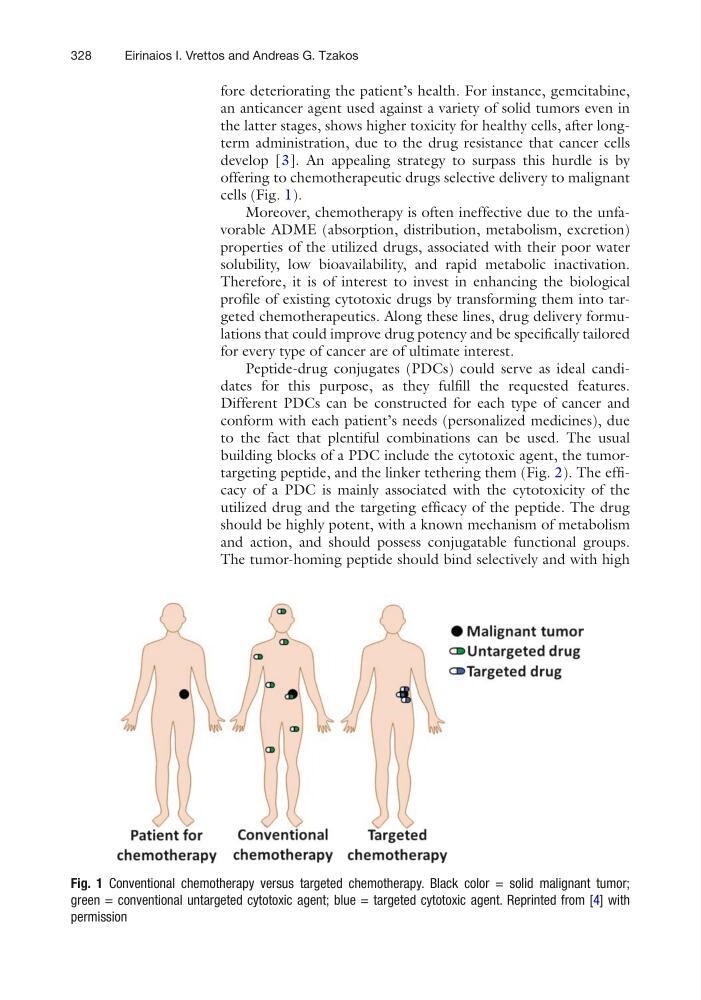
develop [3]. An appealing strategy to surpass this hurdle is by
offering to chemotherapeutic drugs selective delivery to malignant
cells (Fig. 1).
Moreover, chemotherapy is often ineffective due to the unfavorable ADME (absorption, distribution, metabolism, excretion)
properties of the utilized drugs, associated with their poor water
solubility, low bioavailability, and rapid metabolic inactivation.
Therefore, it is of interest to invest in enhancing the biological
profile of existing cytotoxic drugs by transforming them into targeted chemotherapeutics. Along these lines, drug delivery formulations that could improve drug potency and be specifically tailored
for every type of cancer are of ultimate interest.
Peptide-drug conjugates (PDCs) could serve as ideal candidates for this purpose, as they fulfill the requested features.
Different PDCs can be constructed for each type of cancer and
conform with each patient’s needs (personalized medicines), due
to the fact that plentiful combinations can be used. The usual
building blocks of a PDC include the cytotoxic agent, the tumortargeting peptide, and the linker tethering them (Fig. 2). The efficacy of a PDC is mainly associated with the cytotoxicity of the
utilized drug and the targeting efficacy of the peptide. The drug
should be highly potent, with a known mechanism of metabolism
and action, and should possess conjugatable functional groups.
The tumor-homing peptide should bind selectively and with high
Fig. 1 Conventional chemotherapy versus targeted chemotherapy. Black color = solid malignant tumor;
green = conventional untargeted cytotoxic agent; blue = targeted cytotoxic agent. Reprinted from [4] with
permission
Eirinaios I. Vrettos and Andreas G. Tzakos
fore deteriorating the patient’s health. For instance, gemcitabine,
an anticancer agent used against a variety of solid tumors even in
the latter stages, shows higher toxicity for healthy cells, after longterm administration, due to the drug resistance that cancer cells
develop [3]. An appealing strategy to surpass this hurdle is by
offering to chemotherapeutic drugs selective delivery to malignant
cells (Fig. 1).
Moreover, chemotherapy is often ineffective due to the unfavorable ADME (absorption, distribution, metabolism, excretion)
properties of the utilized drugs, associated with their poor water
solubility, low bioavailability, and rapid metabolic inactivation.
Therefore, it is of interest to invest in enhancing the biological
profile of existing cytotoxic drugs by transforming them into targeted chemotherapeutics. Along these lines, drug delivery formulations that could improve drug potency and be specifically tailored
for every type of cancer are of ultimate interest.
Peptide-drug conjugates (PDCs) could serve as ideal candidates for this purpose, as they fulfill the requested features.
Different PDCs can be constructed for each type of cancer and
conform with each patient’s needs (personalized medicines), due
to the fact that plentiful combinations can be used. The usual
building blocks of a PDC include the cytotoxic agent, the tumortargeting peptide, and the linker tethering them (Fig. 2). The efficacy of a PDC is mainly associated with the cytotoxicity of the
utilized drug and the targeting efficacy of the peptide. The drug
should be highly potent, with a known mechanism of metabolism
and action, and should possess conjugatable functional groups.
The tumor-homing peptide should bind selectively and with high
Fig. 1 Conventional chemotherapy versus targeted chemotherapy. Black color = solid malignant tumor;
green = conventional untargeted cytotoxic agent; blue = targeted cytotoxic agent. Reprinted from [4] with
permission
Eirinaios I. Vrettos and Andreas G. Tzakos