

270
vided further coating. In vivo studies showed increase in bioavailability of controlled- release suspension by 24.09% as compared
to pure GBP [89].
Melatonin is a hormone found in animals, plants, and microbes. It
has shown a sleep quality improvement in patients suffering from
sleep diseases, with this molecule being functionally important in
the nocturnal regulation of sleep and thermoregulation. Along
other medical and healthcare properties, melatonin is also known
to exhibit antioxidant properties against the deleterious effects of
reactive oxygen and nitrogen species [90].
A suitable system of transferring the active ingredient to the
skin should be developed in order to fulfill the bioactive function
of melatonin. A bioactive functional fabric was prepared through
cotton fiber functionalization with β-CD carbonate-NSs and then
loaded with melatonin in water/ethanol suspension. The loading
efficiency of melatonin in the nanoporous structure was estimated
in 8 wt%. The in vitro release study with the Franz cell equipment
evidenced that melatonin release rate from the functionalized fabric can be described by a zero-order law. This finding might be the
starting point for the development of biofunctional fabrics storing
multiple doses of melatonin to be released over time [91].
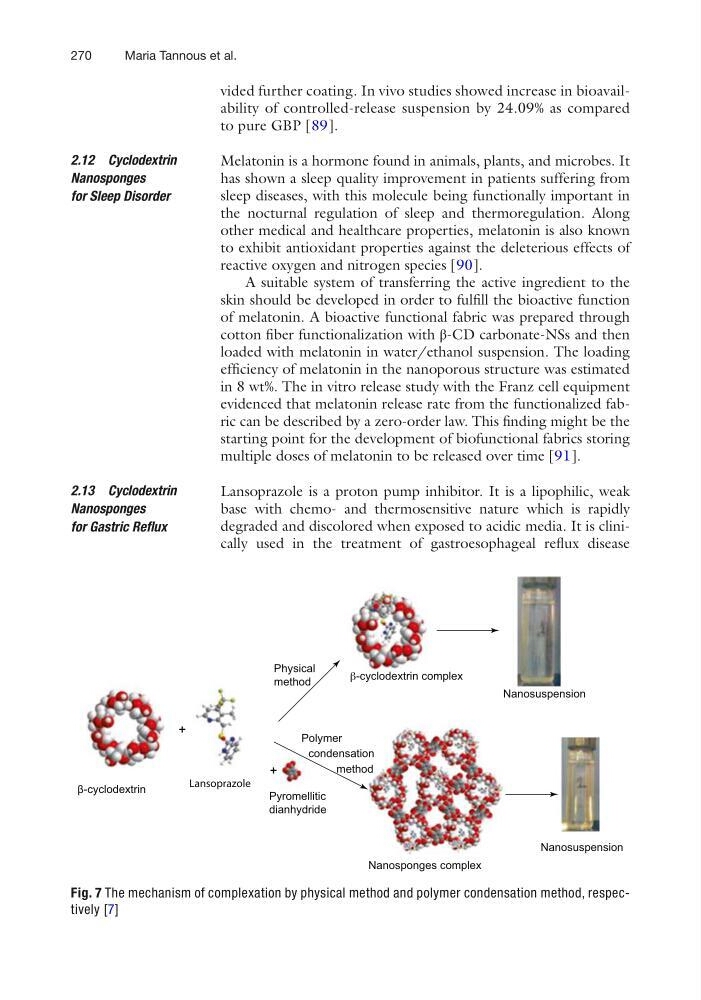
Lansoprazole is a proton pump inhibitor. It is a lipophilic, weak
base with chemo- and thermosensitive nature which is rapidly
degraded and discolored when exposed to acidic media. It is clinically used in the treatment of gastroesophageal reflux disease
2.12 Cyclodextrin
Nanosponges
for Sleep Disorder
2.13 Cyclodextrin
Nanosponges
for Gastric Reflux
Physical
method
Pyromellitic
dianhydride
Polymer
condensation
method
Nanosponges complex
Lansoprazole
Nanosuspension
Nanosuspension
β-cyclodextrin
β-cyclodextrin complex
+
+
Fig. 7 The mechanism of complexation by physical method and polymer condensation method, respectively [7]
Maria Tannous et al.
vided further coating. In vivo studies showed increase in bioavailability of controlled- release suspension by 24.09% as compared
to pure GBP [89].
Melatonin is a hormone found in animals, plants, and microbes. It
has shown a sleep quality improvement in patients suffering from
sleep diseases, with this molecule being functionally important in
the nocturnal regulation of sleep and thermoregulation. Along
other medical and healthcare properties, melatonin is also known
to exhibit antioxidant properties against the deleterious effects of
reactive oxygen and nitrogen species [90].
A suitable system of transferring the active ingredient to the
skin should be developed in order to fulfill the bioactive function
of melatonin. A bioactive functional fabric was prepared through
cotton fiber functionalization with β-CD carbonate-NSs and then
loaded with melatonin in water/ethanol suspension. The loading
efficiency of melatonin in the nanoporous structure was estimated
in 8 wt%. The in vitro release study with the Franz cell equipment
evidenced that melatonin release rate from the functionalized fabric can be described by a zero-order law. This finding might be the
starting point for the development of biofunctional fabrics storing
multiple doses of melatonin to be released over time [91].
Lansoprazole is a proton pump inhibitor. It is a lipophilic, weak
base with chemo- and thermosensitive nature which is rapidly
degraded and discolored when exposed to acidic media. It is clinically used in the treatment of gastroesophageal reflux disease
2.12 Cyclodextrin
Nanosponges
for Sleep Disorder
2.13 Cyclodextrin
Nanosponges
for Gastric Reflux
Physical
method
Pyromellitic
dianhydride
Polymer
condensation
method
Nanosponges complex
Lansoprazole
Nanosuspension
Nanosuspension
β-cyclodextrin
β-cyclodextrin complex
+
+
Fig. 7 The mechanism of complexation by physical method and polymer condensation method, respectively [7]
Maria Tannous et al.