

212
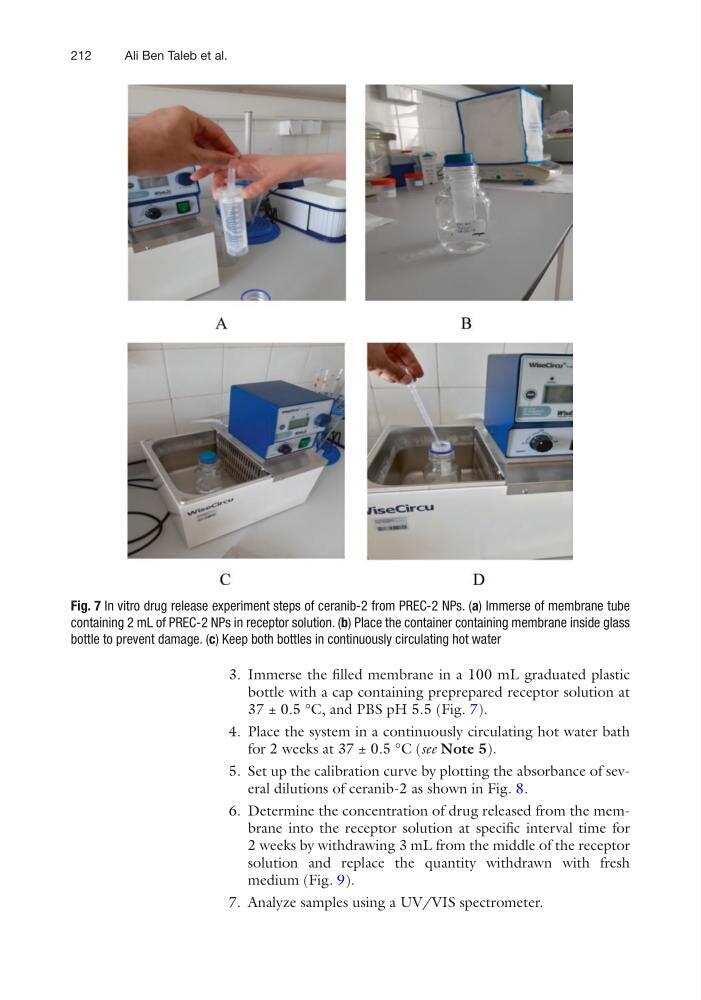
3. Immerse the filled membrane in a 100 mL graduated plastic
bottle with a cap containing preprepared receptor solution at
37 ± 0.5 °C, and PBS pH 5.5 (Fig. 7).
4. Place the system in a continuously circulating hot water bath
for 2 weeks at 37 ± 0.5 °C (see Note 5).
5. Set up the calibration curve by plotting the absorbance of several dilutions of ceranib-2 as shown in Fig. 8.
6. Determine the concentration of drug released from the membrane into the receptor solution at specific interval time for
2 weeks by withdrawing 3 mL from the middle of the receptor
solution and replace the quantity withdrawn with fresh
medium (Fig. 9).
7. Analyze samples using a UV/VIS spectrometer.
Fig. 7 In vitro drug release experiment steps of ceranib-2 from PREC-2 NPs. (a) Immerse of membrane tube
containing 2 mL of PREC-2 NPs in receptor solution. (b) Place the container containing membrane inside glass
bottle to prevent damage. (c) Keep both bottles in continuously circulating hot water
Ali Ben Taleb et al.
3. Immerse the filled membrane in a 100 mL graduated plastic
bottle with a cap containing preprepared receptor solution at
37 ± 0.5 °C, and PBS pH 5.5 (Fig. 7).
4. Place the system in a continuously circulating hot water bath
for 2 weeks at 37 ± 0.5 °C (see Note 5).
5. Set up the calibration curve by plotting the absorbance of several dilutions of ceranib-2 as shown in Fig. 8.
6. Determine the concentration of drug released from the membrane into the receptor solution at specific interval time for
2 weeks by withdrawing 3 mL from the middle of the receptor
solution and replace the quantity withdrawn with fresh
medium (Fig. 9).
7. Analyze samples using a UV/VIS spectrometer.
Fig. 7 In vitro drug release experiment steps of ceranib-2 from PREC-2 NPs. (a) Immerse of membrane tube
containing 2 mL of PREC-2 NPs in receptor solution. (b) Place the container containing membrane inside glass
bottle to prevent damage. (c) Keep both bottles in continuously circulating hot water
Ali Ben Taleb et al.