

202
cancer, peri-tumor, normal breast tissue, and interstitial fluid (that
is a component of tumor microenvironment), because ceramide
has not been as comprehensively studied and may have important
relationships with cancer.
Recently, several novel potent ceramidase inhibitors have been
reported as effective anticancer drugs [30–32]. In 2011, Draper
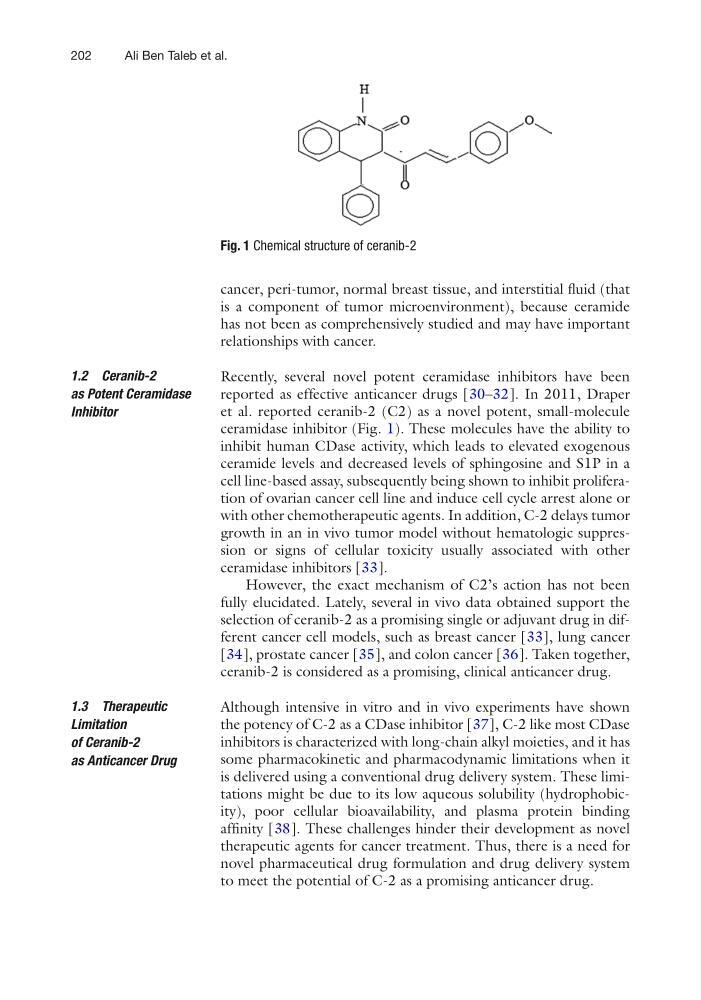
et al. reported ceranib-2 (C2) as a novel potent, small-molecule
ceramidase inhibitor (Fig. 1). These molecules have the ability to
inhibit human CDase activity, which leads to elevated exogenous
ceramide levels and decreased levels of sphingosine and S1P in a
cell line-based assay, subsequently being shown to inhibit proliferation of ovarian cancer cell line and induce cell cycle arrest alone or
with other chemotherapeutic agents. In addition, C-2 delays tumor
growth in an in vivo tumor model without hematologic suppression or signs of cellular toxicity usually associated with other
ceramidase inhibitors [33].
However, the exact mechanism of C2’s action has not been
fully elucidated. Lately, several in vivo data obtained support the
selection of ceranib-2 as a promising single or adjuvant drug in different cancer cell models, such as breast cancer [33], lung cancer
[34], prostate cancer [35], and colon cancer [36]. Taken together,
ceranib-2 is considered as a promising, clinical anticancer drug.
Although intensive in vitro and in vivo experiments have shown
the potency of C-2 as a CDase inhibitor [37], C-2 like most CDase
inhibitors is characterized with long-chain alkyl moieties, and it has
some pharmacokinetic and pharmacodynamic limitations when it
is delivered using a conventional drug delivery system. These limitations might be due to its low aqueous solubility (hydrophobicity), poor cellular bioavailability, and plasma protein binding
affinity [38]. These challenges hinder their development as novel
therapeutic agents for cancer treatment. Thus, there is a need for
novel pharmaceutical drug formulation and drug delivery system
to meet the potential of C-2 as a promising anticancer drug.
1.2 Ceranib-2
as Potent Ceramidase
Inhibitor
1.3 Therapeutic
Limitation
of Ceranib-2
as Anticancer Drug
Fig. 1 Chemical structure of ceranib-2
Ali Ben Taleb et al.
cancer, peri-tumor, normal breast tissue, and interstitial fluid (that
is a component of tumor microenvironment), because ceramide
has not been as comprehensively studied and may have important
relationships with cancer.
Recently, several novel potent ceramidase inhibitors have been
reported as effective anticancer drugs [30–32]. In 2011, Draper
et al. reported ceranib-2 (C2) as a novel potent, small-molecule
ceramidase inhibitor (Fig. 1). These molecules have the ability to
inhibit human CDase activity, which leads to elevated exogenous
ceramide levels and decreased levels of sphingosine and S1P in a
cell line-based assay, subsequently being shown to inhibit proliferation of ovarian cancer cell line and induce cell cycle arrest alone or
with other chemotherapeutic agents. In addition, C-2 delays tumor
growth in an in vivo tumor model without hematologic suppression or signs of cellular toxicity usually associated with other
ceramidase inhibitors [33].
However, the exact mechanism of C2’s action has not been
fully elucidated. Lately, several in vivo data obtained support the
selection of ceranib-2 as a promising single or adjuvant drug in different cancer cell models, such as breast cancer [33], lung cancer
[34], prostate cancer [35], and colon cancer [36]. Taken together,
ceranib-2 is considered as a promising, clinical anticancer drug.
Although intensive in vitro and in vivo experiments have shown
the potency of C-2 as a CDase inhibitor [37], C-2 like most CDase
inhibitors is characterized with long-chain alkyl moieties, and it has
some pharmacokinetic and pharmacodynamic limitations when it
is delivered using a conventional drug delivery system. These limitations might be due to its low aqueous solubility (hydrophobicity), poor cellular bioavailability, and plasma protein binding
affinity [38]. These challenges hinder their development as novel
therapeutic agents for cancer treatment. Thus, there is a need for
novel pharmaceutical drug formulation and drug delivery system
to meet the potential of C-2 as a promising anticancer drug.
1.2 Ceranib-2
as Potent Ceramidase
Inhibitor
1.3 Therapeutic
Limitation
of Ceranib-2
as Anticancer Drug
Fig. 1 Chemical structure of ceranib-2
Ali Ben Taleb et al.