

183
7. Maintain the column and auto-sampler temperature stable (seeNote 7).
8. On the same chromatographic runs, optimize the various ESI
parameters of mass spectrometer like spray voltage, heated
probe temperature, gas, and nebulizer.
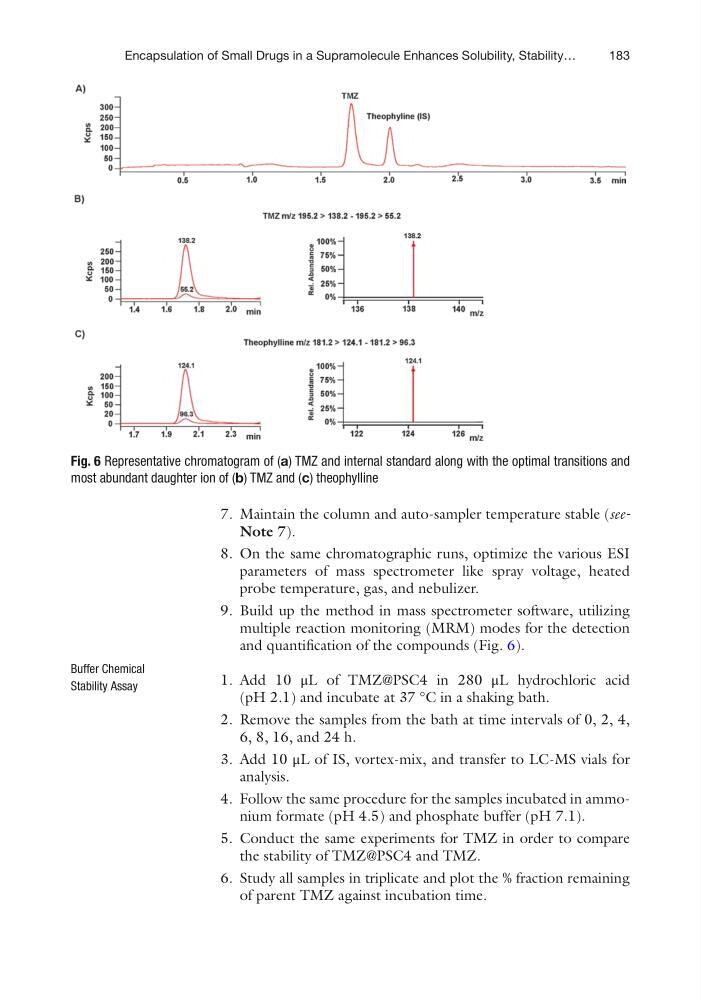
9. Build up the method in mass spectrometer software, utilizing
multiple reaction monitoring (MRM) modes for the detection
and quantification of the compounds (Fig. 6).
1. Add 10 μL of TMZ@PSC4 in 280 μL hydrochloric acid
(pH 2.1) and incubate at 37 °C in a shaking bath.
2. Remove the samples from the bath at time intervals of 0, 2, 4,
6, 8, 16, and 24 h.
3. Add 10 μL of IS, vortex-mix, and transfer to LC-MS vials for
analysis.
4. Follow the same procedure for the samples incubated in ammonium formate (pH 4.5) and phosphate buffer (pH 7.1).
5. Conduct the same experiments for TMZ in order to compare
the stability of TMZ@PSC4 and TMZ.
6. Study all samples in triplicate and plot the % fraction remaining
of parent TMZ against incubation time.
Buffer Chemical
Stability Assay
Fig. 6 Representative chromatogram of (a) TMZ and internal standard along with the optimal transitions and
most abundant daughter ion of (b) TMZ and (c) theophylline
Encapsulation of Small Drugs in a Supramolecule Enhances Solubility, Stability…
7. Maintain the column and auto-sampler temperature stable (seeNote 7).
8. On the same chromatographic runs, optimize the various ESI
parameters of mass spectrometer like spray voltage, heated
probe temperature, gas, and nebulizer.
9. Build up the method in mass spectrometer software, utilizing
multiple reaction monitoring (MRM) modes for the detection
and quantification of the compounds (Fig. 6).
1. Add 10 μL of TMZ@PSC4 in 280 μL hydrochloric acid
(pH 2.1) and incubate at 37 °C in a shaking bath.
2. Remove the samples from the bath at time intervals of 0, 2, 4,
6, 8, 16, and 24 h.
3. Add 10 μL of IS, vortex-mix, and transfer to LC-MS vials for
analysis.
4. Follow the same procedure for the samples incubated in ammonium formate (pH 4.5) and phosphate buffer (pH 7.1).
5. Conduct the same experiments for TMZ in order to compare
the stability of TMZ@PSC4 and TMZ.
6. Study all samples in triplicate and plot the % fraction remaining
of parent TMZ against incubation time.
Buffer Chemical
Stability Assay
Fig. 6 Representative chromatogram of (a) TMZ and internal standard along with the optimal transitions and
most abundant daughter ion of (b) TMZ and (c) theophylline
Encapsulation of Small Drugs in a Supramolecule Enhances Solubility, Stability…