

156
The fabricated vehicles can be characterized structurally by FT-IR
spectroscopy and morphologically by scanning (SEM) and transmission electron microscopy (TEM) techniques (see Notes 12–15).
Microscopy is one of the most powerful techniques and can
provide valuable information about the size, shape, and morphology of nanoparticles. Electron microscopy provides high- resolution
images and is the only technique that provides reliable information
about the shape on this scale. However, scientists need to ensure
that enough particles are examined to have a statistically valid representation of the size and shape distribution. This can be very
difficult and time consuming and may require the analysis of the
image of literally thousands of individual particles. However, scientists need to ensure that enough particles are examined to have a
3.3 Characterization
of Vehicles
4
3,5
3
2, 5
2
A
1, 5
1
0, 5
0
0
50
100
150
200
250
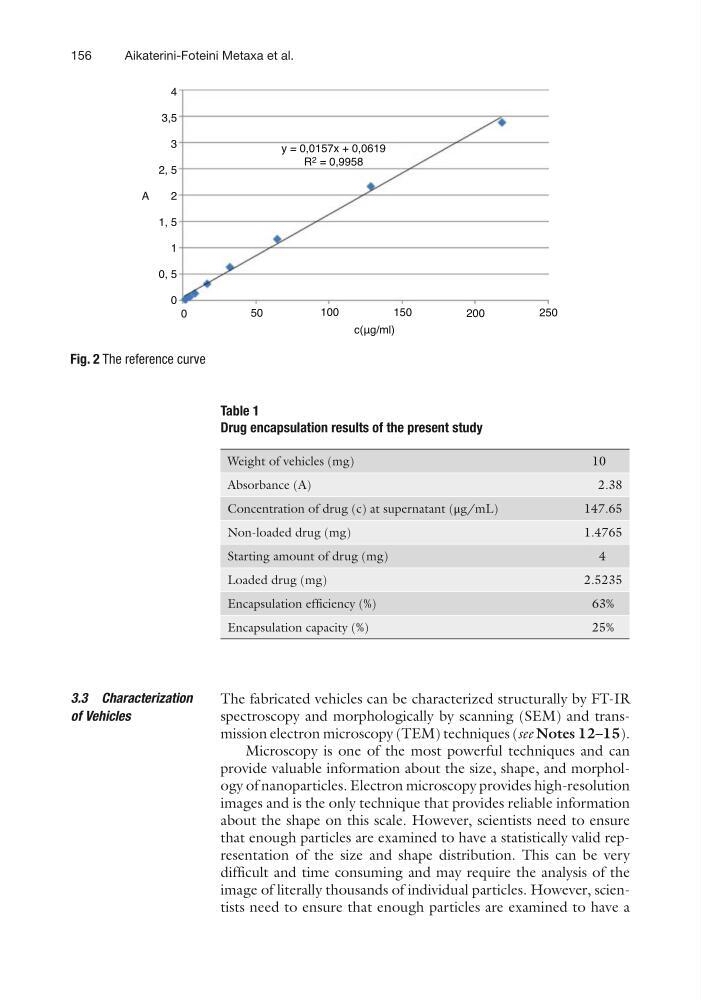
y = 0,0157x + 0,0619
R 2 = 0,9958
c(μg/ml)
Fig. 2 The reference curve
Table 1
Drug encapsulation results of the present study
Weight of vehicles (mg)
10
Absorbance (A)
2.38
Concentration of drug (c) at supernatant (μg/mL)
147.65
Non-loaded drug (mg)
1.4765
Starting amount of drug (mg)
4
Loaded drug (mg)
2.5235
Encapsulation efficiency (%)
63%
Encapsulation capacity (%)
25%
Aikaterini-Foteini Metaxa et al.
The fabricated vehicles can be characterized structurally by FT-IR
spectroscopy and morphologically by scanning (SEM) and transmission electron microscopy (TEM) techniques (see Notes 12–15).
Microscopy is one of the most powerful techniques and can
provide valuable information about the size, shape, and morphology of nanoparticles. Electron microscopy provides high- resolution
images and is the only technique that provides reliable information
about the shape on this scale. However, scientists need to ensure
that enough particles are examined to have a statistically valid representation of the size and shape distribution. This can be very
difficult and time consuming and may require the analysis of the
image of literally thousands of individual particles. However, scientists need to ensure that enough particles are examined to have a
3.3 Characterization
of Vehicles
4
3,5
3
2, 5
2
A
1, 5
1
0, 5
0
0
50
100
150
200
250
y = 0,0157x + 0,0619
R 2 = 0,9958
c(μg/ml)
Fig. 2 The reference curve
Table 1
Drug encapsulation results of the present study
Weight of vehicles (mg)
10
Absorbance (A)
2.38
Concentration of drug (c) at supernatant (μg/mL)
147.65
Non-loaded drug (mg)
1.4765
Starting amount of drug (mg)
4
Loaded drug (mg)
2.5235
Encapsulation efficiency (%)
63%
Encapsulation capacity (%)
25%
Aikaterini-Foteini Metaxa et al.