

118
generalized born surface area (MM–GBSA) method; [25–27]
details on the underlying theory can be found in other publications
[28, 29]. The input (mmpbsa_enthalpy.in) is presented in Note 7.
Execute the following Python script in AMBER:
/amber16/bin/MMPBSA.py -O -i mmpbsa_enthalpy.
in -o RESULTS_MMPBSA.dat -sp complexparm.
top -cp complex_only.parm.top -rp receptor_only.
parm.top -lp ligand_only.parm.top -y complex_
md.nc
Note that the topology (complexparm.top) and trajectory
(complex_md.nc) files from Subheading 3.3 are used as inputs for
the MM–PBSA calculations. Additional input files are the complex_only.parm.top, receptor_only.parm.top, and ligand_only.
parm.top, which are topology files for the complex, 2-HB-β-CD,
and IRB, respectively, and do not include any water molecules.
The RESULTS_MMPBSA.dat file contains the enthalpy estimation in kcal/mol and also provides individual energy components,
such as electrostatic, van der Waals, and nonpolar contributions.
Entropy estimation: The entropy estimation is obtained with
normal mode analysis. The execution is the same as for the enthalpy
calculations, with the only difference being the use of input
mmpbsa_entropy.in instead of mmpbsa_enthalpy.in (see differences
in Note 7).
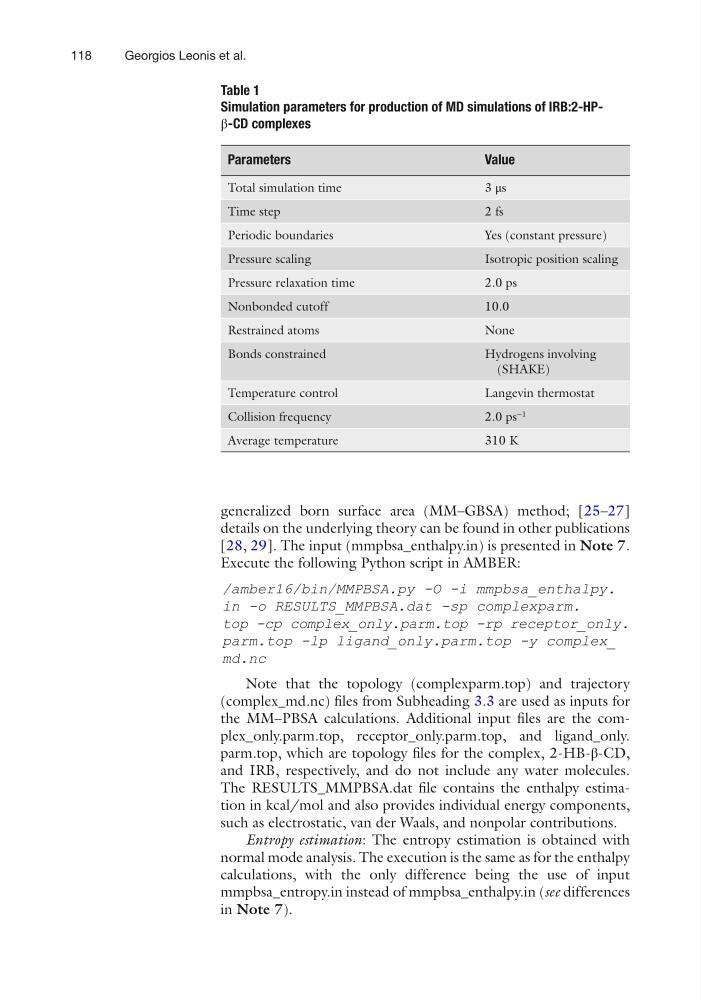
Table 1
Simulation parameters for production of MD simulations of IRB:2-HPβ-CD complexes
Parameters
Value
Total simulation time
3 μs
Time step
2 fs
Periodic boundaries
Yes (constant pressure)
Pressure scaling
Isotropic position scaling
Pressure relaxation time
2.0 ps
Nonbonded cutoff
10.0
Restrained atoms
None
Bonds constrained
Hydrogens involving
(SHAKE)
Temperature control
Langevin thermostat
Collision frequency
2.0 ps
−1
Average temperature
310 K
Georgios Leonis et al.
generalized born surface area (MM–GBSA) method; [25–27]
details on the underlying theory can be found in other publications
[28, 29]. The input (mmpbsa_enthalpy.in) is presented in Note 7.
Execute the following Python script in AMBER:
/amber16/bin/MMPBSA.py -O -i mmpbsa_enthalpy.
in -o RESULTS_MMPBSA.dat -sp complexparm.
top -cp complex_only.parm.top -rp receptor_only.
parm.top -lp ligand_only.parm.top -y complex_
md.nc
Note that the topology (complexparm.top) and trajectory
(complex_md.nc) files from Subheading 3.3 are used as inputs for
the MM–PBSA calculations. Additional input files are the complex_only.parm.top, receptor_only.parm.top, and ligand_only.
parm.top, which are topology files for the complex, 2-HB-β-CD,
and IRB, respectively, and do not include any water molecules.
The RESULTS_MMPBSA.dat file contains the enthalpy estimation in kcal/mol and also provides individual energy components,
such as electrostatic, van der Waals, and nonpolar contributions.
Entropy estimation: The entropy estimation is obtained with
normal mode analysis. The execution is the same as for the enthalpy
calculations, with the only difference being the use of input
mmpbsa_entropy.in instead of mmpbsa_enthalpy.in (see differences
in Note 7).
Table 1
Simulation parameters for production of MD simulations of IRB:2-HPβ-CD complexes
Parameters
Value
Total simulation time
3 μs
Time step
2 fs
Periodic boundaries
Yes (constant pressure)
Pressure scaling
Isotropic position scaling
Pressure relaxation time
2.0 ps
Nonbonded cutoff
10.0
Restrained atoms
None
Bonds constrained
Hydrogens involving
(SHAKE)
Temperature control
Langevin thermostat
Collision frequency
2.0 ps
−1
Average temperature
310 K
Georgios Leonis et al.