

117
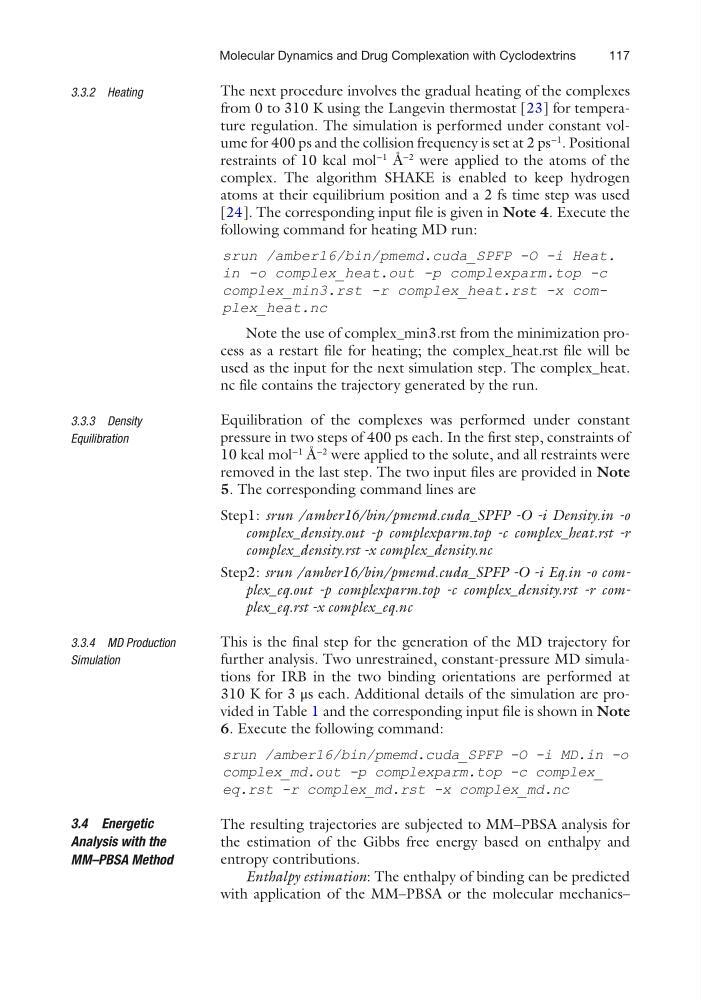
The next procedure involves the gradual heating of the complexes
from 0 to 310 K using the Langevin thermostat [23] for temperature regulation. The simulation is performed under constant volume for 400 ps and the collision frequency is set at 2 ps
−1
. Positional
restraints of 10 kcal mol
−1
Å
−2
were applied to the atoms of the
complex. The algorithm SHAKE is enabled to keep hydrogen
atoms at their equilibrium position and a 2 fs time step was used
[24]. The corresponding input file is given in Note 4. Execute the
following command for heating MD run:
srun /amber16/bin/pmemd.cuda_SPFP -O -i Heat.
in -o complex_heat.out -p complexparm.top -c
complex_min3.rst -r complex_heat.rst -x complex_heat.nc
Note the use of complex_min3.rst from the minimization process as a restart file for heating; the complex_heat.rst file will be
used as the input for the next simulation step. The complex_heat.
nc file contains the trajectory generated by the run.
Equilibration of the complexes was performed under constant
pressure in two steps of 400 ps each. In the first step, constraints of
10 kcal mol
−1
Å
−2
were applied to the solute, and all restraints were
removed in the last step. The two input files are provided in Note
5. The corresponding command lines are
Step1: srun /amber16/bin/pmemd.cuda_SPFP -O -i Density.in -o
complex_density.out -p complexparm.top -c complex_heat.rst -r
complex_density.rst -x complex_density.nc
Step2: srun /amber16/bin/pmemd.cuda_SPFP -O -i Eq.in -o complex_eq.out -p complexparm.top -c complex_density.rst -r complex_eq.rst -x complex_eq.nc
This is the final step for the generation of the MD trajectory for
further analysis. Two unrestrained, constant-pressure MD simulations for IRB in the two binding orientations are performed at
310 K for 3 μs each. Additional details of the simulation are provided in Table 1 and the corresponding input file is shown in Note
6. Execute the following command:
srun /amber16/bin/pmemd.cuda_SPFP -O -i MD.in -o
complex_md.out -p complexparm.top -c complex_
eq.rst -r complex_md.rst -x complex_md.nc
The resulting trajectories are subjected to MM–PBSA analysis for
the estimation of the Gibbs free energy based on enthalpy and
entropy contributions.
Enthalpy estimation: The enthalpy of binding can be predicted
with application of the MM–PBSA or the molecular mechanics–
3.3.2 Heating
3.3.3 Density
Equilibration
3.3.4 MD Production
Simulation
3.4 Energetic
Analysis with the
MM–PBSA Method
Molecular Dynamics and Drug Complexation with Cyclodextrins
The next procedure involves the gradual heating of the complexes
from 0 to 310 K using the Langevin thermostat [23] for temperature regulation. The simulation is performed under constant volume for 400 ps and the collision frequency is set at 2 ps
−1
. Positional
restraints of 10 kcal mol
−1
Å
−2
were applied to the atoms of the
complex. The algorithm SHAKE is enabled to keep hydrogen
atoms at their equilibrium position and a 2 fs time step was used
[24]. The corresponding input file is given in Note 4. Execute the
following command for heating MD run:
srun /amber16/bin/pmemd.cuda_SPFP -O -i Heat.
in -o complex_heat.out -p complexparm.top -c
complex_min3.rst -r complex_heat.rst -x complex_heat.nc
Note the use of complex_min3.rst from the minimization process as a restart file for heating; the complex_heat.rst file will be
used as the input for the next simulation step. The complex_heat.
nc file contains the trajectory generated by the run.
Equilibration of the complexes was performed under constant
pressure in two steps of 400 ps each. In the first step, constraints of
10 kcal mol
−1
Å
−2
were applied to the solute, and all restraints were
removed in the last step. The two input files are provided in Note
5. The corresponding command lines are
Step1: srun /amber16/bin/pmemd.cuda_SPFP -O -i Density.in -o
complex_density.out -p complexparm.top -c complex_heat.rst -r
complex_density.rst -x complex_density.nc
Step2: srun /amber16/bin/pmemd.cuda_SPFP -O -i Eq.in -o complex_eq.out -p complexparm.top -c complex_density.rst -r complex_eq.rst -x complex_eq.nc
This is the final step for the generation of the MD trajectory for
further analysis. Two unrestrained, constant-pressure MD simulations for IRB in the two binding orientations are performed at
310 K for 3 μs each. Additional details of the simulation are provided in Table 1 and the corresponding input file is shown in Note
6. Execute the following command:
srun /amber16/bin/pmemd.cuda_SPFP -O -i MD.in -o
complex_md.out -p complexparm.top -c complex_
eq.rst -r complex_md.rst -x complex_md.nc
The resulting trajectories are subjected to MM–PBSA analysis for
the estimation of the Gibbs free energy based on enthalpy and
entropy contributions.
Enthalpy estimation: The enthalpy of binding can be predicted
with application of the MM–PBSA or the molecular mechanics–
3.3.2 Heating
3.3.3 Density
Equilibration
3.3.4 MD Production
Simulation
3.4 Energetic
Analysis with the
MM–PBSA Method
Molecular Dynamics and Drug Complexation with Cyclodextrins