

Vortex-Assisted Liquid-Liquid Microextraction for Steroid …
757
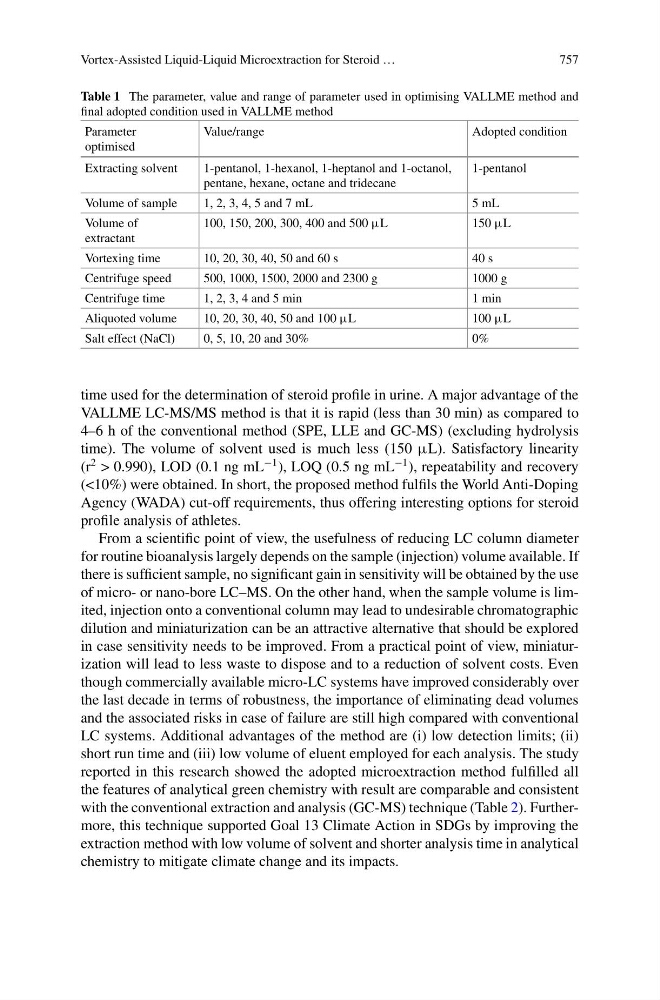
Table 1 The parameter, value and range of parameter used in optimising VALLME method and
final adopted condition used in VALLME method
Parameter
optimised
Value/range
Adopted condition
Extracting solvent
1-pentanol, 1-hexanol, 1-heptanol and 1-octanol,
pentane, hexane, octane and tridecane
1-pentanol
Volume of sample
1, 2, 3, 4, 5 and 7 mL
5 mL
Volume of
extractant
100, 150, 200, 300, 400 and 500 μL
150 μL
Vortexing time
10, 20, 30, 40, 50 and 60 s
40 s
Centrifuge speed
500, 1000, 1500, 2000 and 2300 g
1000 g
Centrifuge time
1, 2, 3, 4 and 5 min
1 min
Aliquoted volume
10, 20, 30, 40, 50 and 100 μL
100 μL
Salt effect (NaCl)
0, 5, 10, 20 and 30%
0%
time used for the determination of steroid profile in urine. A major advantage of the
VALLME LC-MS/MS method is that it is rapid (less than 30 min) as compared to
4–6 h of the conventional method (SPE, LLE and GC-MS) (excluding hydrolysis
time). The volume of solvent used is much less (150 μL). Satisfactory linearity
(r
2 > 0.990), LOD (0.1 ng mL
−1 ), LOQ (0.5 ng mL
−1 ), repeatability and recovery
(<10%) were obtained. In short, the proposed method fulfils the World Anti-Doping
Agency (WADA) cut-off requirements, thus offering interesting options for steroid
profile analysis of athletes.
From a scientific point of view, the usefulness of reducing LC column diameter
for routine bioanalysis largely depends on the sample (injection) volume available. If
there is sufficient sample, no significant gain in sensitivity will be obtained by the use
of micro- or nano-bore LC–MS. On the other hand, when the sample volume is limited, injection onto a conventional column may lead to undesirable chromatographic
dilution and miniaturization can be an attractive alternative that should be explored
in case sensitivity needs to be improved. From a practical point of view, miniaturization will lead to less waste to dispose and to a reduction of solvent costs. Even
though commercially available micro-LC systems have improved considerably over
the last decade in terms of robustness, the importance of eliminating dead volumes
and the associated risks in case of failure are still high compared with conventional
LC systems. Additional advantages of the method are (i) low detection limits; (ii)
short run time and (iii) low volume of eluent employed for each analysis. The study
reported in this research showed the adopted microextraction method fulfilled all
the features of analytical green chemistry with result are comparable and consistent
with the conventional extraction and analysis (GC-MS) technique (Table 2). Furthermore, this technique supported Goal 13 Climate Action in SDGs by improving the
extraction method with low volume of solvent and shorter analysis time in analytical
chemistry to mitigate climate change and its impacts.